Tuesday, March 16, 2021

Mathematician Sophie Germain


Linocut 'Sophie Germain' by Ele Willoughby, 2021

French mathematician, physicist and philosopher Marie-Sophie Germain (1776 – 1831), known as Sophie, taught herself mathematics using books in her father's library and by corresponding with leading mathematicians of her day, including Lagrange, Legendre and Gauss, initially using the pseudonym Monsieur LeBlanc since she knew it was unlikely her contemporaries would take a woman in math seriously. She later wrote to Gauss, the leading mathematician of her day that she used the pseudonym "fearing the ridicule attached to a female scientist." Her work on elasticity theory won her the grand prize from the Paris Academy of Sciences. Her trailblazing work on Fermat's Last Theorem set out a strategy and framework for mathematicians pursuing the problem for hundreds of years. She was denied a formal mathematics education or professional standing due to her sex, but Gauss argued she deserved an honourary degree (though it was never granted).


She was born to a bourgeois family; her father is usually described as a wealthy silk merchant who was elected to the États-Généraux (later the Constitutional Assembly), as a representative of the bourgeoisie. By the time she was 13, the Bastille fell, and she remained indoors for safety during those tumultuous times, her father's library her only source of entertainment. She was fascinated reading about Archimedes' death at Roman soldiers' hands during the siege of Siracusa, unable to tear himself away from mathematics. It piqued her interest and she devoured the mathematics books she found, even teaching herself Latin and Greek in order to read Sir Isaac Newton and Leonard Euler's works. Her parents disapproved this sudden interest in a subject deemed inappropriate for a woman and they denied her warm clothes or a fire to study at night. She simply wrapped herself in quilts and studied by candlelight, when it was so cold her ink froze, eventually winning over her mother's support. Sophie was lucky in that she was not forced to marry and her family was wealthy enough to support her throughout her life, and though mostly excluded from formal education and the society of mathematicians, she was able to pursue her self-study.


The École Polytechnique opened - to men only - in 1794, but lecture notes were made available on request. Students were requested to send solutions to faculty and Sophie began submitting notes to Joseph Louis Lagrange under the name of a former student who had died young, Monsieur Antoine-Auguste Le Blanc. Lagrange recognized "Le Blanc's" ability and requested a meeting, so her rouse was up. Luckily, Lagrange was not opposed to a woman studying mathematics and agreed to mentor her. In 1798, Adrien-Marie Legendre published Essai sur la théorie des nombres and Sophie became interested in number theory and began corresponding with Legendre. Impressed, he included some of her work in the supplement to the second edition of his book, praising it as très ingénieuse ("very ingenious"). Then Gauss published his magnum opus Disquisitiones Arithmeticae. She worked through it for three years before writing him, again as M. Le Blanc, to discuss his book and tell him about her work on Fermat's Last Theorem, a famous grand problem of number theory. Unfortunately, she had made a weak assumption in one of her proofs, and Gauss did not reply to this first letter.


Mathematician Pierre de Fermat famously scrawled his eponymous last theorem in the margin of a book around 1637, without supplying any proof, noting simply that the proof was too long to fit. After 354 years of effort by countless mathematicians, Andrew Wiles was finally able to prove the theorem correct in 1995. The theorem states that no three positive integers x, y, and z satisfy the equation xp + yp = zp for any integer value of p greater than 2. Sophie was working on this problem and making real in-roads.


During the Napoleonic wars, France occupied the German town of Braunschweig, where Gauss lived, and Sophie feared he might suffer the same fate as Archimedes. She wrote family friend General Pernety pleading for him to ensure Gauss' safety. Soldiers were dispatched and found the confused Gauss perfectly safe. Gauss, of course, did not know that Sophie Germain was none other than M. Le Blanc. She decided to reveal her identity and he replied,


How can I describe my astonishment and admiration on seeing my esteemed correspondent M. Le Blanc metamorphosed into this celebrated person ... when a woman, because of her sex, our customs and prejudices, encounters infinitely more obstacles than men in familiarising herself with [number theory's] knotty problems, yet overcomes these fetters and penetrates that which is most hidden, she doubtless has the noblest courage, extraordinary talent, and superior genius.


They became friends and Gauss truly respected her ability, though he was not a reliable correspondent and generally did not review her work (and she would have really benefited from such feedback, lacking mentorship in number theory, and having gaps in her knowledge since she was self-taught). 


She became interested in other problems. German physicist and musician Ernst Chladni had published his experiments on vibrating plates (following the trailblazing work of Robert Hooke). He used a violin bow to vibrate a metal plate covered in sand, so that the sand would concentrate on nodal lines marking divisions between regions that moved in opposing directions. His drawings of the patterns produced are known as Chladni figures (like those shown in lavender in my print). Germain was able to attend his demonstration in Paris. The Paris Academy of Sciences launched a contest to develop the mathematics explaining the vibration of an elastic surface and comparing this to experimental data like Chladni's, with a reward of 3,000 francs. Lagrange pointed out that a new branch of analysis would be required and scared off all would-be contestants with the exception of Sophie and Denis Poisson. But Poisson was elected to the Academy, thus became a judge, leaving only Sophie. She began, mentored by Legendre, but her submission was deemed insufficient, though she provided some ingenious results, which allowed Lagrange to derive an equation, correct under certain conditions. Lagrange died within two years, and Sophie lost a mentor. The Academy decided to extend the contest and Sophie persisted. After initially helping, Legendre withdrew his support. Sophie submitted another attempt anonymously, but it had several errors (of the sort she would have been taught to avoid had she been allowed to study math at a university). She consulted Poisson, and he had access to all her notes as a judge. He then published his own work on elasticity without acknowledging any of her work or their conversations on the subject. At that point in 1816, she published under her own name, "Recherches sur la théorie des surfaces élastiques" partially so what Poisson had done would be clear, and to point out the errors in his work. They extended the contest again partially in response to the breach of confidentiality by Poisson and she persisted with her efforts. She won the gold medal and became the first woman to win a prize from the Paris Academy of Sciences but did not attend the prize ceremony. The Academy was not entirely satisfied; she had the correct differential equation, but having used an incorrect equation by Euler she had incorrect boundary conditions. Even as a prize winner, she was still denied entry to academy meetings as a woman for several years until she made friends with Joseph Fourier, a secretary of the Academy, who got tickets on her behalf. She published her prize-winning essay in 1821, at her own expense as the Academy had neglected to do so, complete with her notes on errors she had made. In 1826, she submitted a revised version of her work; the Academy considered it trivial but they did not want to reject her as they would a man and professional colleague. They both denied her access and were patronizing in their misguided attempt at kindness. She published this essay on the advise of mathematician Augustin-Louis Cauchy. Her nephew later made sure she had a final publication on elasticity, publishing "Mémoire sur la courbure des surfaces" posthumously on her behalf in 1831.


In 1815, the Academy offered an award for a solution to Fermat's Last Theorem, rekindling her first love of number theory. She wrote Gauss with her strategy for a general proof and the significant in-roads towards a proof she had made, but Gauss never replied. She produced what is now known as Sophie Germain's Theorem. To show that Fermat's Last Theorem holds, you can divide the powers p into numbers which are not divisors of x, y or z, or powers p which are a divisor of at least one of x, y or z. She proposed her theorem:


Let p be an odd prime. If there exists an auxiliary prime P = 2Np + 1 (N is any positive integer not divisible by 3) such that:

  1. if xp + yp + zp ≡ 0 (mod P), then P divides xyz, and
  2. p is not a p-th power residue (mod P).

and she used this result to show that Fermat's Last Theorem holds true for all odd primes p < 100. Her method was later used to show it holds true for all p < 1700. Her theorem is known from a footnote in Legendre's treatise on number theory, where he used it to prove Fermat's Last Theorem for p = 5. The text in my print is from one of her on unpublished manuscripts:

Remarque sur l'impossibilité de satisfaire en nombres entiers a l'équation xp + yp = zp. L'impossibilité de cette équation serait hors de doute si on pouvais démontrer la théorème suivant: Pour toute autre valeur de p que p = 2, il y a toujours un infinité de nombres premiers de la forme Np + 1 pour lequels on ne peut trouver deux residus 1ièmes puissances  dont la différence soit l'unité.


(My gloss: "Remarks on the impossibility of any whole numbers satisfying xp + yp = zp . The impossibility of this equation can be shown to be without doubt if we can demonstrate the following theorem: For all p > 2, there are an infinite series of primes of the form Np + 1 for which we cannot find two residues of the first power separated by 1"). She goes on to note that if there's any numbers which do satisfy Fermat's equation for p > 5 it must be numbers "whose size frightens the imagination", around 40 digits long.  


She also pursued philosophy and psychology on her own. Her nephew had two of her works published posthumously: Pensées diverses, a history of science and math with her commentary and Considérations générales sur l'état des sciences et des lettres, aux différentes époques de leur culture in which she argued there no difference between the sciences and the humanities and gained the praise of philosopher August Comte. 


She continued working despite pain after her diagnosis of breast cancer in 1829. She died in 1831, listed only as a property owner, not a mathematician on her death certificate. She is now recognized for her brilliance and originality, but her progress was often sadly hampered by the lack of instruction and the way her peers treated her as a novelty, and avoided proper constructive criticism. She wrote, “These facts are my domain and it is to me alone that they remain hidden. That’s the privilege of the ladies: they get compliments and no real benefits.” Several scholars argue that a contemporary man with similar skills and interest would have had his abilities embraced and talents nurtured. Sophie Germain was able to achieve what she did through both her tremendous talent and extraordinary persistence. Along with her theorem, subsequent discoveries in number theory have been named in her honour, as well as a street in Paris and the Sophie Germain Prize in mathematics offered by the same Academy which had snubbed her.


References

Sophie Germain, Wikipedia, accessed March 2021

Sophie Germain’s Theorem, Wikipedia, accessed March 2021

Ernst Chladni, Wikipedia, accessed March 2021

Ernst Chladni, Entdeckungen über die Theorie des Klanges, 1787, via Chladni Figures (1787) on Public Domain Review

Cristina P. Tanzi, Sophie Germain's Early Contribution to the Elasticity Theory, MRS Bulletin , Volume 24 , Issue 11 , November 1999 , pp. 70 - 71 DOI: https://doi.org/10.1557/S0883769400053549

Alexanderson, G..About the cover: Sophie Germain and a problem in number theory.” Bulletin of the American Mathematical Society 49 (2012): 327-331.

Richard Baguley, Sophie Germain: The Mathematics Of Elasticity, Hackaday.com, March 20, 2018

Evelyn Lamb, Thank You, Sophie, and I'm Sorry, Scientific American Blog, April 1, 2017.

Maria Popova, How the French Mathematician Sophie Germain Paved the Way for Women in Science and Endeavored to Save Gauss’s Life, Brainpickings, org, February, 2017.

Reinhard Laubenbacher and David Pengelley,  “Voici ce que j’ai trouvé:” Sophie Germain’s grand plan to prove Fermat’s Last Theorem, Historia Mathematica Volume 37, Issue 4, November 2010, Pages 641-692

Tuesday, March 9, 2021

Dmitri Mendeleev and the Periodic Table

Dmitri Mendeleev and the Periodic Table by Ele Willoughby
Dmitri Mendeleev and the Periodic Table, linocut by Ele Willoughby, 2021
 

Here’s my Dmitri Mendeleev block print for the Printer Solstice prompt “elements”. I had meant to make his portrait for the 150th anniversary of the periodic table in 2019, but I didn’t get to it. I couldn’t quite figure out how to indicate what he did, in contrast to our modern periodic table. So many people would recognize the shape of the periodic table, from high school, even if they aren’t scientists who use it regularly. But Mendeleev didn’t publish his idea in a form that’s easy to recognize.

First, his table, as published in 1869, is rotated by 90° so it shows groups in rows rather than columns. Second, prior to the discovery of protons and neutrons, he listed and organized elements by atomic weight (now called atomic mass), rather than atomic number (or number of protons). Third, some of his data wasn’t great, so sometimes elements appeared to have the same mass, or were out of order or even were mixtures. He lists Didymium, which is actually a mixture of the elements Praseodymium & Neodymium.

Sometimes you need to think about visual ideas for a long time. Rather than including his notes, or published results as well as a modern periodic table, my idea is to show how much of the modern periodic table he was able to deduce despite limited data. The elements that were unknown or unmeasured are blank- something the viewer can rapidly understand. In several cases he predicted we would find the missing elements in groups (columns). Then, while an impressive amount of the elements known in 1869 are exactly in the right place, there are several which he placed in the wrong groups (due to inaccurate masses). I plan to print those he grouped incorrectly in a different colour. I think this can give an immediate sense of 3 categories: elements he’d figured out, elements he hadn’t quite got right yet, & gaps as of yet unfilled. And if you’ve studied chemistry you can get a sense of what he figured out & why. Even when he placed elements in the wrong group he usual correctly deduced similarities in behaviour found within groups (columns) which we eventually figured out could be explained by structure at an atomic scale.

You can see from Mendeleev's 1869 publication, he got most of the known elements in the right sequence and many in the correct groups. He understood there were connections in properties in adjacent elements and periodicities of properties of elements in the same groups (which he wrote as rows and we now show as columns). He also corrently inferred several as of yet undiscovered elements (see the question marks).

 Mendeleev was born in 1834, in the village of Verkhnie Aremzyani, near Tobolsk in Siberia, the youngest of child of a large family. He was likely the 17th (though 3 older siblings died as infants and there is some dispute among sources). His father was a school principal until he lost his sight and his job. His mother then restarted her family's abandoned glass factory to support the family. His father died and the glass factory was destroyed by fire. Despite economic hardship, 13 year old Mendeleev attended the Gynasium in Tobolsk. In 1849, his mother took him all the way to Moscow to try to get into the university, they were unsuccessful. The now poor Mendeleev family moved to Saint Petersburgh in 1850 so he could instead attend the Main Pedagogical Institute. He graduated, but contracted tuberculosis and went to the Crimean to recover, where he became a science master of the 1st Simferopol Gymnasium. When he was recovered in 1857 he returned to Saint Petersburg. He worked on  capillarity of liquids and the workings of the spectroscope, published the textbook 'Organic Chemistry' and won the Demidov Prize of the Petersburg Academy of Sciences. He married  Feozva Nikitichna Leshcheva (1862), professor at the Saint Petersburg Technological Institute (1864) and Saint Petersburg State University (1865). He got his doctorate on "On the Combinations of Water with Alcohol" in 1865 and got tenure in 1867. He wrote the definitive two-volume chemistry textbook of his day, 'Principles of Chemistry'. By 1871, he had made Saint Petersburgh and international recognized centre of chemical research.

While working on his textbook, he was struck by the periodicity of properties. There had been some earlier, not quite successful attempts to organize elements by properties (of which he was not aware). He claimed to see it in a dream,

"I saw in a dream a table where all elements fell into place as required. Awakening, I immediately wrote it down on a piece of paper, only in one place did a correction later seem necessary."
— Mendeleev, as quoted by Inostrantzev

He started with 9 elements, 3 groups of 3 types of properties, then added the other known elements around the core of the table. On 6 March 1869, he presented  ' The Dependence between the Properties of the Atomic Weights of the Elements' to the Russian Chemical Society, using both atomic weight (now called relative atomic mass) and valence. He published his table in a a Russian language journal.

Modern Periodic Table

He correctly noted that if you arrange elements by their atomic mass there show repeating periodic properties. (We now know that atomic number is more important than atomic mass, but they usual would give you the same sequence, especially for lighter elements). He noted similaries in elements of similar atomic weights (that is, adjacent on the table), and similaries in elements in regularly increasing increments (that is, now in the same columns). He realized the elements were ordered by their valencies. He noted that there are more lighter elements. He noted that atomic weight determines properties (though we would now say atomic number). He predicted as-of-yet undiscovered elements at gaps in his table. He inferred that some of the atomic weight data was not quite accurate because the placement in the table did not line up with properties. He noted that knowing the atomic weight could help you predict an element's properties.

He met Anna Ivanova Popova, and divorced his wife in order to marry her, but the divorce was not finalized until a month after his wedding; further the Russian Orthodox Church stipulated 7 years were required between marriages; so, he caused a scandal in 1882. This is likely why he was never admitted to the Russian Academy of Sciences. But he received international acclaim, including receiving the Davy Medal (1882) and Copley Medal (1905) from the Royal Society of London. He resigned from Saint Petersburg University in 1890. He was elected a Foreign Member of the Royal Society (ForMemRS) in 1892. In 1893 he was appointed director of the Bureau of Weights and Measures, for the remainder of his life. He died in at 72, in 1907, from influenza.


Monday, March 1, 2021

William Henry Perkin and the Discovery of Mauve


William Henry Perkin Discovers Mauve, linocut by Ele Willoughby, 2021

The next prompt for #printersolstice is "a well-made mistake" which prompted this tale of failure and serendipity.

This handprinted lino block print ‘William Henry Perkin Discovers Mauve’ is about how the British chemist and entrepreneur made the serendipitous discovery of the first synthetic organic dye: mauveine. William Henry Perkin (1838-1907) was only 18 and was washing up after trying and failing to synthesize quinine to treat malaria when he produce a bright mauve chemical from aniline and he recognized its potential as a dye. He set up a factory, revolutionizing fashion and launching the synthetic organic chemicals industry. The linocuts are 8” by 10” on ivory Japanese kozo (or mulberry) paper.

Perkin entered the Royal College of Chemistry in London in 1853 when he was only 15, studying with August Wilhelm von Hofmann. Hofmann hired him as his assistant in 1855 and had Perkin working on a series of experiments to try and synthesize quinine, used to treat malaria. During his Easter break in 1856, Perkin was performing some experiments to this end, in his makeshift lab in his own apartment. Hofmann thought allyl toluidine from coal tar could be oxidised with potassium bichromate to make quinine (which we now know cannot work). Perkin tried this method and got an unpromising brown precipitate. So instead he tried the method with another coal tar product, aniline, which produced a black sludge.... but left purple stains on the lab bench when he cleaned up with alcohol. Perkin was interested in painting and photography and had already been thinking about dyestuffs with his friend Arthur Church and his brother Thomas. They did not tell Hofmann. Perkin used a purified extract of the black sludge to colour samples of silk and sent them to a Scottish textile manufacturer. The results were so promising he decided to quit college, file for a patent and set up dye factory in Greenford Green, Middlesex. They named the dye mauveine.

Hofmann opposed his plan and feared the 18 year old lacked the experience to launch this enterprise, but he managed the logistics of securing ingredients reactive vessels and suitable mordants for dying. Then he tackled marketing the product: 'Perkin's mauve'.

His timing was perfect. Purple was a challenging colour to produce with natural pigments, many of which tended to fade. Considered a sign of royalty for centuries, 'Tyrian purple' was made from glandular mucus of certain molluscs; it was expensive and complicated to produce. Aided by Napoleon III's wife, the Empress Eugénie's choice of mauve fashion, as well as Queen Victoria favouring purple dresses, Perkin's mauve, the first mass-produced synthetic dye, became all the rage. In England they joked about 'mauve measles' and 'mauve mania'. Several of Hofmann's other students discovered other colours of synthetic dyes and an industry was born. Perkin was able to sell his business and retire from manufacturing at 36!

He then focused on research in organic chemistry. He published 90 papers in the Transactions of the Chemical Society, develipped the 'Perkin synthesis’ for unsaturated organic acids, did the first synthesis of coumarin, one of the first synthetic raw materials of perfume, synthesized cinnamic acid from benzaldehyde and developped a means of commercial production from anthracene of the brilliant red dye alizarin. He became a fellow of the Royal Society in 1866, received its Royal Medal in 1879 and Davy Medal in 1889, and was president of the Chemical Society and the Society for Chemical Industry. He had two sons by his first marriage to Jemima Lisset in 1859 (William Henry Jr and Arthur George). He remarried Alexandrina Mollwo after her death. They had a son (Frederick Mollwo) and four daughters (Helen, Mary, Lucie and Annie). They were a family of serious  musicians, who played together as a nine-piece chamber orchestra. Perkin had considered forming a professional string quarted with his brother and two sisters. His son William Perkin Jr was an excellent pianist. His son Arthur played flute with the family orchestra and later, first bassoon in a Yorkshire amateur orchestra. All three sons became chemists. William Henry Perkin was knighted in 1906, and received the first ever Perkin Medal of the Society of Chemical Industry, created on the 50th anniversary of discovery of mauveine, the year before his death. 


References

William Henry Perkin, wikipedia, accessed February 2021

Mike Sutton, The Perkin family legacy, Chemistry World, 26 February, 2010.

The mystery of the Victorian purple dye, Research Outreach, 2020.

Sir William Henry Perkin 1838 - 1907, Science Museum Group, accessed February 2021

William Henry Perkin: how an 18-year-old accidentally discovered the first synthetic dye, Vox.com, March 18, 2018.


Thursday, February 25, 2021

Freedom of the Press, Blood, Sweat and Tears, Creative Blocks and Animal Prints

 I have been working away, when I could, while we've been trying to do remote school for the first couple months of the year. I actually managed to keep up with the Printer Solstice prompt and made a new print a week. Now that schools have reopened here, I have a chance to share some of my latest prints. 


Freedom of the Press, linocut by Ele Willoughby, 2021

I wasn't quite sure where to go with the theme "freedom of the press". I went with a winged Gutenberg press, thinking of the initial freedom it represented after its invention. (By the way, it's often presented as the first press, moveable type and paper were invented in China). I made a several different prints with this block, rather than a single edition.

The next theme was Blood, Sweat and Tears:

Blood, Sweat and Tears, linocut by Ele Willoughby, 2021

This "Blood, Sweat and Tears" lino block print is about how we as people reflect our origines in the ocean. Printed from 8 hand-carved blocks it shows blood cells racing through an artery, a cross-section of our skin with a sweat gland, an eye with a tear and a section of ocean seawater.

There's a well-known quotation from Isak Dinesen (the pen-name of Karen Blixen);

“‘Why, yes,’ he said, ‘I know of a cure for everything: salt water.’

‘Salt water?’ I asked him.

‘Yes,’ he said, ‘in one way or the other. Sweat, or tears, or the salt sea.’"

This oft-given advice that hardwork, releasing your emotions or visiting the sea is the answer to any problem plays on the fact that sweat and tears are just salty water. But, in fact, we ourselves are predominently water, and we preserve the salinity of the environment of our earliest ancestors, from even before the first lobe-finned fish decided to seek refuge on land, in the Devonian (about 360 million years ago).

Next up was Creative Blocks. I opted for carving a collection of kid's wooden building blocks and then printing them on assorted beautiful patterned papers (both Japanese washi and European papers), so that some of them were "creative". I have made a whole series of these prints, each unique.

Creative Blocks, series of linocuts by Ele Willoughby, 20201

The next prompt was Animal Prints. So much of what I do is animal prints I wasn't sure what to do. It occurred to me that choosing insects might be a less common choice. Then I discovered that a group of moths is called an eclipse and I knew I had to add to my terms of venery series for groups of animals.

An Eclipse of Moths, linocut by Ele Willoughby 2021


This hand-printed lino block print shows five of the noctural moths of Ontario in front of the moon at a lunar eclipse. The five moths are: the gorgeous green Luna moth (Actias luna), the yellow and purplish-pink Imperial moth (Eacles imperialis), the Five-spotted Hawk Moth in brown with orange spots (Manduca quinquemaculata), the red-orange, black and cream Virgin Tiger Moth (Apantesis virgo), and the black and white White Underwing (Catocala relicta).

I designed the typefaces to suggest the meaning of the words. "Eclipse" is full of crescent moon shapes. "Moths" is written in moth shapes.

Friday, February 19, 2021

Hertha Ayrton, Mathematician, Physicst, Engineer and Inventor


Hertha Ayrton, linocut by Ele Willoughby
Hertha Ayrton, linocut, 9.25" x 12.5" by Ele Willoughby, 2021.


This is my linocut portrait of British engineer, mathematician, physicist & inventor Hertha Ayrton (1854-1923). She is remembered for her research on the electric arc lamp, on ripple marks in sand & water, and her inventions including of mathematical line dividers which allowed artists, architects & engineers to enlarge or diminish drawings. I’ve shown her with a diagram of the dividers from her 1st of 26 patents, one of her diagrams about the origin & growth of ripple marks & one of her diagrams of an electric arc lamp (a subject on which she literally wrote the textbook).⁠

Born Phoebe Sarah Marks in Portsea, Hampshire, she was the third of eight children of a Polish Jewish immigrant watchmaker father & seamstress mother. After her father’s death when she was 7 in 1851, the family was left penniless and her mother returned to work as a seamstress. Sarah, as she was then known, had to care for her younger siblings. When she was 9, her maternal aunt Marion Hartog, who ran a school in north-west London with her husband Alphonse Hartog, invited her to join their household and attend their school. Though a hardship to her family, her mother recognized her potential and supported the move to London and the opportunities for her daughter. Her cousins introduced her to math and science. In her family, she was known as a fiery and occassionally crude character. By 16, she was living independantly, employed as a governess.

Her friend Ottilie Blind nicknamed her Hertha after the poem by Algernon Swinburne. They coached each other to prepare for the Cambridge entrance exam. Blind introduced Hertha to her mentor feminist, suffragette and founder of Girton College (the first residential college for women in England), Barbara Bodichon, after who she would later name her daughter. Her extended family and the suffrage community helped her get a higher education; author George Eliot* (a friend whom she met through Bodichon) wrote in support her application to Girton College, at Cambridge. She did not win a scholarship and would not have been able to afford tuition but she was supported with loans and donations from the suffrage community. While there studying math, she founded the fire brigade, led the choral society, and with fellow student and mathematician Charlotte Scott, formed a mathematics club. She also developed her first patented invention, the line divider and developed and built a sphygmomanometer (for measuring a person's pulse) while still an undergraduate. She passed the famous Mathematical Tripos in 1880, but Cambridge wouldn’t grant women degrees. She was able to take and pass a University of London equivalency exam, and they granted her a BSc in 1881.⁠

She earned an income teaching embroidery and math. She ran a club for working girls and looked after her invalid sister. By 1884 she had her first patent for a line divider; she also sought a US patent for it in 1885. Lady Goldsmid and Barbara Bodichon provided the funding she needed to seek these patents. The invention was well-received and got good reviews in the scientific press. She presented a paper on her invention to the Physical Society in 1885 and the device was manufactured in six sizes by a scientific instrument maker. Supporters encouraged her to become an entreprenneur and inventor but she wanted to pursue a scientific career.

She began evening classes on electricity with Professor Will Ayrton, trailblazer in engineering education at Finsbury Technical College. She was one of 3 women among 121 students. He was a widower with a young daughter, and a supporter of women's education and fight for voting rights. They married in 1885 and began collaborating on physics experiments and she was able to work from the lab in their home. A year later, they had a daughter, Barbara Bidochon Ayrton. From 1888 she taught practical and domestic electricity to women. Between this, domestic chores and raising her young daughter she had little time for research.

When her mentor Bodichon died in 1891, she left Ayrton enough money to support her mother and hire a housekeeper. Will supported her research but was also careful to not always collaborate with her, so that her work would be recognized as independant from his. He once told a friend “you and I are able people, but Hertha is a genius.” She began her own studies of the electric arc, solving the pressing problem of why they would flicker and hiss. She showed this was a result of oxygen coming into contact with carbon rods used to create the arcs. She patented a number of improvements to arc lights and published 12 articles on her advances. She was the first woman to deliver a paper to the Institution of Electrical Engineers (IEE), which was more progressive than other institutions and always allowed women to attend meetings. She was also able to present three papers to the British Association for the Advancement of Science (BAAS, now the British Science Association) in 1895, 1896 and 1898. She was elected a member of the IEE, recognized a professional qualification, in 1899; she was the sole female full member of the institution until 1958. Her cousin Marcus Hartog used her 1900 lecture at the International Electrical Congress in Paris to argue that the British Association for the Advancement of Science shouls allow women on their committees. Denied the right to present her paper to the Royal Society due to her sex, renown engineer John Perry (and Will's former colleague) presented it on her behalf in 1901. After she published her textbook The Electric Arc, Perry proposed her as Fellow of the Royal Society but they rejected this (as she was married, and hence had no independant legal standing). But in 1904, she became the first woman to present her own paper ‘The Motion of Ripples in Sand and Wave’ to the Royal Society. By 1906 she was the first woman to win the Hughes Medal, for her work on ripples and the electric arc.⁠

In Paris in 1903 she met Marie Curie and they became close friends, both physicists who collaborated with their physicist husbands and dedicated to social causes, and concerned about the role of women in society. They visited whenever Ayrton was in France. Ayrton vocally defended Marie, when Pierre died and the British press identified him (rather than Marie) as the discovered of radium, writing ‘Errors are notoriously hard to kill, but an error that ascribes to a man what was actually the work of a woman has more lives than a cat.’ Then in 1911, Marie won the Nobel for chemistry but endured a scandal in when her affair with married physicist Paul Langevin. Ayrton defended her again, and Marie and her daughters took refuge with the Ayrtons in England for two months. She was deeply involved in the women’s suffrage movement, marched in many marches (and recruited her friend Marie Curie to the cause).⁠

After poisoned gas was used as a weapon during WWI, she put her expertise in fluid dynamics to work trying to develop a means of removing gas from the trenches. She also invented a fan and despite initial resistance from the War Office was able to demonstrate its effectiveness in protecting soldiers from poison gas and she herself organized production of her first manually operated fans in 1916. By 1917 she had developed a new, mechanically operated fan, more resistant to high winds, and she again fought War Office bureaucracy and organized the production of 104,000 sent to the Western Front.⁠ Her research on fans was later used to improve ventilation in mines and sewers. She continued to study vortices until she died. She left much of her estate to the IEE.

*Apparently, the character Mirah, in George Eliot's novel Daniel Deronda, is based on Hertha. You might recall that George Eliot was also friends with another mathematician I've portrayed, Sofia Kovalevski. The sentence "In short, woman was a problem which, since Mr. Brooke's mind felt blank before it, could hardly be less complicated than the revolutions of an irregular solid," from Eliot's Middlemarch, is undoubtedly due to her friendship with Kovalevski. I like to imagine George Eliot was quietly a math groupie. 

 References 

Elizabeth Bruton, The life and material culture of Hertha Marks Ayrton (1854–1923): suffragette, physicist, mathematician and inventor, Science Museum Group Journal, Autumn 2018, Issue 10 Article DOI: http://dx.doi.org/10.15180/181002

Ayrton, Hertha. “The origin and growth of ripple-mark.Proceedings of the Royal Society of London. Series A, Containing Papers of a Mathematical and Physical Character 84, no. 571 (1910): 285-310.

Kim Martini, The origin of ripples and other fantastic fluid experiments by Hertha Marks Ayrton, Deep Sea News, April 28, 2016.

Hertha Ayrton, Wikipedia, accessed February, 2021.

Joan Meiners, Meet Hertha Ayrton, the mathematician who cleared WW1 trenches of poisonous gas, Massive Sci, June 5, 2020.

Archives Biographies: Hertha Ayrton, The Institute of Engineering Technology, accessed February, 2021

Thursday, January 14, 2021

Tea Pots and Other Recent Prints


Green Tea Chemistry print
                                            Green Tea Chemistry linocut by Ele Willoughby


I thought I should add a tea chemistry linocut to go with the coffee linocut, which includes the caffeine molecule. Of course, tea chemistry is quite complex! I asked on Twitter, thinking I might have some tea loving scientist followers with good suggestions and I wasn't disappointed. Not only was I given some good feedback about which chemicals to feature, but also the suggestion of including the chromotography, as a means of telling the fuller chemical story.

There's a tea pot, two cups of tea and a tea plant (Camellia sinensis) on a tray, and in the steam, you can see some of the organic chemicals found in green tea. Up to 27% of the composition of green tea can be a member of the flavonoids called catechins like the molecule illustrated on the right. The stimulating effect of green tea is of course related to caffeine (the molecule in the middle) but, unlike say coffee, green tea also has an amino acid in tea called L-Theanine (the molecule on within the tea pot handle). L-Theanine has a direct effect on the brain, relaxing it without making you drowsy and can help with focus and mood; it's also largely responsible for taste. Since the chemistry of green tea is complex, and I can't show all the molecules involved, at the base of the tray is a chromatogram to illustate the L-Theanine (largest peak) and other amino acids in the green tea. 

With tea and teapots on the brain, I started thinking about a suggestion for another "imaginary friend" of science (my collection of charismatic thought experiments like Maxwell's Demon or Schroedinger's cat): Russell's Teapot. 


 Russell's Teapot
by Ele Willoughby

The alledged china teapot, in orbit between Earth and Mars is an analogy by philosopher Bertrand Russell (1872–1970) to make the case that the philosophic burden of proof lies upon a person making unfalsifiable claims, rather than shifting the burden of disproof to others. The print is made by hand on lovely 8" x 9" (20.3 cm x 22.9 cm) Japanese Obonai paper with a feathery sheen.

The Earth appears in blue in the corner. The China teapot itself has a blue flower pattern, and is shown magnified. Mars is in red with two tiny moons. At the bottom are the symbols for the solar system: Sun, Mercury, Venus, Earth, and the extra teapot, Mars, Jupiter, Saturn, Uranus and Neptune.


I also made a couple of Snowy Owl light boxes, which include my snowy owl linocut and colour changing LEDs to simulate the aurora.

While, we've been on a lockdown here in Toronto, and the schools are closed, so I'm spending a lot of time every day fascillitating online school for my 7 year old, I have also been trying to do all of the Printer Solstice prompts (one a week since the winter solstice).


Humpback linocut for prompt "under pressure".


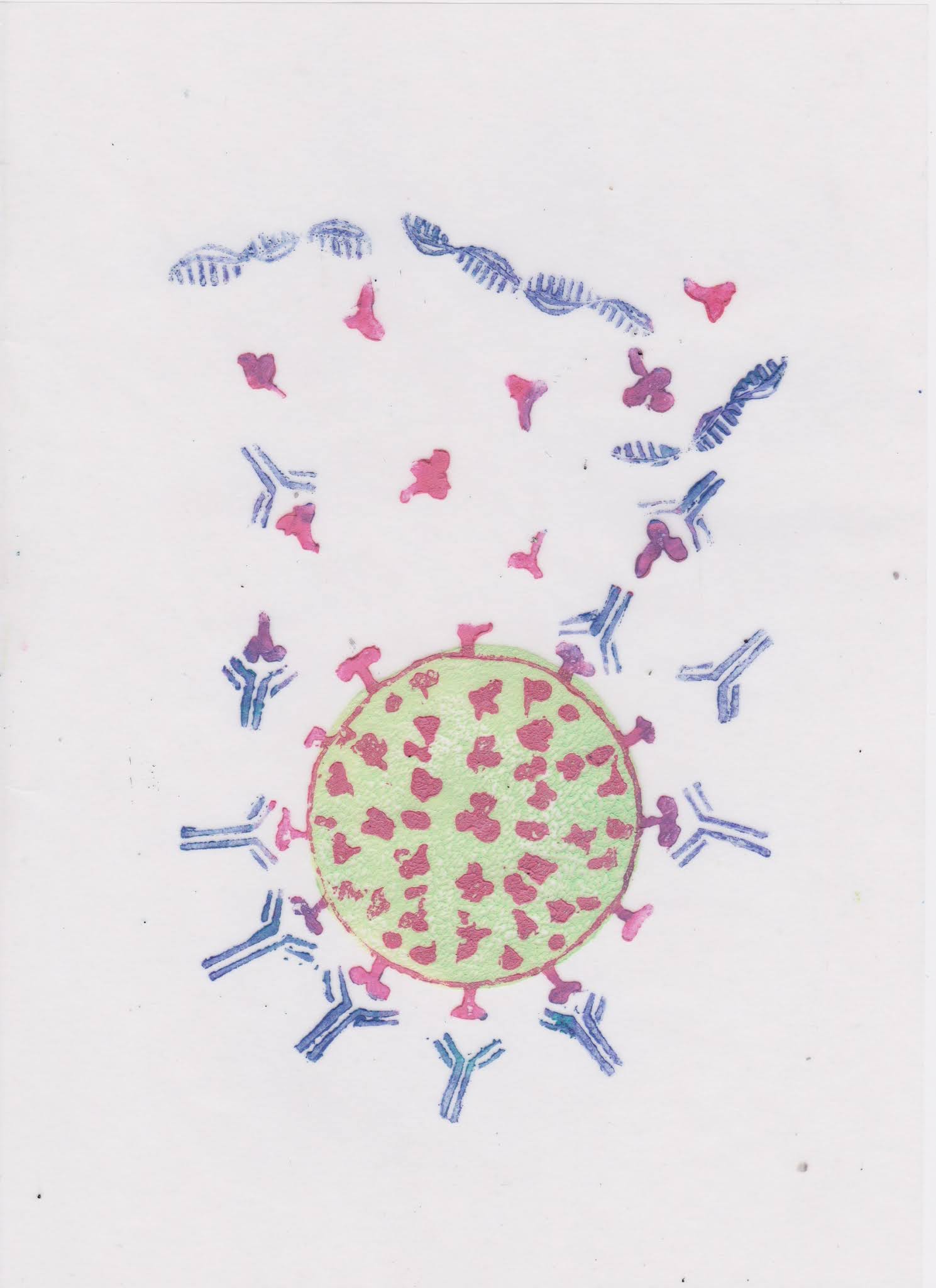
A New Hope linocut schematically shows how mRNA vaccines against COVID-19, train the body to make spike protein, which our immune system then learns to combat.
 

Blep linocut, for "in good taste" is thinking creatively about taste and tongues. 


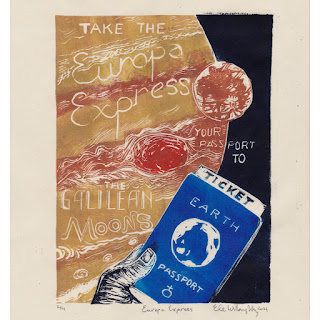
Europa Express linocut for the prompt "passport"

Wednesday, November 25, 2020

Multimedia! Collage all the leftover bits of linocuts!

I've long wanted to put all my scaps and offcuts of my linocut prints on beautiful washi papers to use, so I've started making multimedia collage works. I want to move towards elliminating waste in my art practice and I'm enjoying being creative in a much more improvisational way. Find these works and more available online in my shop!