Monday, May 27, 2024

Crustaceans!

 May is crustacean month for #InsertAnInvert2024. Playing on the idea of carcinisation, the process by which again and again, other crustaceans keep evolving crab-like bodies, the prompts are "crab," "false crab," "not crab" - and, shudder, "really not crab." Some of the non-crab crustacean abominations are, well, in my subjective opinion, nightmare fuel, so I veered off the path of suggested species and found a cute but distinctly non-crab crustacean for you. Also, it was a cue to try different print media. 

First up is "true crab" and I had my frog crab ready, from the warm colour prompt for Printer Solstice.

Frog crab, linocut print on washi paper, 8" x 8", by Ele Willoughby, 2024
Frog crab, linocut, 8" x 8" Ele Willoughby, 2024


Next up was false crab, so I re-shared my porcelain crab.

Porcelain crab linocut, Ele Willoughby, 2021
Porcelain crab linocut, 8" x 10", Ele Willoughby, 2021


Then was "not a crab" - I cheated a bit by sharing another false crab: the yeti crab. It has crab in its name but it's really closer to a squat lobster.

Yeti crab linocut by Ele Willoughby
Yeti crab linocut by Ele Willoughby, 2020


The last prompt is "really not a crab" with some suggestions that I honestly did not feel like contemplating at length. There are some scary looking crustaceans out there!

Daphina longispina, Tetrapak drypoint, 4" x 6" by Ele Willoughby, 2024

Instead, I went for the adorable microscope (1 to 5 mm) planktonic crustacean Daphina or water flea! Daphina longispina is a wee little freshwater water flea found worldwide in bodies of water from the size of rock pools to large lakes. They are filter feeders who mainly eat algae. This one is a female full of green eggs. I made this print using an actual Tetrapak juice container. I etched in the fine lines and peeled a bit of the surface material for coloured areas, then pushed ink into the etched areas with some card, and wiped away the excess ink. I cut my plate in a circle to suggest that this is a view through a microscope. I was able to pull a few prints on dampened watercolour paper using my etching press.

Thursday, May 23, 2024

Turtles, all the way down for World Turtle Day


Turtles, all the way down, world, linocut by Ele Willoughby, 2024
Turtles, all the way down, world, 11" x 14" linocut by Ele Willoughby, 2024

Today is World Turtle Day, a day to celebrate and protect turtles and their habitats worldwide. Years ago I made a print called ‘Turtles, all the way down’ for an art show about cosmology, where the expression is used as a metaphor for infinity regress. This echos origin myths that the Earth is supported on the back of the World Turtle. Though ostensibly about astrophysics, I took the opportunity to depict many species of turtles to celebrate their biodiversity.

This year I was commissioned by Turtle Survival Alliance, to illustrated this expression again, with a variety of wonderful but sadly endangered turtle species of special focus, in two prints: one for turtles from around the world, and one for North American species. Turtle Survival Alliance works to prevent extinctions of these amazing and varied animals worldwide, so I am very glad to make art for this cause!

My newly completed prints are on their way to Turtle Survival Alliance who will be auctioning them, as well as selling signed, limited edition, signed and numbered archival printed posters of each to raise funds for turtle conservation, later this summer.

The worldwide selection of turtles, from top to bottom are:
1 - Vallarta Mud Turtle (Kinosternon vogti), from Mexico
2 - Pancake Tortoise (Malacochersus tornieri), from Africa
3 - Indochinese Box Turtle (Cuora galbinifrons), from Asia
4 - Radiated Tortoise (Astrochelys radiata), from Madagascar
5 - Burmese Roofed Turtle (Batagur trivittata), from Myanmar
6 - Asian Giant Tortoise (Manouria emys phayrei), from Bangladesh


Turtles, all the way, North America, linocut by Ele Willoughby, 2024
Turtles, all the way, North America, 11" x 14" linocut by Ele Willoughby, 2024

Turtles from North America are:
1 - Bog Turtle (Glyptemys muhlenbergii)
2 - Spotted Turtle (Clemmys guttata)
3 - Eastern Box Turtle (Terrapene carolina carolina)
4 - Diamondback Terrapin (Malaclemys terrapin)
5 - Wood Turtle (Glyptemys insculpta)
6 - Alligator Snapping Turtle (Macrochelys temminckii)


My original Turtles, all the way down:


Turtles, All the Way Down, 11" x 14" (27.9 cm x 35.6 cm)
linocut with chine-collé by Ele Willoughby, 2016

The turtles in my original print are from the top we have an eastern mud turtle (Kinosternon subrubrum), a red-eared slider (Trachemys scripta elegans), a black pond turtle (Geoclemys hamiltonii), a painted batagur (Batagur borneoensis), a Oaxaca mud turtle (Kinosternon oaxacae), a green sea turtle (Chelonia mydas) and the hint of something larger.

Tuesday, April 23, 2024

Worms!

April is worm month for #InsertAnInvert2024 and I confess, worms are not my favourite invertebrates. But, I have been making some science art about the worms, especially some flamboyant marine worms. For the prompts long no limbs, long with limbs, not long no limbs and not long no limbs, I made a six-lined ribbon worm, Y, a fuchsia flat worm and an Elvis worm.


Six-lined Ribbon Worm, linocut, 8" x 8" by Ele Willoughby, 2024
 

The suggested species for the "long, no limbs" theme was Tubalanus sexlineatus. The six-lined ribbon worm (Tubulanus sexlineatus) is dark brown with five narrow, (sometimes discontinuous) longitudinal, white stripes, with indications of a sixth stripe midventrally and encircled in up to 150 white bands. Tubulanus is a genus of primitive nemertean worms in the order Palaeonemertea. It lives on the Pacific coast of North America from Alaska to California. Amazingly this is a species which can  to regrow a head after amputation!

What’s inside this cigar box? A black smoker - with giant tube worms (Riftia pachyptila) for #InsertAnInvert2024. I’ve had the idea for this multimedia in my head for years! Cigar box, collaged papers, gouache, Posca pen, glue, washi tape.


I’ve never had the opportunity to go on a research cruise to a hydrothermal vent, though I have contributed to plans for monitoring and seen a lot of footage shot by marine geophysicist/geologist/geochemist colleagues. I used to walk by the top of a chimney daily at work at PGC; it had been recovered by an ROV (something scientists no longer do, as these vents are protected).

Black Smoker multimedia: Cigar box, collaged papers, gouache, Posca pen, glue, washi tape. Three photos of inside and outside of box.
Black Smoker multimedia: Cigar box, collaged papers, gouache, Posca pen, glue, washi tape. Ele Willoughby, 2024


They are extraordinary, otherworldly environments and it tells us a lot about life that such vents, called black smokers or white smokers (for fluids emitted from the natural chimneys) are home to so many creatures. Crustal fluids in the seabed are vented due to volcanic heating near mid-ocean ridges and chimneys are built with the deposition of minerals in fluids coming out of solution when hot vent fluids (~60°C!) come in contact with the cool ~2°C ocean bottom water. These high pressure environments with hot fluids filled with the sorts of chemicals we find toxic like sulfides, are actually home to vibrant communities based on a food chain founded by chemosynthetic bacteria. These black smokers in the Pacific are often carpeted with these giant tube worms (& home to other invertebrates like limpets, clams, shrimp and more). These extremophiles may also be showing us that hydrothermal vents may have been a nursery for early life on this planet.

The giant tube worms (diameter ~4 cm, length up to 3 m) tolerate extremely high hydrogen sulfide levels and they were a great shock to the geologists who found them in this hostile environment. As adults they make a white chitinous tube, with a bright red branchial plume & NO digestive system but rely on symbiosis with chemosynthetic bacteria for nutrition!
 
Black Smoker multimedia: Cigar box, collaged papers, gouache, Posca pen, glue, washi tape.
Black Smoker multimedia: Cigar box, collaged papers, gouache, Posca pen, glue, washi tape. Ele Willoughby, 2024

 
Fuchsia Flatworm, linocut by Ele Willoughby, 2024 
Fuchsia Flatworm, linocut by Ele Willoughby, 2024

You'll remember I posted this one before: the strange and beautiful fuchsia flatworm (Pseudoceros ferrugineus) with its gorgeous aposematic colours, a warning to predators that it's not worth the trouble to try and eat. A flexible ruffled oval creature it is a little hard to capture in an illustration. It crawls around eating on the reefs of the Indo-Pacific without any fear of predators.


Elvis worm, linocut on washi, 8" x 8" by Ele Willoughby, 2024

In 2020, scientists discovered 4 types of scale worms, with shimmering lavender, blue, orange and exoskeletons, which looked like they were wearing sequined jumpsuits like Elvis Presley! They named these worms Elvis worms. These species in the genus the genus Peinaleopolynoe are called P. goffrediae, P. mineoi, P. orphanae, and P. elvisi. The worm in my print is Peinaleopolynoe orphanae, a iridescent and lavender worm named for geobiologist Victoria Orphan. These fancy scale worms live in the nutrient-rich deep sea. P. orphanae have been observed biting and fighting each other. No matter how pretty, they are actually fierce little creatures in their sequined outfits.

To recreate these iconic worms in print form, I have used layers of delicate handmade Japanese washi paper and iridescent cellophane. It's a challenging thing to photograph or scan but the colours change with the angle of the light.

Thursday, March 7, 2024

Triadic Colours, CYMK, Primary Colours, and Warm Colours and My Printer Solstice Prints


Ochre Sea Stars, linocut by Ele Willoughby on 8" x 8" washi paper

For the #PrinterSolstice prompt triadic colours, I choose the secondary colours orange, purple and green, which are three equidistant on the colour wheel. I was looking forward to #InsertAnInvert2024 and needing an intertidal creature.

My lino block print of two Pisaster ochraceus, generally known as the purple sea star, ochre sea star, or ochre starfish, on a bed of kelp, is hand-printed on 8" x 8" (20 cm x 20 cm) delicate white Japanese paper with bark inclusions. A common sea star, or starfish of the Pacific, it is a keystone species considered an indicator of health in the intertidal zone. Most of these starfish are purple but they can also come in orange (as shown), or ochre, yellow and brown.

These were amongst my favorite finds on the beaches of Vancouver Island.


A collection of small gel prints made with cyan, magenta, yellow and black ink, cut paper stencils, lino blocks and plant materials

For the #PrinterSolstice prompt CMYK I spent a morning experimenting with my gel plate, using paper stencils, lino blocks and plant materials and my process cyan, magenta, yellow and black inks.

For the #PrinterSolstice prompt primary colours, I thought I would play with adding yellow and red to a cyanotype (which are in tones of blue of course). I decided to return to my idea of contrasting a fractal Sierpiński triangle and the naturally occurring fractal shape of a fern leaf. The Sierpiński triangle (also called the Sierpiński gasket or Sierpiński sieve) is a fractal equilateral triangle, subdivided recursively into smaller equilateral triangles. It's a self-similar sets—that is, it is a mathematically generated pattern that is reproducible at any magnification or reduction named after the Polish mathematician Wacław Sierpiński. This was a decorative pattern many centuries before Sierpiński. I made a cyanotype of a fern leaf and used a gel plate to add a red circle. I lino block printed the yellow Sierpiński triangle.

Fractal Geometry, cyanotype with gel print and linocut, 9" x11" by Ele Willoughby, 2024
 

And for the final prompt warm colours, I looked ahead once again to prompts for #InsertAnInvert2024 and decided I needed to make a true crab.

Frog crab, linocut print on washi paper, 8" x 8", by Ele Willoughby, 2024

 My hand-printed red frog crab (Ranina ranina), also known as a spanner crab or Huỳnh Đế crab, is hand-printed on Japanese kozo (or mulberry) paper 8" x 8" (20.3 cm x 20.3 cm) square. This crab is found in tropical and sub-tropical waters offshore Australia, the Philippines, Vietnam, the east coast of Africa, through the Indian ocean to  the Pacific offshore Japan and Hawai'i. It is the sole known member of its genus and it is fished for its meat. The 5.9" (15 cm) crabs live in 10 to 100 m (33–328 ft) or water, where they bury themselves in the sand during the day and hunt bottom-dwelling fish. Known as "frog crabs", on account of their elongated carapace and frog-like appearance. Their claws are modified into tools for digging, and the body is a rounded shape that is easy to bury in sand. Unlike most other true crabs, the abdomens of raninids are not curled under the cephalothorax, so they are a little unusual looking.

Ranina ranina is a regional specialty in some regions of the Philippines where it is known as curacha. It is generally eaten steamed as halabos, or cooked in coconut milk as ginataan. In Vietnam the species is named as "Huỳnh Đế crab", literally means "emperor crab" as it has been a favorite high-ranked cuisine of historical Vietnamese monarchs hailed "monarch of all the crab".


Wednesday, February 28, 2024

Mussels and Chitons - New marine invertebrate prints

 Looking ahead to some #InsertAnInvert2024 prompts, I made some linocut marine invertebrates.


Blue Mussel, linocut, 8" x 8" by Ele Willoughby, 2024

The blue mussel (Mytilus edulis), or common mussel, is a medium-sized edible marine bivalve mollusc in the family Mytilidae. They are aptly called common mussels and are found on temperate beaches worldwide. They are also yummy.

A more complicated print is my lined chiton. They are extraordinary wee animals, which come in all sorts of colours. 

Lined Chiton, Linocut, 5" x 7" by Ele Willoughby, 2024

The lined chiton, Tonicella lineata, is a beautiful, colourful tiny marine mollusc of the North Pacific. Each 5 cm (2") long animal has zigzag purple or black lines on eight valves on a array of different colours like brown, red or burgundy like here but can also be bright blue or yellow to orange with a hairless girdle in colours like brown to red or pink, often with regular yellow or white patches. It is found from the Aleutian Islands of Alaska to San Miguel Island of California, as well as the Sea of Okhotsk of Russia and northern Japan in the intertidal to subtidal waters of 30 to 90 m (100 ft to 300 ft) depth. It's thought their colourful bodies are intended to camouflage against algae. They are prey of the ochre starfish.

Chitons are also sometimes known as sea cradles or coat-of-mail shells or suck-rocks, or more formally as loricates, polyplacophorans, and occasionally as polyplacophores.

Each print is made on 12.7 cm x 17.7 cm (5" x 7") printmaking paper. Because this is a reduction print, after each colour, I carved away more of the block, this is a limited edition of 12 prints. When they are gone, there will be no more originals.


Monday, February 5, 2024

Heart Cockles and Fuchsia Flatworm


Heart Cockles, linocut by Ele Willoughby, 2024
Heart Cockles, 6.5" x 8" linocut by Ele Willoughby, 2024 

Was thinking of both the #PrinterSolstice prompt monochromatic and the upcoming #InsertAnInvert2024 prompt infauna for March (shell month) when I made this print... and of course, Valentine's Day.

Corculum cardissa, the heart cockle, is a species of marine bivalve mollusc in the family Cardiidae found in the Indo-Pacific. If viewed from the side, it looks like a heart. There is a lot of colour variation in shells, but they often have patterns in coral pink like those in my print. Interestingly, the shells are translucent in places, allowing light in which benefits its symbiotic relationship with  photosynthesizing  dinoflagellates (zooxanthellae), which live within its tissues. The cockle takes in the dinoflagellates by its mouth. Their presence causes a tertiary series of tubules develop from the walls of the cockle's digestive system which are a safe environment for them to live and photosynthesize, producing metabolites which help the cockle.

The next #PrinterSolstice prompt was split complimentary and it lead me to another #InsertAnInvert2024 prompt. To make a split complimentary colour, choose two complimentary colours, like yellow and purple, and replace the second colour by the two colours adjacent to it on the colour wheel - fuchsia and indigo.

Fuchsia Flatworm, linocut by Ele Willoughby, 2024

One of the suggested #InsertAnInvert2024 organisms is the strange and beautiful fuchsia flatworm (Pseudoceros ferrugineus) with its gorgeous aposematic colours, a warning to predators that it's not worth the trouble to try and eat. A flexible ruffled oval creature it is a little hard to capture but it does indeed have a split complementary colour scheme. It crawls around eating on the reefs of the Indo-Pacific without any fear of predators.

Friday, February 2, 2024

Annie Jump Cannon, Census Taker of the Sky

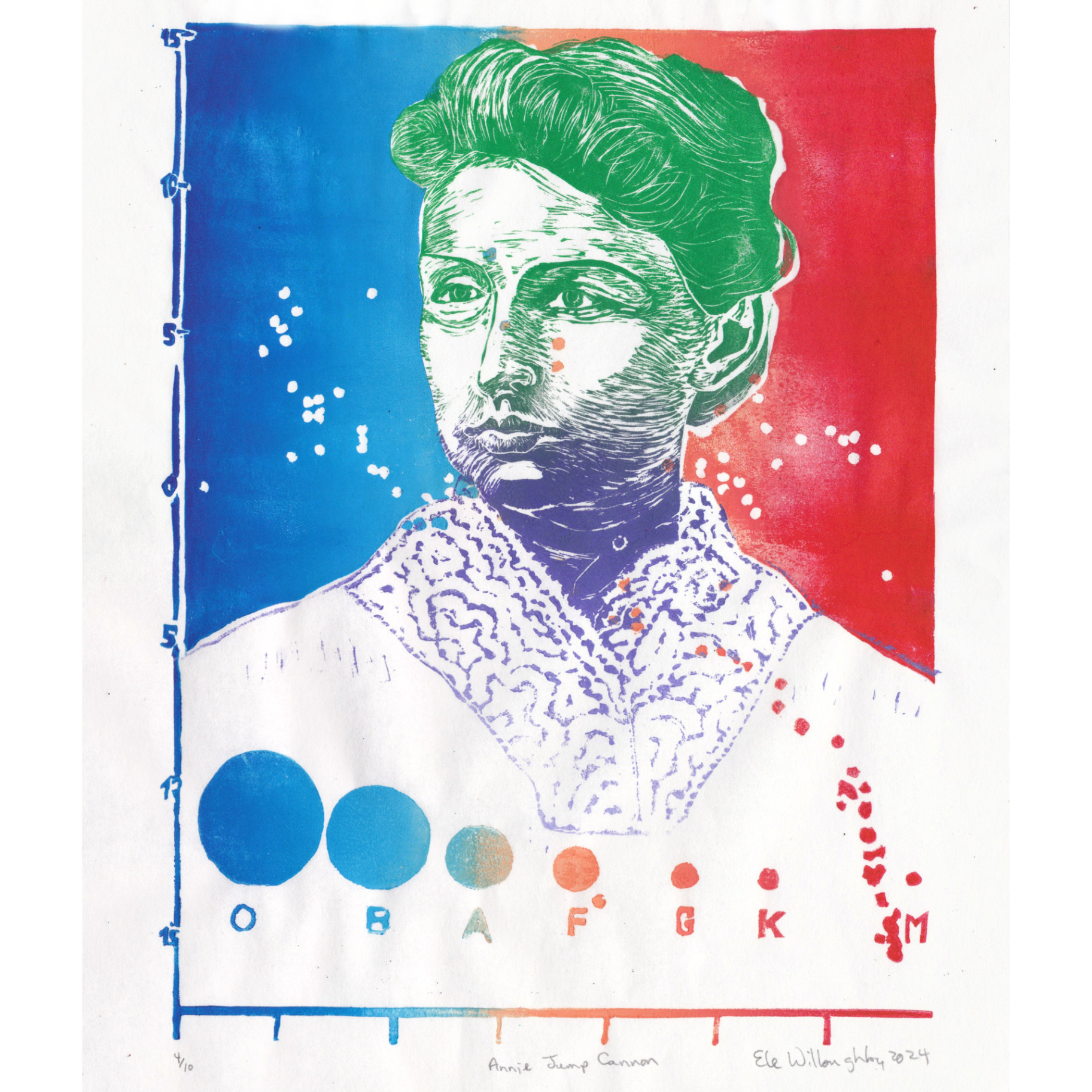
Annie Jump Cannon, 11" x 14" linocut by Ele Willoughby, 2024

I knew the #PrinterSolstice prompt "spectrum" called for another scientist portrait!

My hand printed lino block portrait of trailblazing American astronomer Annie Jump Cannon (December 11, 1863 – April 13, 1941) shows her with her stellar classification system which sorted stars based on spectral types and turned out to reveal their temperature from hot blue stars through cool red stars into O,B,A, F, G, K and M, as shown on the Hertzsprung-Russell diagram behind her. Along with her supervisor Edward C. Pickering, she is credited with the creation of the Harvard Classification Scheme, the first serious stellar classification scheme. The name, citing Harvard rather than Cannon herself, who still lacked a university appointment, makes her achievement less visible than it might have been.

The eldest of three daughters of Delaware shipbuilder and state senator Wilson Cannon and his second wife Mary Jump, Annie was born in Dover, Delaware. Her mother taught her the constellations, home economics (and the organization skills she would later need) and encouraged her to pursue her own interests. Annie and her mother used old astronomy textbooks to identify stars they could see by climbing out a trapdoor onto their roof. She studied mathematics, chemistry, and biology at Wellesley College, a top school for women, where she excelled at math. She studied physics with Sarah Frances Whiting, one of the few US women physicists at the time, and became the valedictorian. She graduated with a degree in physics in 1884 and returned home to Delaware. Over the next decade she studied the new art of photography, photographing her travels through Europe with her Blair box camera. The Blair company published her photos and prose about Spain, "In the Footsteps of Columbus" and distributed it as a souvenir at the Chicago World's Columbian Exposition of 1893.

A cheerful and energetic person, she lost most of her hearing as a young adult, possibly due to scarlet fever. She found it made it hard to socialize. Then her mother died in 1894, which made family life difficult too. She wrote Sarah Frances Whiting seeking a job and was hired as a junior physics teacher, which allowed her to take graduate physics and astronomy classes and study spectroscopy on her own. She gained access to a better telescope by enrolling in Radcliffe College (a women's college affiliated with Harvard) in 1894 as a "special student" which allowed her to use the he Harvard College Observatory. Harvard astronomer Edward C. Pickering hired her as his assistant in 1896. He was running a program to map and catalogue every visible star in the sky to a photographic magnitude of about 9 (16 times fainter than visible by human eye alone) to complete the Henry Draper Catalogue, a research program fund by the widow of a wealthy physician and amateur astronomer. He hired men to do the physical jobs of operating heavy telescopes and making photographs. He hired and supervised a group of women (whom he could pay as little as 25 cents an hour to work seven hours a day, six days a week) known as the Harvard Computers to do examine data, do calculations and catalogue photos - work he did not deem proper scientific analysis. Though hired as mere "computers" this team included such astronomy luminaries as Cannon, Henrietta Swan Leavitt, Williamina Fleming and Antonia Maury who made important advancements in the field. Pickering wanted the optical spectra of as many spectra as possible with the goal of indexing and classifying stars by spectra. The Draper Catalogue became an indispensable tool for astronomers.

Cannon worked at the Observatory until 1940. In her first three years, she classified 1000 stars. By 1911 she was made the Curator of Astronomical Photographs at Harvard and by 1913 she had learned to accurately classify 200 stars an hour! She published her first star catalogue in 1901. She finished her studies at Wellesley and was awarded a master's in 1907. In 1927, Pickering  said "Miss Cannon is the only person in the world—man or woman—who can do this work so quickly," about her skills in star classification.

The classification work was begun by Nettie Farrar, but she left the Observatory after a few months to get married. Antonia Maury (the first person to detect an calculate the orbit of a spectroscopic binary, and Draper's niece) took over. She insisted on a complex scheme, to the dismay of project manager Williamina Fleming (who catalogues ten thousand stars, 59 gaseous nebulae, over 310 variable stars, 10 novae and other astronomical phenomena including discovering the Horsehead Nebula) who wanted a simpler scheme. Cannon negotiated a compromise, applying a scheme dividing of stars into the spectral classes O, B, A, F, G, K, M, based on the Balmer absorption lines of hydrogen. Later when the scheme was understood to reflect stellar temperatures her initial sequence of the classes was reordered to go from hot to cold.

Cannon excelled at the work thanks to her organizational skills and patience with the tediousness of the work. Her calm, friendly and hardworking personality lead her to a sort of ambassador-like role, brokering exchanges of equipment between male colleagues.  Nicknamed "Census Taker of the Sky,"  she catalogued an estimated  350,000 stars, more than any other person. She also discovered 300 variable stars, five novas, and one spectroscopic binary.

In 1914, she was admitted as an honorary member of the Royal Astronomical Society. Awarded an honorary doctor's degree in math and astronomy from Groningen University in 1921, she became one of the first women to receive an honorary doctorate from a European university. On May 9, 1922, the International Astronomical Union passed the resolution to formally adopt Cannon's stellar classification system. With minor changes (to include intensity as well as temperature) Annie Jump Cannon's classification system is still in use today. She got the opportunity to spend six months in Arequipa, Peru, photographing stars in the Southern hemisphere. In 1925 she became the first woman to receive an honorary science doctorate from Oxford and was elected to the American Philosophical Society. In 1929 she chosen as one of the "greatest living American women" by the League of Women Voters. In 1931, she was the first woman to win the Henry Draper Medal. In 1932 she won the Ellen Richards prize from the Association to Aid Scientific Research by Woman. She represented professional woman at at the World's Fair in Chicago in 1933. She became the William C. Bond Astronomer at Harvard University in 1938.

Cecilia Payne (later Payne-Gaposchkin) used Cannon's data to show that stars are mainly composed of hydrogen and helium.

Cannon retired in 1940 but kept working at the Observatory until a few weeks before she died at 77. Her work helped women gain acceptance and respect in the field. A dedicated suffragette she was also a member of the National Women’s Party. As The Woman Citizen’s noted in 1924, despite her achievements “The traffic policeman on Harvard Square does not recognize her name. The brass and parades are missing. She steps into no polished limousine at the end of the day’s session to be driven by a liveried chauffeur to a marble mansion.” But her legacy lives on in the discoveries she made, the classification system she developed, and the trail she blazed for women in astronomy. In 1935 she created the Annie J. Cannon Prize, awarded by the American Astronomical Society, for "the woman of any country, whose contributions to the science of astronomy are the most distinguished." The first recipient became the first woman full professor of astronomy at Harvard: Cecilia Payne-Gaposchkin. Like her mother before her, and her first physics professor Sarah Frances Whiting, Annie was able to mentor and promote the next generation of women astronomers. Payne-Gaposchkin wrote in Science, upon her death, “On the thirteenth of April, 1941, the world lost a great scientist and a great woman, astronomy lost a distinguished contributor and countless human beings lost a beloved friend by the death of Miss Annie J. Cannon.” Harlow Shapely, Directory of the Harvard Observatory wrote, “Her official position at the Harvard Observatory was the William Cranch Bond Astronomer and Curator of the Photographic Collection. Her unofficial position was dean of women astronomers of the world and a leading and most honored woman scientist.”


References

Annie Jump Cannon, wikipedia, accessed February 2024 

Christ, Marian., Annie Jump Cannon, American Philosophical Society, January 16, 2022.

Geiling,  Natasha., The Women Who Mapped the Universe and Still Couldn’t Get Any Respect, Smithsonian Magazine, September 18, 2013

Murphy, Norah M., Eyes to the Sky: Annie Jump Cannon and the Harvard Observatory, The Harvard Crimsom, May 5, 2017

Stellar classification, wikipedia, accessed February 2024