Showing posts with label dictionary. Show all posts

Sunday, July 6, 2014

Dictionary of imaginary mini print creatures

I used to regularly blog what I was reading, but fell out of the habit last year. Something about the heat of the summer, and feeling so pregnant, and then, having the baby in the winter. I did read last year... less than in some years... but I read and failed to document it. It's no longer fresh in my mind, but I have been meaning to try and catch up.

This year, when I get a moment, I'm usually feeding the baby and so I don't have two hands and have found trying to read a book awkward. So I've been reading copious amounts of non-fiction on my phone, rather than books. The one book I read when I have some quiet and two hands to gently hold it is the Codex Seraphinianius, written and illustrated by Italian architect Luigi Serafini from 1976 to 1978. It's a visual encyclopedia, of a foreign, paradoxical yet familiar, world, complete with its own language and obscure meanings. I've written about it and alluded to it previous to ever seeing a copy in person, a few times, in fact. An original first edition will run you about $5000, but a new edition came out last year, for a much more conceivable $200 for a large, beautiful, hardcover book. It comes complete with a new preface by the author, which I enjoyed. He describes how he made the book - the physical process - without destroying the beauty of the unknown why or what it really is about. He basically writes (and I should perhaps post a spoiler alert for the purist), I don't know, I was somehow compelled, maybe that weird stray cat 'dictated' the Codex to me? RJH gave it to me for Christmas. Wanting to get back into writing reviews of what I read (in the most generous sense of the word), I've been thinking about how one could review a mysterious tome, all alien illustrations and imagined alphabet or syllabary and language.

It occurred to me the best way would be something like this.

1. Codex Seraphinianius, written and illustrated Luigi Serafini.
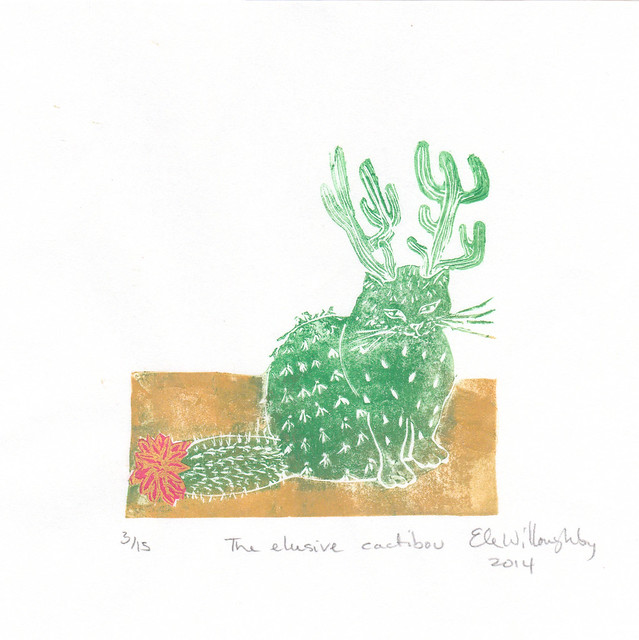
The elusive cactibou linocut

I mean, it's sort of obvious in hindsight, no? What can one say to the Codex, but to reply in kind with an illustration of a bizarre, unknown creature, which nonetheless seems to be built of familiar parts (say, a cat, cacti and caribou antlers) and its own internal logic? No sooner had this idea had entered my mind than it grew into a series of mini print illustrations of fantastical creatures, beginning with my previous mini print, the winged walrus.
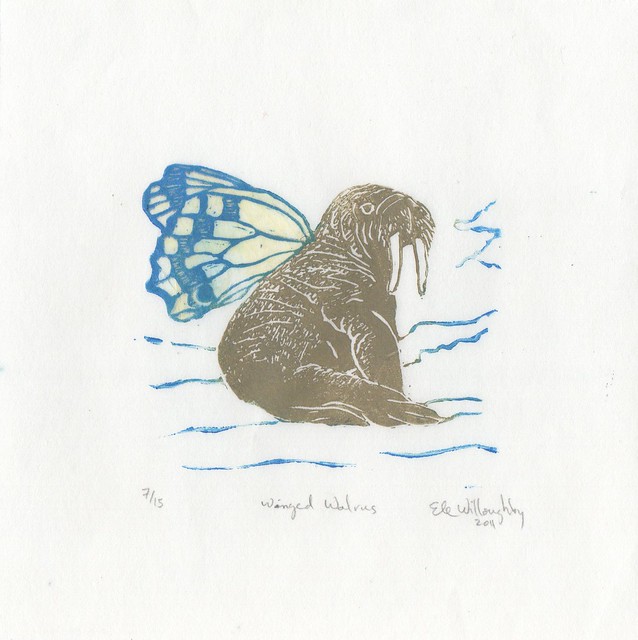
Winged Walrus

And before long, I needed to make a print of the Batbearoo (neither bat, nor bear, but a flying marsupial).
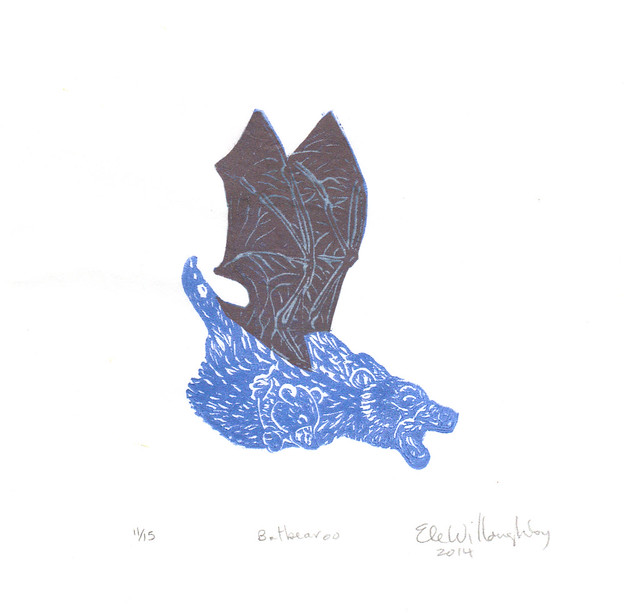
Batbearoo linocut
http://vennarecci.free.fr/Rhinogrades/
 Anatomie Et Biologie Des Rhinogrades — Un Nouvel Ordre De Mammifères, Masson, France (1962) is the most wonderful sort of fictional science (rather than traditional science fiction). The original was published in German as Bau und Leben der Rhinogradentia in 1957. There exists an English translation by Leigh Chadwick in 1967 called The Snouters: Form and Life of the Rhinogrades, but I've only found my French edition. Stümpke created an entire new (imaginary) order of mammals, the rhinogrades (or "snouters") whose most remarkable characteristic was the nasorium, an organ derived from the ancestral species' nose, which had variously evolved to fulfill every conceivable function, notably including locomotion. It's written much like a regular scientific treatise, complete with footnotes, references, Latin species information and a straight face. He never actually says anything to suggest that this order of mammals, or their home the Hi-Yi-Yi Pacific Islands are anything other than real. As I explain here, this 'scientific' text is truly magical, and I even cried at the end. It is understandably a great favorite amongst zoologists.
I was reminded of a couple of my other favorites. Harald Stümpke's

The other favorite is "The Book of Imaginary Beings" by Jorge Luis Borges with (poor forgotten) Margarita Guerrero (who is often omitted from the author list), which I did review here. It's another sort of imaginary encyclopedia of sorts, though written in human languages (Spanish, and readily available in English translation). It's a miscellany of the marvellous, written in Borges' typical magical scholarly fashion.

It's possible I have also been influenced by reading my tiny son Mercer Mayer's Little Monster's Bedtime Book several times. It's a lovely little illustrated storybook of 15 poems about monsters he invented - and, importantly, defined and described, published when I was but a wee little thing myself.

It occurred to me that there is in fact an entire proud tradition of these sorts of scholarly or scientific treatises on the not quite real, masquerading as fact. You might consider the 15th century Voynich manuscript, to which the Codex is often compared. It too is written in an unknown script, appears to be a sort of illustrated encyclopedia, or possibly nonsense. It has long intrigued scholars. Just last year, an article on a new study, published in the journal PLoS One, argued that the manuscript has a real, decipherable message (as reported by the BBC here). A large portion of the what I think of as 'proto-science', both intentionally (usually to confuse competitors, if one was say an alchemist) or unintentionally fall into this category. During the classical advent of history, Herodotus and Pliny for instance, did not really distinguish between "I can attest that this is factual" and "some guy told me this half-baked story over beers". Or, at least, it's fair to say they compiled their works in the absence of modern methods to try and establish the veracity of natural history of any sort.

So my next project is clear. These works have given me so much pleasure, I need to write my own fictional zoological text, featuring the likes of the winged walrus, batbearoo and cactibou! I plan a collection of mini prints, along with pseudo-zoological descriptions of these rare (and you know, possibly imaginary) creatures. After all, I think of much of my work as a sort of wunderkammer, and a true cabinet of curiosity is not just group of specimen of natural history both real and imaginary, but a proper collection, of ordered, organized and described things, in its own proto(pseudo)-scientific fashion.

Tuesday, February 9, 2010

Reading is sexy XXXII

{image: The sorceress (1911) by John William Waterhouse (Rome 1849-London 1917) via Guarda chi legge}
7. Ingenious Pursuits by Lisa Jardine Following reading Jardine's biographies of both Christopher Wren (accidental architect/astronomer/anatomist/mathematician/occasional surgeon/man about town) and Robert Hooke (engineer/architect/microscopist/inventor/surveyor/secretary to the royal society/astronomer/botanist/unfortunate self-medicator and coffee enthusiast) I read her story of the birth of modern science. It is a well written, clear concise and beautifully-illustrated book detailing astronomy, microcopy, anatomy, the early pursuit of clockworks to solve the longitude problem, the collection of exotic specimens and wunderkammer, the birth of the peer-review with an epilogue on the discovery of DNA's double-helix. Disclaimer: Now, if you're like me, you are ill-equipped to read about the earliest discoveries of William Harvey about blood circulation and worse - those who tried to verify his claims through vivisection. I did enjoy learning more about a variety of scientists and enthusiastic supporters. I will also re-iterate my one frustration: scientists sometimes make loosy historians of science, because they can lack context or create hagiographies, conversely, my issue with this fascinating 'anthropology of scientists' created by Jardine is the lack of scientific context. Yes, I am interested in reading about Hooke and Christiaan Huygens battling it out over their respective attempts to claim priority for spring watches, however, insufficient technical detail is provided here to allow the reader to form an informed opinion on the issue! When Hooke claims priority over Newton for the inverse-square law form for the force of gravity, can this be substantiated? Was Oldenburg a spy? She points out that Newton himself erroneously dismissed astronomer-royal Flamsteed's ideas about periodicity in comet orbits by saying they follow straight line at a time that Hooke and Wren were discussing inverse-square laws for gravity, but she does not go that (to a physicist) obvious next step, to discuss who knew what when!

Also, I ♥ Edmond Halley. He should be the next topic of any scientific biography! Without Halley, all these prickly scientists would have not functioned. Not only was he a sea captain/astronomer/geophysicist/adventurer/gentleman and discoverer of the periodicity of his comet. He was the one who managed to pry data away from Flamsteed and the Principia Mathematica away from Newton! Poor man was repaid for many of his efforts on behalf of the Royal Society with 50 copies of Willoughby*'s A History of Fishes.

Also, the minimal sketches of a few interesting female astronomers left me wanting to read more.

8. One Letter Words - a Dictionary by Craig Conley Somehow, I became someone who reads dictionaries. The idea behind this one is intriguing (well, to me at least), and the definitions are illustrated with quotations from literature (some, sadly repeated). As the author points out, most people respond by saying there are only two or three one-letter words (the obvious ones: 'a', 'I' and maybe 'O'). However, if you put a little thought into it, you remember there are a large number of vitamins, musical notes, base pairs in our genetic sequence, personality types, Roman numerals and other things which are labelled with single letters. Then, of course, there are shapes (A-frame, f stop, j stroke, T-shirt, and so forth). Each and every letter can be used to signify a piece of type or a key for that letter. There are also numbers (c is the speed of light, e is the base of natural logorithms, h is Planck's constant, i is the square root of -1, k can be Boltzmann's constant - though sensible people use a subscript 'B'). He also includes commonly used scientific symbols - and here is where he goes wrong! Because the only real justification for such a dictionary could be some sort of completeness -otherwise, why segregate the words based on length? And yet, here, off the top of my head are single letter word definitions he has omitted: a for acceleration, B for magnetic field (and yet he does include H for magnetic field!) or b for bottom quark - formerly known as beauty, C for capacitance or c for charm quark, d for displacement or down quark or D for Deuterium (which is particularly annoying because he repeatedly uses a literary quotation which erroneoulsy calls heavy water H2O2, which is wrong, rather than D2O), E for energy or Young's modulus, f for frequency, g for gluon, h for height, I for the identity matrix (and yet he defines several other matrices!?!), j for i (hahah! it's true though, we often use j to signify the square root of negative one to distinguish it from I for current), k for 1000 (and yet, he has it for 1024 in computer science) particularly for money (he does get the more colloquial G), L for luminosity or angular momemntum, m for meter (how can anyone miss the meter?) or mass, N for Newton, O for Orthonormal group, P for power, q for electric charge or Q for question (!), R for resistance, S for Siemens or s for strange quark, T for Tritium or Tesla or Tertiary (and yet he has K for Cretaceous!) or t for top quark - formerly known as truth, U for internal energy or potential energy or the up quark, v for velocity, W for work, x for Planet X or even The X files (as he certainly includes other proper nouns), y for the Bessel function, Z for the Z vector boson. It should NOT be this easy for me to brainstorm missing items from any "Dictionary". Apart from that, serious complaint** (and the fact that he clear knows no mathematics and thinks that 'e is the base of the natural logarith' and 'e is Euler's constant' are two distinct definitions), I did enjoy reading the book, and recommend it for your washroom.

9. Like I give a frock: Fashion Forecasts and Meaningless Misguidance by Michi Girl (Michi is the pen-name imaginary friend of Chloe Quigley and Daniel Pollock). Illustrated by Kat Macleod. This was a highly enjoyable, beautifully illustrated book, with no more intellectual pretention than Go Fug Yourself, but as wickedly funny. If the lovely layered, collaged, multimedia illustrations weren't reason enough, the questionaire regardining whether it is acceptable to wear fishnets to work, or definitions like "fashion vermin: noun. a once-cute animal that has become far too popular for its own good" ("Oh, deer, there are currently over 1.5 million web pages that feature a reference to a deer brooch"), and the petition to put an end to badly dressed pets make it worth its price.

Next up will be:
10. Beautiful Evidence by Edward Tufte, because some of us are obsessed with text and images as a means of conveying information - we may be scientists but our bookshelves are stuffed with the folios of da Vinci and the complete works of Blake. (See, not only Reynardin finds Type (the bookstore) dangerous.)


{Series so far: books read, more books read, books read, books read continues, more books read, I, II, III, IV, V, VI, VII, VIII, IX, X, XI, XII, XIII, XIV, XV, XVI, XVII, XVIII,XIX, XX, XXI, XXII, XXIII XXIV, XXV, XXVI, XXVII, XXVIII, XXIX, XXX, XXXI}

*To my knowledge, no relation.
** Now before any of you say, "But, you're a scientist!" consider this:
1) most of these definitions I learned in High School
2) tell me honestly that you have not seen a single one of these before? Surely, if nothing else, you've seen the phrase 'Q & A' or 'm' for meter (or metre if you're British).
3) My Dictionary of Physics cost about $10 and is readily available in any University booksore. Likewise, my Dictionary of Earth Science.
4) Last, but not least, consider, wikipedia, where, with 10 minutes effort one could fill in dozens of missing definitions.