Using the New York City's actual subway system schedule, routes, and expected travel times, recordings of cello pizzicato and a wee bit of artistic licence, Alexander Chen has created Conductor.
He chose certain parameters for aesthetic reasons (colours, fading lines, number of allowed simultaneous trains, and how to relate length to pitch). I love how both visually and audibly the lines appear to be plucked. "When a string is in the middle of being drawn by a subway car, its pitch is continually shifting." The pitch of the sound is determined by length of the straight-line segments but rather to avoid dissonance he stuck with, a "simple major C scale but with the lowest note as a raised third E, which keeps it from ever feeling fully resolved."
Meanwhile, French artist Armelle Caron in her Anagrammes graphiques de plans de villes - 2005 / 2008 series takes cities and deconstructs them into their constituent blocks, arranges these by size and shape and reveals the inner rhythms experienced by the pedestrian - like an anagram of a sentence.*
This morning I've been listening to A.S. Byatt being interviewed by the Australian Radio National 'All in the Mind' for National Science Week. It was a great pleasure to hear a favorite author talk about her love of science, her horror at the idea that the English Department would be the centre of the University, snail neurons, mirror neurons, her mind maps (though she doesn't use that term) and the colours of her novels (in an almost synesthesian* sense).
I am fascinated by the intersection of art and science, and this is one of the reasons I am so fond of her novels. She quite clearly articulates that she understands what some of her more disdainful peers in literature did not; that science is very much a creative field of endeavour. Further, she explains how she develops some of the key concepts underlying her novels (specifically Babel Tower) through the process of analogy, which she links to metaphor. Byatt is quite obsessed with metaphor, as well as being very interested in neurology. As such, I always think she should read one of my other favorite authors, Douglas Hofstadter. I am always telling people they should read Gödel, Escher, Bach, and then refusing to lend it to them, because I need to have it on my bookshelf at all time.**
Hofstadter works in artificial intelligence, so he thinks very deeply about how it is we think. He feels that analogy is the core of cognition, as he explains in the amusing and unpretentious lecture included below (the unpretentious part his lecture itself begins at 13.5 minutes in). When I was in grad school and he came to give a physics colloquium. He was trained as a physicist (and in fact, his father was a Nobel laureate in physics). He created a wonderful lecture on how Einstein, in his miraculous year (1905 - wherein he discovered the core of special relativity and much of the core of quantum mechanics), came up with his ideas through the process of ANALOGY. Einstein was also a great and honest observer of his own mind. The talk as I recall it, in fact, went through the entire history of physics and explained it all as a process of analogy. I'll give you but a hint: Rutherford proposed his model of the atom (which of course is both wrong, and a revolutionary step forward) with electrons circling the positively-charged nucleus by analogy to our model of the solar system, with planets orbiting the sun.
I think it is quite wonderful that Byatt can look to science as a means of enriching her literature - not simply with pretty metaphors, but in a deep structural sense, and Hofstadter can look at the tiniest linguistic errors we make***, and see them as data on how it is we actually think. In the interview Byatt speaks about mirror neurons - neurons which light up both when we perform an act and when we see an act performed. This is explained as a possible source of empathy. I wonder if this mirroring (which I've seen also postulated as an explanation for how we understand facial expression) does in fact indicate that on a fundamental level we understand actions we observe directly from analogy - not just in a higher level 'software' sense, as Hofstadter tends to discuss, but in a neuron-level 'hardware' sense as well.
*Is this a word? I think it should be. I created it by analogy. **I made an exception for the time, years ago, I convinced my friend JM to go get it signed by Hofstadter, since I had to teach when he was speaking with the grad students in our department. JM was a good sport. I confess I was actually unsure I wanted to meet Hofstadter - because I was uncertain he would match the mental construct I had formed of him in my head. This is ironic since I formed my ideas about mental constructs of people partly by reading Hofstadter's Le Ton Beau de Marot (which of course, is in English). ***He collects linguistic slips. My favorite, of the spoken errors in English by native speakers, which I have observed is one made by my friend Jill. Jill once said, "I'm turd, even though I have a chordle-neck on." I love that 'turd' came from 'turtle' and 'cold' not only swapped places with the first syllable of 'turtle', it also morphed into 'chord', because, presumably, she couldn't drop the 'r' sound. (Also, it's quite interesting that I typed 'turdle' before correcting myself with 'turtle'). But, most of all, I love that she said, "I'm turd" and persisted with her sentence despite the fact that I was laughing uncontrollably. Incidentally, Jill also faces a prospect discussed late in this lecture. That was a teaser, to try to intice you to listen to it.
The Owl and the Pussycat are now together in my shop. My namesake cat, Minouette's portrait is blockprinted in mauve on gold silk fabric, and a western screech-owl in is blockprinted in brown on gold silk. The reverse is a wonderful print fabric illustrating their tale. (The set: ocean as turquoise, knit, throw blanket, boat, sky & sun as Japanese washi paper. The Owl is about 22 cm or 8.5 talls and Minouette is 7 inches or 18 cm tall)
I think he's squinting at you in disbelief, this Western Screech-Owl (Otus kennicottii). He's pretty well life-sized. The Western Screech-Owl, common to woodlands throughout western North America, grows to be 8.5 inches or 22 cm tall. This one is the nourthwest coast type I would have seen when I lived on Vancouver Island. You can tell because he's more brown and less gray. All the raptors out there were very impressive. They gave the impression that they were just tolerating our presence and the Island really belonged to them.
I carved Mr. Otus Kennicottii in linoleum and printed him in water-based block printing ink, on Japanese kozo (or mulberry) paper, in an edition of six prints. Each print is 6 and a quarter by 12 and a half inches (15.9 cm by 31.8 cm).
I think I'm going to name owls Otus from now on (though their name in the other official language, le Petit-duc des montagnes kind of rocks too).
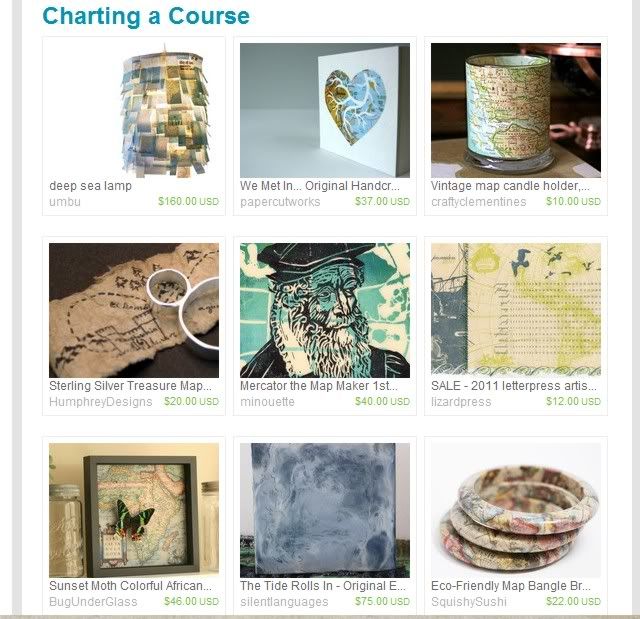
Earlier this week, Ulixis, my colleague on the Mad Scientists of Etsy Street Team, featured my Mercator block print on her blog, and then cross-posted it to the Mad Scientists of Etsy blog (which, you know, you should follow, cause it's awesome). Then this morning, 'Etsy Finds' the daily shopping guide which one can receive via email from Etsy (or view here) featured my Mercator in a sailing and exploring themed (how apt is that?) missive, under the section "Charting a Course"! The print sold before I was even able to open my email, as some buyers are clearly swifter than I.
So, I am going to say that so far I like the Year of the Rabbit, what with one art show and five prints and one pillow sold already. In my experience, if you are an etsy seller and wonder about whether you might want to join a team, I would say yes! Also, I'm thinking that my on-going shop makeover project is going well.
Did I mention I love my new scanner?
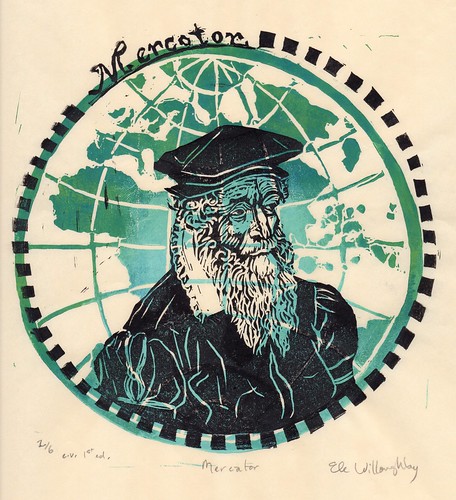
Everything you wanted to know about Mercator, but were afraid to ask... Gerardus Mercator was a 16th century Flemish cartographer. I would say "The" cartographer, except Flanders seemed to be overrun with first rate cartographers in the 16th century (Gemma Frisius, Abraham Ortelius... stiff competition), perhaps because mapping their territory was extremely challenging, what with the floods and the succeeding armies... I don't even know how they managed to keep track of whether they were (bizarrely) part of Spain, or the Holy Roman Empire or what. Mercator himself had to be on the ball as his tendencies ran to the Protestant end of the spectrum.
What made Mercator a contender for "The" cartographer, was in fact his abilities as a mathematician -and like those of us scientists who feel compelled also to create art he was wasn't hindered by his immense ability as an engraver. He produced beautiful world maps (a version of which is depicted in this print), globes, but his name has gone down in history for the Mercator Projection. The Mercator projection is a cylindrical map projection which became the standard map projection for nautical purposes because of its ability to represent lines of constant course, known as rhumb lines or loxodromes, as straight segments. While the linear scale is constant in all directions around any point, thus preserving the angles and the shapes of small objects (which makes the projection conformal), the Mercator projection distorts the size and shape of large objects, as the scale increases from the Equator to the poles, where it becomes infinite.
The Mercator projection will be quite familiar to you. It is generally used as a sort of 'default' projection, even today. If you are Canadian, like me, you might be lead to over-estimate the size of the arctic archipelago and underestimate the immensity of the African continent, due to the ubiquity of this projection. However, his achievement was fundamental to the explosion in exploration that came after his paradigm breaking world maps.
When the Mad Scientists of Etsy chose CARTOGRAPHY as our theme for November, 2008, I knew, as an earth scientist, (especially a marine geophysicist, used to spending quality time with nautical charts), a lover of the history of science and as a printmaker, that Mercator was the apt choice.
If you're in Toronto, you should join me at the Year of the Rabbit International Print Exhibit Opening at PROOF Gallery, in the Distillery District this evening!
Since I have yet to make any sort of groundhog art, I hope you will accept this other urban animal greetings instead. Actually, I keep envisioning a comic with three squares. In the first square there is a groundhog which comes out in broad daylight and sees no shadow with the legend 'sees no shadow, winter is over!' In the second square is an intimidated groundhog running from its shadow and the legend 'sees shadow: 6 more weeks of winter.' In the third panel is frozen mound of of vaguely groundhog-shaped snow with the legend 'see no groundhog: ....'
So yes, we have snow, but really, it strikes me as neither disasterous, nor monstrous, nor surprising, but I guess it gives the media an excuse for melodrama. I hope you are having a snow day, should you be in the wake of this storm, and that all the melodrama is on your television, not in your life.