One of the things I want to do this year is participate in some new (to me) print exhibits and exchanges. BC based printmaker Lori Dean Dyment and I were discussing on FB the yearly Chinese New Year exhibits and print exchanges held by PROOF Studio Gallery. We weren't sure if they were going to do one this year (the call for submissions for their Year of the Monkey show came one only recently*) and she suggested we both participate in Leftovers, a print exchange hosted by Wigtip Press. I was very flattered that she said she'd love to do an exchange together, because I think her prints are really quite magical and you should go have a look at her portfolio. Also, I had hear of Leftovers which has been growing in size year by year. The idea is that printmakers can make tiny prints, no larger than 5" x 7", and use of all the scraps of precious papers we've been hoarding. They have multiple exhibits of all the tiny prints and auction off prints from hunger relief (with funds going to the Idaho Hunger Relief Task Force). They invite printmakers to choose any subject, but suggest that food or hunger might be appropriate.
I thought about that for a while and I had no inspiration. Whenever I thought about hunger, what came to mind were all-too-real images from the news, of starving people in Syria (though there are starving people in many other places too). It was not a topic I wanted to live with intimately, while composing a print. So, I took them at their word that all subjects were welcome and looked for something which was a little more in my wheelhouse, so to speak. Then I saw an image of a juvenile burrowing owl who appeared to be wearing pantaloons. And while fluffy-legged owlets might not be as serious seeming a topic as hunger, I am able to celebrate the beauty and whimsy of wildlife (and perhaps bring some attention to how endangered burrowing owls have become on the Canadian prairie) while helping some fellow printmakers raise some funds to combat hunger in their community.
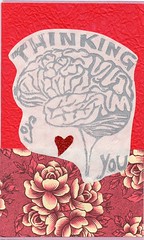
Every year I print a Valentine. This year I also chose to revisit an old brain block by carving a second block, so a one colour print could become a two colour print. Cause love isn't really about hearts at all, is it? It's about our minds and brains. Plus, brainy Valentines are great for zombie (or anatomy) lovers.
If you're reading my blog, pretend to look surprised on the 14th, husband.
I do enjoy the PROOF Chinese New Year prints shows and plan to submit my Monkey this year, and perhaps select a few random Chinese Zodiac animals for their print exchange.
*Due date for submissions is February 15th, 2016 for their
15th & FINAL International Print Exhibition and Exchange
This morning I've been listening to A.S. Byatt being interviewed by the Australian Radio National 'All in the Mind' for National Science Week. It was a great pleasure to hear a favorite author talk about her love of science, her horror at the idea that the English Department would be the centre of the University, snail neurons, mirror neurons, her mind maps (though she doesn't use that term) and the colours of her novels (in an almost synesthesian* sense).
I am fascinated by the intersection of art and science, and this is one of the reasons I am so fond of her novels. She quite clearly articulates that she understands what some of her more disdainful peers in literature did not; that science is very much a creative field of endeavour. Further, she explains how she develops some of the key concepts underlying her novels (specifically Babel Tower) through the process of analogy, which she links to metaphor. Byatt is quite obsessed with metaphor, as well as being very interested in neurology. As such, I always think she should read one of my other favorite authors, Douglas Hofstadter. I am always telling people they should read Gödel, Escher, Bach, and then refusing to lend it to them, because I need to have it on my bookshelf at all time.**
Hofstadter works in artificial intelligence, so he thinks very deeply about how it is we think. He feels that analogy is the core of cognition, as he explains in the amusing and unpretentious lecture included below (the unpretentious part his lecture itself begins at 13.5 minutes in). When I was in grad school and he came to give a physics colloquium. He was trained as a physicist (and in fact, his father was a Nobel laureate in physics). He created a wonderful lecture on how Einstein, in his miraculous year (1905 - wherein he discovered the core of special relativity and much of the core of quantum mechanics), came up with his ideas through the process of ANALOGY. Einstein was also a great and honest observer of his own mind. The talk as I recall it, in fact, went through the entire history of physics and explained it all as a process of analogy. I'll give you but a hint: Rutherford proposed his model of the atom (which of course is both wrong, and a revolutionary step forward) with electrons circling the positively-charged nucleus by analogy to our model of the solar system, with planets orbiting the sun.
I think it is quite wonderful that Byatt can look to science as a means of enriching her literature - not simply with pretty metaphors, but in a deep structural sense, and Hofstadter can look at the tiniest linguistic errors we make***, and see them as data on how it is we actually think. In the interview Byatt speaks about mirror neurons - neurons which light up both when we perform an act and when we see an act performed. This is explained as a possible source of empathy. I wonder if this mirroring (which I've seen also postulated as an explanation for how we understand facial expression) does in fact indicate that on a fundamental level we understand actions we observe directly from analogy - not just in a higher level 'software' sense, as Hofstadter tends to discuss, but in a neuron-level 'hardware' sense as well.
*Is this a word? I think it should be. I created it by analogy. **I made an exception for the time, years ago, I convinced my friend JM to go get it signed by Hofstadter, since I had to teach when he was speaking with the grad students in our department. JM was a good sport. I confess I was actually unsure I wanted to meet Hofstadter - because I was uncertain he would match the mental construct I had formed of him in my head. This is ironic since I formed my ideas about mental constructs of people partly by reading Hofstadter's Le Ton Beau de Marot (which of course, is in English). ***He collects linguistic slips. My favorite, of the spoken errors in English by native speakers, which I have observed is one made by my friend Jill. Jill once said, "I'm turd, even though I have a chordle-neck on." I love that 'turd' came from 'turtle' and 'cold' not only swapped places with the first syllable of 'turtle', it also morphed into 'chord', because, presumably, she couldn't drop the 'r' sound. (Also, it's quite interesting that I typed 'turdle' before correcting myself with 'turtle'). But, most of all, I love that she said, "I'm turd" and persisted with her sentence despite the fact that I was laughing uncontrollably. Incidentally, Jill also faces a prospect discussed late in this lecture. That was a teaser, to try to intice you to listen to it.
So I made another Unicorn Amongst Umbrellas pillow, cause I needed one. This one is all mine. :) I sold two of the Unicorn Amongst Umbrella multimedia (i.e. paper prints) and I have a mega-package for ! Next week, I start my Power Printmaking course at Open Studio. I'm looking forward to doing other forms of printmaking.
In other news, I got a lovely free French/Spanish dinner with our visiting scientist and several profs yesterday, and you will be amused to know, despite learning many things about what science tells us about worldviews* and how scientists can use this knowledge to better communicate with those who have other worldviews, and um, the history of computing**, even when you go to a fancy dinner, with distinguished scientists, the conversation still lead back to Star Trek.
I tell you, it's hopeless. I feel like Elena in Victoria, and her heroic attempt to teach the earth scientists to enjoy fashion and not to wear socks with sandals and polar fleece every. single. day. It's a loosing battle.
*Apparently, there's a link between dopamine receptors in the brain and voting tendancies. You can classify outlooks into two broad categories - and these are 60% hereditary. I find this amazing.
**My mind is still boggling over the cathode-ray-tube memory (think: oscilloscopes) in 1957 and the description of 'peering into the memory of the machine'.
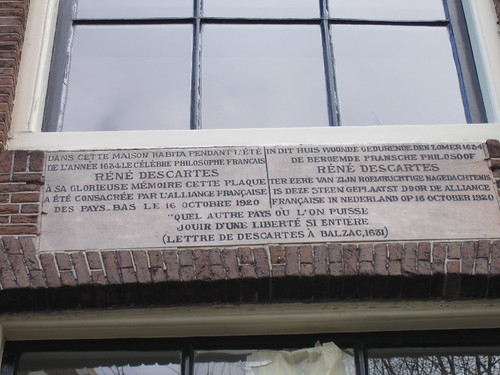
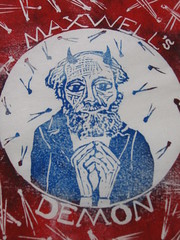
The 2nd in my 'Imaginary Friends of Science' series - after Maxwell's Demon* - is Descartes' Demon. Despite (or because) of his rationalism, René Descartes hypothesised the existence of an evil** daemon, a personification who is "as clever and deceitful as he is powerful, who has directed his entire effort to misleading me." The evil d(a)emon presents a complete illusion of an external world, including other people, or even his own body, when perhaps they didn't in fact exist. This is a sort of thought experiment to test the very idea of empiricism.
The modern version of this is the "brain in vat" (i.e. how do we know we aren't just brains in vats of biochemicals being stimulated to simulate what we sense). Descartes' Demon moves with the times, except perhaps when it comes to fashion. In fact, he bares an uncanny ressemblance to René Descartes himself, except for the horns, and the brain in a vat, of course.
Prior to taking the methodological skepticism (or, in the lovelier original, doute hyperbolique) to its extreme, in the Demon, Descartes used the dream argument as a thought experiment. Do we know this reality we each observe and experience exists or is it nothing but a dream? He uses this to show that in fact we can distinguish dream from reality. In this argument he was preceeded by two millenia by Zhuangzi (庄子;), 4th century BCE Chinese philosopher, who wrote, amongst other things "Zhuangzi dreamed he was a butterfly", which I came across in Jorge Luis Borges' famous essay "A New Refutation of Time".
Once Zhuangzi dreamt he was a butterfly, a butterfly flitting and fluttering around, happy with himself and doing as he pleased. He didn't know he was Zhuangzi. Suddenly he woke up and there he was, solid and unmistakable Zhuangzi. But he didn't know if he was Zhuangzi who had dreamt he was a butterfly, or a butterfly dreaming he was Zhuangzi. Between Zhuangzi and a butterfly there must be some distinction! This is called the Transformation of Things. (2, tr. Burton Watson 1968:49)
This philosopher was influential to Zen.
It's little wonder that in more recent and contemporary culture, we are still fascinated by these ideas. Consider Tweedledee and Tweedledum's warning to Alice in Through the Looking-Glass that the Red King asleep in the grass is dreaming about her, and that if he were to wake up she would "go out—bang!—just like a candle." Or The Matrix, which directly alludes to Alice. Likewise "Abre Los Ojos" (Open Your Eyes) (or its American remake, Vanilla Sky). Also the brain in a vat specifically makes appearances everywhere from Star Trek to Donovan's Brain.
Descartes himself was quite the character, alarming to contemporaries, even the scientists and philosophers. He liked to stay in bed until noon. It seems the enthuasism of his last great patron, Queen Christiana of Sweden, who demanded early morning tutorial, may have killed him. The moral of the story kids: no good come from studying before noon. Also, it's fun to try and tie all one's favorite things together.
*Remember him? Maxwell's Demon fights entropy, rather than empiricism. I love these far-out gedenkenexperiments (or thought-experiments, but if you are trained in physics you take language cues from Einstein) of such solid rationalists. Maxwell's Demon is more benign... after all, he might yet save the Universe from heat death.
**Personally, I would translate malin in le malin génie as wicked, rather than evil. I associate the word with mischievious, clever elves in fairytales... a trickster rather than something you'd see on Supernatural.
This card is a linoleum block print brain & text with collage on handmade Japanese papers. Valentines for the pro-zombie cute-phobic set.
I post it to mention hearts- a thought to try cheer myself up. I notice that my etsy shop has now topped 300 hearts!
Thank you to all who have added me to their favorites list. I appreciate it more than you would ever imagine. Secretly the Heart-o-Tron 3000 is quite ah... habit-forming.