Please join 25 local handmade vendors for the first ever The TESTy Spring Craft Show The Gladstone Hotel Ballroom, Saturday April 30th, 10:00 AM - 4:00 PM!
Great time and place to pick up some handmade goodness for Mother's Day!


 (image credit: Ramon Casas- Decadence 1899) Wow, I have been woefully neligent of reporting on my reading. I've also been reading a bit less, but the main problem was my response to a certain book (see below). I felt so strongly that a proper review required re-analysis of data, charts and maps (undoubtedly a surefire way to diminish my imaginary, book review audience to vanishingly small size and/or make it come to question my sanity) and then never found the time to do so. Of course, the solution is to post some brief reviews with a pointer to a future planned post where I explain that those of us with a facility with numbers are not mean, arrogant, ogres to be avoided, and we may even have incredibly useful data-analysis skills which we would be willing to share with
  That would not pass the peer review in science. It's simply inconceivable. I doubt that there's anything wrong with their models, but have the respect to share them with your audience rather than say, this is the right answer, trust me. Further I am saddened that a dataset which strikes me as downright heroic (imagine gathering the records of all slaves exported from Africa for centuries) is not used to its full potential (and I indent to show what I mean by this in a further post). Lastly, there are entire paragraphs written to explain the unexpected "trends" in voter turn-out versus nature of land tenure in India when is obvious that a random-number generator could produce an equivalent plot. THERE IS NO TREND. Basic hypothesis-testing, which is something taught to undergraduates in say, biology or statistics could have avoided these needless errors. Some of these articles could have been vastly improved if the authors learned to judge the quality of a linear fit by looking at the chi-squared per degrees of freedom. Pity they took more time taking cheap shots at the numerate, and too little time to learn why and how we apply numerical methods. These words and attitudes really taint what otherwise would have been a fascinating book.
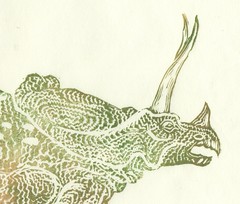 Torosaurus with its big frill had the largest known head of any land animal. It was a sort of long-frilled Ceratopsians who lived in at the end of the Cretaceous period, 70 to 65 millon years ago. It might even be the same thing as best-known of the horned dinosaurs, the Triceratops. Recent research suggests that Torosaurus were not a distinct genus, but a mature form of Triceratops. Either way, this animal had one impressively large head. Skulls have been found which are 2.6 m or 8.5 feet long.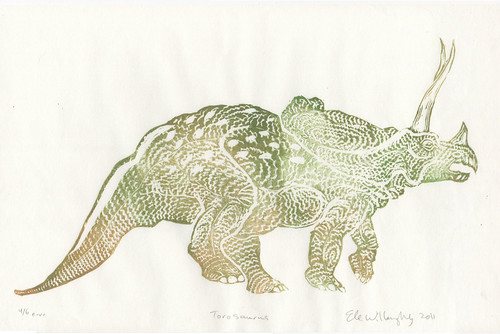
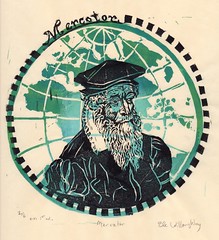 Mercator knew a thing or two about his environment, and scale, and the disruption caused by people, so he's here today to remind us to be kind to our planet. He's printed in water-soluble ink on kozo paper (from leaf fibre rather than wood pulp, so it's more easily renewable), by the way.
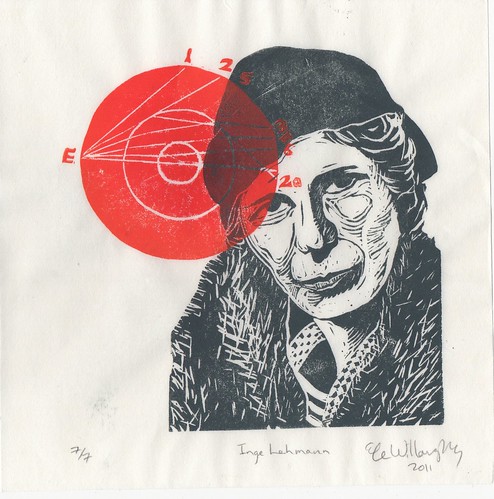
 We now know, as she first postulated, that the earth has roughly three equal concentric sections: mantle, liquid outer core and solid inner core. The crust, on which we live is merely a thin, um, scum really, on top of this slowly boiling pot. The only way to probe deep into the earth's core is to employ massive earthquakes, the waves they generate and the paths they follow. There are two main types of seismic waves used for studies of the globe, unimaginatively named Primary (or P, or compressional) and Secondary (or S, or shear). Imagine a glass of water with a straw; the straw will appear broken at the air-water interface, because light bends as it enters the water. Just like light travelling through different media, these seismic waves can bend, reflect or be transmitted at any boundary. The difference in physical properties between the mantle and outer core causes a P-wave shadow. (For S-waves, the shadow zone is absolute because liquids, like the outer core, do not support shear - imagine trying to cut water with a pair of shears and you can see this for yourself. Thus, no shear waves can make it through the outer core, and thus we can be certain the outer core is fluid). That means, the compressional waves from an earthquake can be recorded at seismic stations out to 105o from an epicentre and then there is a zone which is in the core's shadow. Lehmann found that there were some late-arriving P-waves are much larger angles (142o to 180o) which had been vaguely labelled 'diffractions'. She showed that these could be explained instead by deflections of the waves which travelled through the outer core at her postulated inner core boundary.
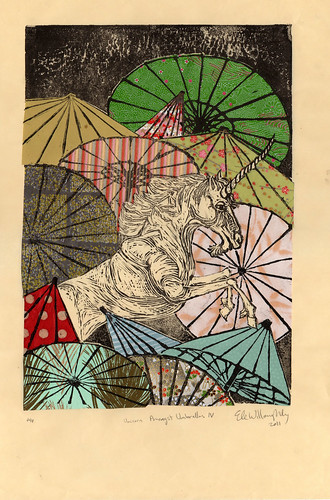
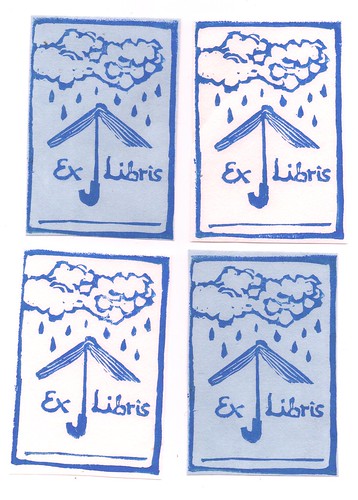
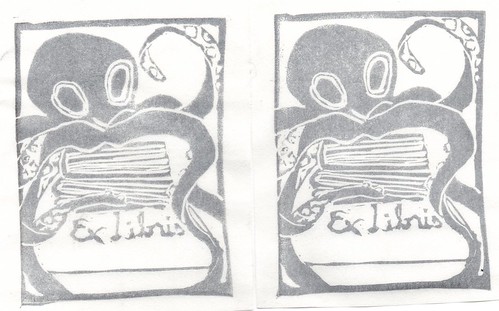
 So I know some of you hate the idea of twitter, some of you love it. I've been using it for quite some time now (@minouette), and enjoy it a lot more than I would have suspected. If you're curious there are many tricks to making it work for you. It's pretty easy to avoid the mundane, the shrill, or otherwise unfortunate users, and their existence shouldn't deter you from the entire concept. I find it a great news source for specific interests, and a means to filter the internet for interesting links. (I can follow everyone from @NASA to @feministhulk to @DAVID_LYNCH to @rebelmayor (William Lyon MacKenzie, Toronto's first mayor and 1837 rebel) to @sockington (a rotund cat) to collections of artists and science journalists, and of course several of the people on my friends' list here and this works for me). But it is, what it is. I doubt anyone's tweets warrant archiving (I'm looking at you, @librarycongress the Library of Congress). One can only be so profound in 140 characters. So, after that verbose caveat, let me pass on this funny Twitter tool du jour, That Can Be My Next Tweet, which employs your previous tweets as a means to predict your next (via teenangster, who calls it "like magnetic poetry, except way more embarrassing and personal.")
“More block print of Memories’ wedding guestbook will show up the pussycat… pillow. congratulations!”
“You promised tweets. Still waiting. : enough seismic data. perspective is crazy, but luckily not inside.”
“Haha! I watched a carpentry tool? It ought to Scott Walker and eating a documentary about reindeer and.”
“Radiolarians block prints. Will be at Pearson. Somehow, I’m listening to radiolarians Working on my block.”
“New monster avatar : today too!”
“Model wireless solar-powered charging ‘tree’ for a block printed pillow new monster avatar ; drinking tea?”
and, my favorite, (though I do love the idea of listening to radiolaria at the airport),
“Debugging imaginary problems is crazy, but more elegant than Toronto Street Team.”