Monday, September 21, 2020

Trilobites, ubiquitous Paleozoic arthropods as collaged linocut prints


Trilobite: Cheirurus ingricus prints Ele Willoughby, 2020


Trilobite: Cheirurus ingricus prints Ele Willoughby, 2020

My latest Paleozoic print once again takes advantage of a segmented fossil body to add colour and pattern with collaged Japanese washi papers. This member of the ubiquitous and wildly successful trilobites, prehistoric creatures which lived for hundreds of millions of years, was a Cheirurus ingricus which lived during the Late Cambrian through the Early Devonian era.

Cheirurus lived from about 500 million years ago to 390 million years ago. Trilobites were arthropods (as are modern day insects, lobsters, shrimp and more) which left fossils of their exoskeletons worldwide. There are many thousands of different species and their fossils have been important  to biostratigraphy, paleontology, evolutionary biology, and plate tectonics. It was hard to choose which one to portray as there are tens of thousands of different species of these critters, but I thought they were well suited to collaged segments.

Friday, September 4, 2020

More Animal Prints and Imaginary Friends of Science

I haven't kept up with my own prints during this weird time, so today I'm going to share a bunch of recent prints!


Pair of Adélie Penguins linocut by Ele Willoughby
Adélie Penguins linocut by Ele Willoughby

Orca linocut by Ele Willoughby

Black Bear linocut by Ele Willoughby

Beaver linocut by Ele Willoughby

Moose linocut by Ele Willoughby
Moose linocut by Ele Willoughby  

Yeti crab linocut by Ele Willoughby

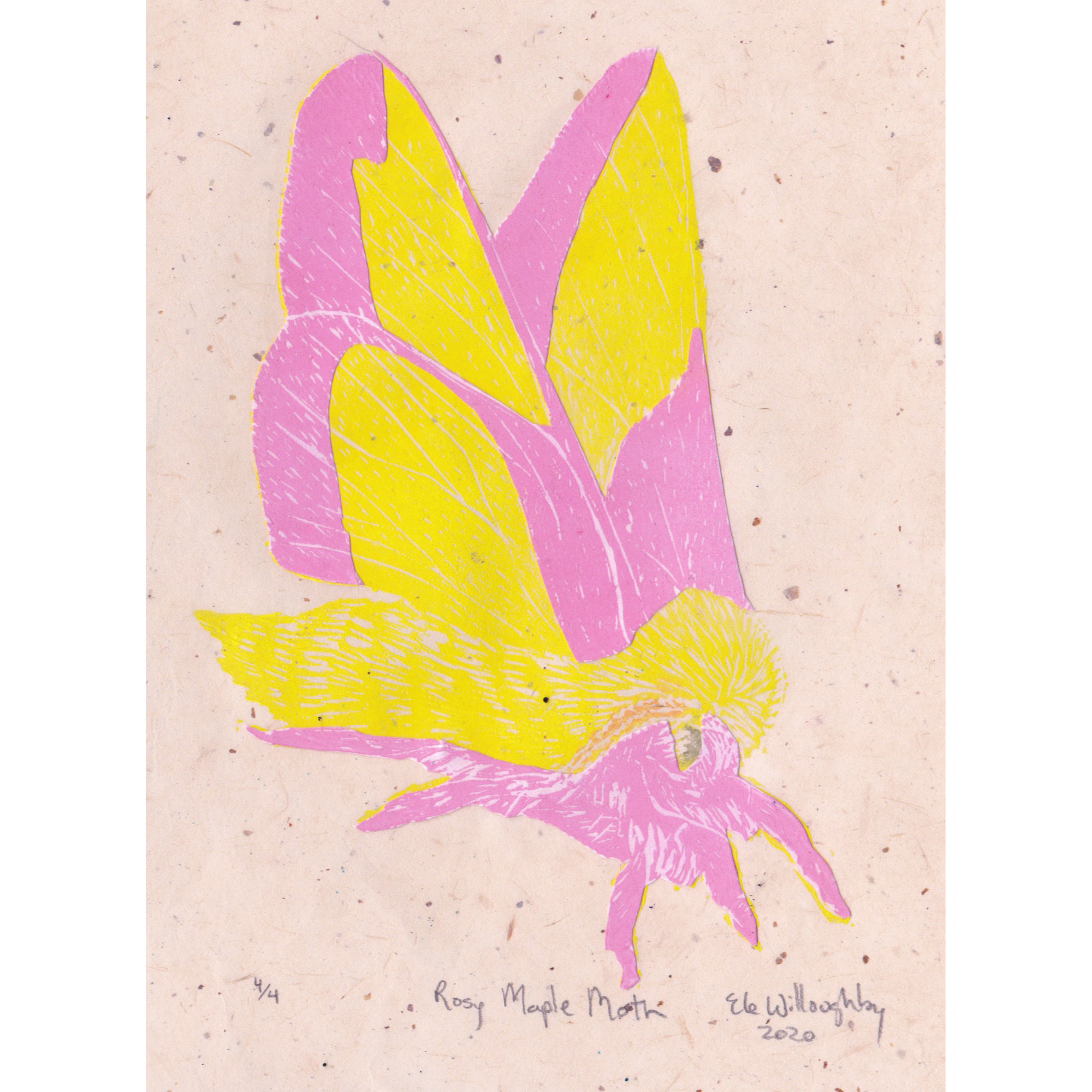
Rosy Maple Moth linocut by Ele Willoughby


Occam's Razor linocut by Ele Willoughby

That last one probably needs some explantions. This print "Occam's Razor" is about the Law of Economy or Parsimony postulated by Scholastic philosopher William of Ockham (1287–1347), "pluralitas non est ponenda sine necessitate" or entities should not be needlessly multiplied. More simply this law, or really, rule of thumb is that the simplest explanation is usually right. The print should Ockham himself, inspired by an image of him from a stained glass window in Surrey, the proverbial razor and many unlikely things (aliens, ghosts, cryptozoological creatures) it would cut away.

 This is my most recent "Imaginary Friend" of science, along with demons (Maxwell's, Descartes' and Laplace's), Schroedinger's cat, and the Spherical Cow. If you have another charismatic thought-experiment/imaginary friend of science to suggest, please let me know!

Monday, July 6, 2020

Gladys West, mathematician and geodesist who found the Earth's shape for GPS

Gladys West, linocut, 11" x 14" by Ele Willoughby, 2020


Geodesy is the study of the shape of the Earth. The Earth isn’t a ball so much as an oblate spheroid- that means it’s a bit of a flattened oval in cross-section. Further there are bumps and divots, deviations from the reference ellipsoid. Measuring these deviations teaches us about our Earth and oceans, and the orbital dynamics of satellites. This mathematician and geodesist only started to get the recognition she deserves in recent years for the role she played in various satellite programs, including most famously the Global Positioning System (GPS).  

Gladys Mae West (née Brown) was born in 1930 in in Sutherland, Dinwiddie County, in rural Virginia. Her family were farmers in a community of share-croppers; her mother also worked at a tobacco company and her father also worked for the railroad. She decided early on that she needed an education if she didn't want to work in a factory or in the cotton, corn or tobacco fields. She secured a scholarship to Virginia State University, a HBPU (Historically Black Public University) as her high school class valedictorian. A great all-around student, she was unsure what subject to pursue but was encouraged to major in science and math since fewer people had the aptitude to tackle them. She choose the male-dominated field of mathematics, and joined the Alpha Kappa Alpha sorority. She graduated with a Bachelor of Science in Mathematics in 1952 and taught math and science for two years before returning to complete her Masters in Mathematics at VSU in 1955. She taught again briefly before starting her career at the Naval Proving Ground in Dahlgren, Virginia (now the Naval Surface Warfare Center) in the US in 1956. There were only 3 other Black people there, one woman and two men, and she says felt the pressure to always do everything right and set an example. She was hired as a computer programmer in the Naval Surface Warfare Center Dahlgren Division and a project manager for satellite data-processing systems. All the while, she earned a second Master's in public administration from the University of Oklahoma.

She fell in love with one of her two male, Black mathematician colleagues, Ira West. They married, had three children (and now seven grandchildren) and have been together for over 60 years.

In the 1960s, she participated in an award winning study which  proved the regularity of Pluto’s motion relative to Neptune. She then began using satellite altimeter data to model the Earth's shape, particularly the oceans. Her hard work paid off, when her department head recommended her for a commendation 1979 and she became the project manager for the Seasat radar altimetry project, the first remote sensing satellite for the oceans. From the mid 70s through the 80s West developed complex algorithms for an IBM 7030 “Stretch” computer in order to model distortions in the Earth's shape due to gravitational, tidal and other forces. Her calculations produced an extremely accurate geodetic Earth model, or geoid, optimized to determine the sallite orbits of what we now know as the Global Positioning System. She thus played a pivotal role in the development of technology which is so central to our lives, as GPS is embedded in industry, navigation, telecommunications and applications which exceed anything the US Navy could ever have imagined.

In 1986, West also published Data Processing System Specifications for the Geosat Satellite Radar Altimeter, a 51-page technical report for the Naval Surface Weapons Center (NSWC), a guide to increase the accuracy of the estimation of geoid heights and vertical deflection, based on Geosat radio altimetry data.

My portrait features three of the satellites central to her carreer: Seasat, a GPS satellite and GEOS-3, as well as the satellite paths for Geosat based on her own publications.

After 42 years, she retired 1998. She and Ira travelled, but she decided to return to academia and pursue a doctorate. She suffered a stroke which impacted her hearing, vision, balance and mobility, but despite this, she persisted and completed a PhD in Public Administration from Virginia Tech in 2018 at age 88!

Her acheivements only started to receive recognition when a sorority sister from Alpha Kappa Alpha read the brief bio she submitted for an alumni function and pointed out to her that she was a "Hidden Figure" of GPS. Her story started to be covered in the press. She was officially recognised by the Virginia Senate and she was inducted into the United States Air Force Hall of Fame in 2018, one of the highest honors bestowed by Air Force Space Command (AFSPC).

Edited January 19, 2026: Gladys West died January 17, 2026 at age 95, surrounded by her family.

References

Amelia Butterly, '100 Women: Gladys West - the 'hidden figure' of GPS,' BBC.com, May 20, 2018

Air Force Space Command Public Affairs, 'Mathematician inducted into Space and Missiles Pioneers Hall of Fame,' December 07, 2018
 
Cathy Dyson, 'Gladys West's work on GPS 'would impact the world,' January 19, 2018,
The Free Lance Star, Fredericksburg.com

Gladys West, wikipedia, accessed July 6, 2020 

West, Gladys B. (June 1986). "Data Processing System Specifications for the Geosat Satellite Radar Altimeter" (PDF). Naval Surface Weapons Center, Report NSWC TR 86-149.

Friday, July 3, 2020

Delicacies in the Garden of Plenty Album Cover & Second Harvest Fundraiser

My digital collage of linocuts for the album artwork for 'Delicacies in the Garden of Plenty'

My friend Sarah Peebles asked me about making this album and I decided to donate my artwork since this is a fundraiser for Second Harvest, Canada’s largest food rescue charity. The pandemic has hit food banks very hard and I wanted to help. Today is the day to check out the music by Sarah Peebles, Kyle Brenders and Nilan Perara and pay what you can to contribute, because on Friday, July 3 (in fact, the first Friday of each month), Bandcamp is waiving its revenue share for all sales, from midnight to midnight PDT on each day. Check isitbandcampfriday.com for timezone demystification. ⠀

Free/PWYC On Bandcamp now via Second Harvest⠀
“Artists & Second Harvest have come together to support Canadians impacted by COVID-19! “ Delicacies in the Garden of Plenty” (Peebles, Brenders, Perera) is a new album supporting Second Harvest, Canada’s largest food rescue charity with a dual mission of environmental protection and hunger relief. Creative music & sound art with gorgeous cover art! Listen to these beautiful tracks and Donate what you can at : https://secondharvestca.bandcamp.com/releases. All proceeds go straight to Second Harvest. " #BandAgainstHunger

Cover: lino-cut collage by Ele Willoughby / @the.minouette

Thursday, July 2, 2020

Death by Shakespeare Illustrations

My linocut chapter illustration for Chapter 1 of Death by Shakespeare’ by Kathryn Harkup
In early March, like everyone else I guess, my attention was taken by current events and the impending pandemic. Sure enough, once schools closed as the lock-down set in, I found I had little time and less energy. Blogging is one of the things I neglected. I managed to keep posting art to Instagram and made a point to post women in science daily for Women's History Month, trying to avoid the all-too-common physicist's mistake of playing arm-chair epidemiologist (and assuming if you've mastered numerical modelling that you know what to do) or since I share a lot of science communication, I wanted to avoid talking about Covid-19, because I have no pertinent expertise (being a scientist doesn't qualify you to talk about all subjects and this one in particular needed I think, fewer self-appointed experts muddying the waters). Also, since "doomscrolling" is now a recognized fixation of people, I wanted to break up people's mounting tension with art. So I have been sharing a lot of art and making art when not amateur homeschooling our son... but not much else. Today, I'm playing catch up.
My linocut chapter illustration for Chapters 2, 3 and 4 of Death by Shakespeare’ by Kathryn Harkup


I neglected to share this here, though I am excited to be able to share. Last fall I made the chapter illustrations for ‘Death by Shakespeare’ by Kathryn Harkup! I just got my copies in the mail right before the lock-down. Such a fun project researching, planning and carving linocut chapter headings for 11 chapters about how Shakespeare offed his characters (see handy pie chart here). The illustrations are supposed to be reminiscent of the engravings you would see in old books, and set the scene for each chapter. I made the linocuts at 4 times the scale that they appear to get the details I wanted. I spent October reading about Shakespeare, his plays and life, poisons, weapons, Renaissance medicine and various awful corporal and capital punishment techniques. And the language of flowers.


My linocut chapter illustration for Chapters 5, 6 and 7 of Death by Shakespeare’ by Kathryn Harkup

The first chapter was fairly straightforward, about the bard himself. So in conversation with author and publisher I choose plume, inkwell, drama masks and the spear from Shakespeare’s coat of arms.
The 2nd chapter is about Shakespeare’s world. Since he wrote “all the world’s a stage” and literally named his theatre The Globe, I thought of illustrating the Globe and its neighbourhood. The 3rd chapter is about medicine and what could be treated in Shakepear's day. My first thought was William Harvey who discovered the circulation of blood in Shakespeare’s day, but we opted for some more general images of contemporary medicine (rather than referencing specific experiments of Harvey which aren’t mentioned in the text). The urology flask was used as a sign for a doctor, as testing urine was a vital diagnostic tool. I was able to find a lot of reference prints for Renaissance surgical tools. Medicinal plants included the poppy and mandrake root - a fun thing to research! In the centre is a specific allusion to Shakespeare’s ‘Pericles’ where a medical chest was thrown overboard. I researched antique medical chests and first imagined it viewed through a round porthole window. Then I decided I had better check if 16th century vessels had round porthole windows and wasn’t able to find any hard evidence that they did. So I went for some nautical looking rope to frame that part of the image instead to avoid any anachronism.⠀

My linocut chapter illustration for Chapters 8, 9 and 10 of Death by Shakespeare’ by Kathryn Harkup
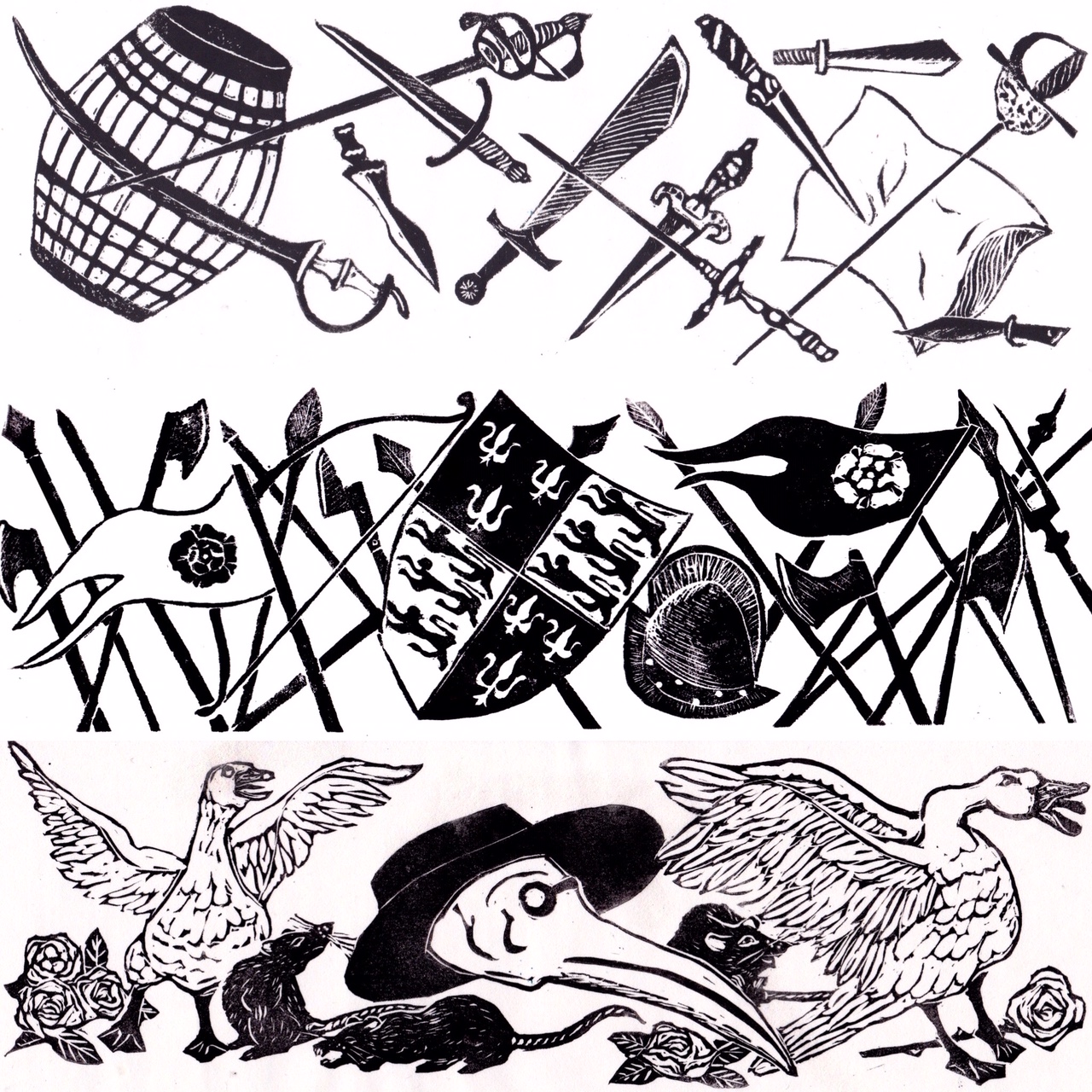
Chapter 4 was a little grim for me, to be honest, spending a few days thinking about execution. This print includes heads on spikes, noose, executioner’s mask, block and axe, as well as a Gibbet. If you aren’t familiar, don’t look them up. There’s a lot of murder in Shakespeare and most of them, in fact most deaths in the plays, are stabbings. So for Chapter 5 I researched Renaissance weapons, knives, swords and daggers. We’ve also got Clarence in the butt of malmsey and Desdemona with the pillow. A butt is a specific type of barrel or even a unit of volume of the time and I now know a bunch of barrel and cask facts! Chapter 6 is the “dogs of war.” When I was younger I read all the history plays and I have a great illustrated collection of the plays. They cover centuries of history so there were variations in arms and armour over that time but the majority of stories of war in Shakespeare are about England and the War of the Roses, so I wanted to include the lions and fleur de lys shield and the white and red roses of Lancaster and York. The phrase “the dogs of war” made me think of an inexorable march so I wanted spears, pikes, halberds and pennants to suggest advancing armies. Chapter 7 is “A Plague O’both Your Houses” about disease. The plague itself and a plague doctor’s mask were clearly needed! Rats, suspected plague carriers also make an appearance. I looked into the history of plague doctor masks which varied in different times and places. The other imagery is more subtle: roses are geese were associated with syphillis! I keep thinking about the Untitled Goose Game and giggling to myself. I wanted the geese to be aggressive looking.⠀The plague mask feels more topical now than I could ever imagine.

Poison was my favourite chapter to illustrate for ‘Death by Shakespeare’ - bottles, pots, and vials of fluids and powder. Renaissance apothecary jars are delightfully imperfect. Cleopatra’s venomous asp also makes an appearance as well as poisonous plants and mushroom known and used at the time: aconite, hellbane, deadly nightshade, yew and fly agaric. Chapter 9 is about Shakespeare’s characters who take their own lives, so we wanted to treat this sensitively and symbolically, so we have Ophelia’s flowers. There is a long tradition of the language of flowers and Ophelia herself specifies what several mean. She mentions rosemary, pansies, fennel, violets, columbines and daisies.⠀Chapter 10 is about the effects grief and broken-heartedness . A conceptual chapter is a bit less obvious but what came to mind was memento mori, symbolic reminders of our mortality which have long played a part of art history. The symbolism runs deep, but I tried to incorporate and stick to symbols common in Shakespeare’s day. The skull is common of course- and famously used precisely as a reminder of our mortality in Hamlet. The hourglass and candle (which could be snuffed out) represent our finite lifetimes. The live flowers contrast with the skull but wilting flowers again suggest our lives are finite. Butterflies are also common and can be a symbol of the soul. I enjoyed carving this one.

My linocut chapter illustration for Chapter 11, how it appeared in the book and the cover (cover art not by me) of Death by Shakespeare’ by Kathryn Harkup

The strange misfit Shakespearean deaths chapter includes “Exit, pursued by a bear,” baked in a pie, an ounce of flesh, lightening and um, severed hands. I worried about getting the bear species right. There are a lot of poorly identified bears on the internet, let me tell you. ⠀
This is the first time I have done all the illustrations for a book, something I've long wanted to do and it was a real treat to have a fascinating and rich topic like this.

Tuesday, March 3, 2020

Loons and Snowy Owls, wildlife in black and white


The loon, linocut on Japanese paper, 9.5" x 12", by Ele Willoughby 2020

Between getting pneumonia and the school strikes, I feel like I've not had as much time as I would like so far in 2020 and I am behind where I would like to be. On the other hand I have several projects on the go! I have plans to make art with more varied media this year. I'm starting with some textiles but also working on some more 3D works and more electronics. Got some collaborations in the works too. I'm starting with some black and white animals and exploring how to combine different black and white prints.

Snowy Owl, linocut on Japanese paper, 11" x 14" by Ele Willoughby 2020

The black and white animals will do double duty on my quilt in progress. I thought I would try something (moreorless) monochromatic. I'm learning that black and white can be busier than the most colourful piece I've made and that combining these patterns is new challenge.


Thursday, January 16, 2020

Finding our predecessors as women in STEM, Pitfalls and Mistaken Identity of Merit Ptah

Merit Ptah, Chief Physician, linocut by Ele Willoughby, 11" x 14", 2018
An astronomy professor of mine memorably told our class that Tycho Brahe lost his nose in a dwell over a "woman of ill repute" - while colourful, this isn't true. The aristocrat Brahe was not supposed to marry a commoner, but he did, and she, like his sister, was involved in his scientific enterprise and does not deserve to be remembered vaguely and inaccurately as a "woman of ill repute".

Being a woman on the Internet, sometimes I receive none-too-polite "corrections" to history of science I present. Once I posted on Twitter about Marie Tharp and how she found the Mid-Atlantic ridge. I got a blunt reply from a professor of crystallography that this knowledge predates her by centuries. He was wrong. He was confusing knowledge of the rise (the geographic feature indeed known in broad strokes for centuries) with knowledge of the ridge (which is a geophysical feature where we now know new crust is born) which helped usher in the plate tectonics revolution in the latter part of the twentieth century. The fact that my doctorate in marine geophysics is a lot closer in subject matter than his did not protect me from being chastised, publicly, and wrongly. But, I am keenly aware that scientists themselves are not always the most accurate re-tellers of the history of science, and that we can fall into the pitfalls of repeating misinformation provided by fellow scientists. Sometimes, we can't resist a good story.

I was once told one of my scientist portraits was "an insult" because, though I had used several references, my anonymous critic has correctly inferred I had included a portrait of the subject's sister-in-law (which can be commonly found online, mislabelled as the scientist herself). While dismayed, I don't think this strident critic was reasonable or communicating productively. I used the incorrectly labelled portrait mainly as a reference for her clothing, so I think my error is regretable but not historically misleading. Sadly this critic's antagonism is all too common online.

In complete contrast, I'm quite impressed at the kindness and consideration of a recent message I received from medical historian Jakub Kwiecinski who has been researching Merit Ptah, reputedly the earliest recorded woman in medicine and subject of one of my portraits. He wrote me to say though he's a fan of my portrait (and has bought two), he's quite certain she didn't exist! He generously assumed I suspected as much. To be honest, I did not, but as I wrote about her here I was clear that information about her online was surprisingly thin, repetitive and often inaccurate. I had seen that the same information was repeated again and again, without ever seeming to find anything independent. I had also noted that there were no credible images of her, which seemed weird since there was allegedly an inscription about her made by her son. I also noted the existence of other documented near-contemporary ancient Egyptian doctors. I hadn't concluded that in fact this self-referential nest of authors citing each other was all perpetuating an untrue story. He included his article on the subject, where he carefully traces all information about her back to a single source from almost a century ago. He explains why it appeared that there were independent sources and gives a very credible explanation how the author who introduced her, Canadian feminist medical doctor Kate Campbell Hurd-Mead, likely made an innocent error, misinterpreting a report and conflating two people. The healer and Overseer of Healer Woman that did exist was  Peseshet (5th Dynasty, 2465-2323, later than supposed for Merit Ptah). Since the name, tomb location and date were confused with someone a bit earlier, that gave "Merit Ptah" priority. Kwiecinski's article is one half detective story, showing how all online sources and even published popular histories are interconnected and link back to Hurd-Mead and how she likely misinterpreted a report about Peseshet. The second half is a study of the role of popular histories, and how "Merit Ptah" became a feminist hero. While pointing out the dangers of secondary sources, and how amateur historians or scientists seeking female predecessors in their fields have different interests than historians (none of whom had written about Merit Ptah) the article doesn't chastise those who did write about Merit Ptah. Instead, it documents how the supposed existence of this doctor, has been very important to contemporary women in science and medicine. I, and this blog, actually make a cameo appearance in his article. As mentioned in footnote 87, my post was apparently the only one he found which cast doubt on Merit Ptah, pointing out that online images that purport to be her are clearly mislabelled (either men, or another woman who was named Merit Ptah who lived a full millennium later).  I'm tickled to have been cited in this scholarly publication for actually looking at online images and information with a critical eye!

The article 'Merit Ptah, “The First Woman Physician”: Crafting of a Feminist History with an Ancient Egyptian Setting' in the Journal of the History of Medicine and Allied Sciences is paywalled though the abstract is here. But the story has been picked up by the press, for instance this National Post article where Kwiecinski argues, “She is a very real symbol of the 20th-century feministic struggle to write women back into the history books, and to open medicine and STEM to women.”

So now, I have to figure out what to do with my portrait. As a print, I think it works. But, I don't want to perpetuate misconceptions. I could reimagine her as a symbol of legendary predecessors, of the feminist drive to point out that women did play a role in many historical endeavours, including science, though they have been left out of the story, rather than a portrait of an actual documented individual. I could also revise the print, change the hieroglyphics and making my Old Kingdom female doctor into Peseshet. Interestingly, I was able to find the actual inscription about Peseshet online. What to do when your historical portrait turns out to be of an imaginary person is an interesting problem. I think I might do both. I will continue to make the remaining Merit Ptah prints available, with a new description and I may also carve a new ancient Egyptian incription and print a second print with my doctor with real text which was written about a real woman Peseshet. What would you do?

Depiction of the Stela of the lady Peseshet from John F. Nunn, Acient Egyptian Medicine,
University of Oklahoma Press, 2002