Tuesday, September 22, 2015

Storms and coffee, raccoons and books

Oh, poor neglected blog! I'm sorry I've been so busy. I spent much of August travelling through New England and the Maritime provinces and I'd love to share some photos (as soon as I have some more time and can get them from my husband's computer, where we dumped the data while on the road). After that, it's been non-stop Etsy: Made in Canada planning! We've been working on it since January and now it's practically here. Please do come out and see the show this Saturday, September 26th, 10 am to 6 pm, at the MaRS Centre Atrium at Collge and University if you're in Toronto. If you're not, you can find 33 other shows at cities across the country.

Keeling and the Keeling Curve I've even failed to mention other shows. My portrait of Charles Keeling was in Art.Science.Gallery's show about climate change, 'From the Mountains To the Sea'.

I have a coffee-themed linocut which will be exhibited as part of the Coffee Art Project at The New York Coffee Festival from September 25th – 27th 2015. The Coffee Art Project is a competition and sale, with proceeds going to Project Waterfall which brings clean water to coffee growing regions in the developping world. (If you're in NYC and want free tickets, drop me a line. I can't use mine.)

Last weekend, I participated in my first outdoor show, the DECAF show in East Lynn Park (bit of a coffee theme here...). Saturday was, frankly, terrifying. RJH encounted some difficulty as the advance party, sent to set up my borrowed 10' tent


(thanks to some unsolicited but well-intentioned "help" we ended up with a broken frame).  I was managing okay with our jerry-rigged set-up until after lunch, when the light rain turned to violent, gusting wind and a sudden storm. It was the sort of weather where all sane people go inside. I was there by myself and called RJH for help. I didn't even have proper walls; we had suspended tarps. We ended up with the two of us holding the tent down, so it didn't fly away with the baby in the stroller in the middle of the tent to stay dry and safe. When the rain let up a little, I ran home with the baby and called my mother for help. She was able to babysit, so I could return... but by that point everyone was closing for the day and all I could do was mop up the mess. While I had to go through all of my prints and dry them off, damage was minimal because they are sealed in plastic envelops. It was just nerve-wracking. My friend Queenie said it was her first and last outdoor show. Maybe the risk of weather just isn't worth it for those of us who make paper goods. Luckily, the Sunday was beautiful. RJH re-jigged the tent with new and more thorough tarps. Hilariously, I had a raccoon visitor in my tent, presumably there to check out my raccoon high five prints.

After Etsy: Made in Canada I have one more thing to do before I can relax, and take a break. Next Monday, Elizabeth Gilbert (author of Eat, Pray, Love) will be in Toronto at the Elizabeth Bader Theatre to discuss her highly-anticipated new book, Big Magic: Creative Living Beyond Fear. I'm going to be there as part of the Toronto Etsy Street Team pop-up market before and after the event! Penguin Random House Canada sent me an advance copy and it's really great. I enjoyed it much more than I imagined I would. I'm always a bit dubious of the bestsellers or blockbusters, because sometimes wildly popular means less than challenging, or middle-of-the-road and I haven't read Eat, Pray, Love. I also didn't think I needed a pep talk about welcoming creativity, but I think now that even those of us driven to create can learn to be more gentle with ourselves and open to creativity. We're also likely to enjoy thinking about the very concept. Big Magic reads like having a frank, free-wheeling discussion about creativity and what's she's learned about being an artist (both before and after acheiving fame and financial success). It's also a sort of caring, empathetic manifesto for why and how you should do everything to welcome creativity into your life. Her experience with creativity is as a writer, so she writes a lot about writing, though she defines creativity quite broadly and includes examples of everything from ice skating to ecology. I love the idea of celebrating a book about creativity by hosting a hand-made market at the book reading. It promises to be a interesting night. The reading is sold out, I'm afraid... but she's got some great things to say. You can catch some of her take on the creative life today on the Etsy Blog.

Thursday, July 16, 2015

High Five Elle!

High Five Elle
A friend emailed last week and said, "You may already know this but I just saw it in the August issue of Elle Canada :) Just wanted to share with you in case!" I did not know and was very excited! She included a pic from her iPhone so I got a peek... but I've been wanting to scan it and share it.

I walked several kilometers with the baby in the stroller, visiting multiple stores, but every one was still stocking the July issue. Finally, I got a hold of one. It's fabulous. It's in with an article called 'Elle Radar Canadian Special' about the 'next generation of artists, musicians and social-medial stars who are redefining Canadiana cool'. It's on a page with what's hip in Canadian whiskey (apparently), and facing Shad's music picks. It's the beginning of their 'Art & Design' section. So it's the perfect place to direct Canadians to come visit their nearest Etsy: Made in Canada this September 26th. Also, it's amazing to be singled out amongst that talented crew! I like their succinct review, "colourful block prints that are equal parts history lesson and tongue-in-cheek vintage Canadiana."

Tuesday, June 23, 2015

Koi Tattoo

koi tattoo
my brother's koi tattoo inspired by my linocut

My brother got my koi linocut tattooed on his arm! He has several tattoos. The only other print inspired one is 'The Great Wave off Kanagawa" by Hokusai, so I'm in good company. I always think it's a great compliment. I like how the tattoo artist has reinterpreted he image to suit the medium. My mother will not be happy with either of us, but he's a grown up and I'm flattered.


Wednesday, June 17, 2015

The Keeling Curve, Keeling and the atmospheric CO2 trend linocut

Keeling and the Keeling Curve
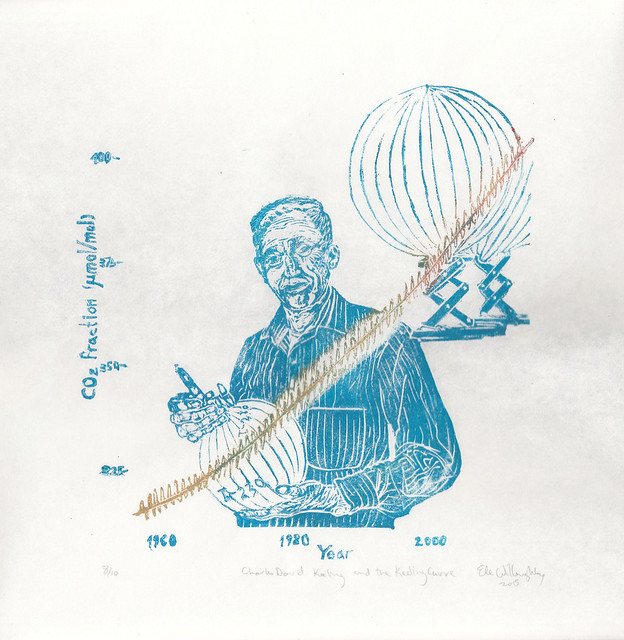
Charles David Keeling and the Keeling Curve, linocut 12" x12", 2015 by Ele Willoughby

Sometimes, I take suggestions for prints subjects, especially the scientists series. This is a portrait of American geochemist Charles David Keeling (1928 - 2005) whose decades long observations of carbon dioxide (CO2) in air samples at the Mauna Loa Observatory were some of the first direct data to show the human contribution to the greenhouse effect and global warming. He was suggested for an upcoming Art.Science.Gallery show about climate change. The 'Keeling Curve' shown in copper and red shows both the seasonal variations (the wiggles) and the strong upward trend with time as CO2, a known greenhouse gas (which traps solar radiation), built up in the atmosphere. It turns out this is topical, not only because climate change is always topical, but this week, the American Chemical Society honoured the Keeling Curve as a National Historic Chemical Landmark at a ceremony at Scripps.

After completing his PhD in chemistry at Northwestern in 1954, he did a postdoc in geochemistry at the California Institute of Technology where he developed the first instrument to measure carbon dioxide in atmospheric samples. He then joined the Scripps Institute of Oceanography at UCSD, where he remained for his career, as a professor of oceanography. He had good timing; 1957 - 1958 marked the International Geophysical Year and he was able to get IGY funding to set up a base 3000 m above sea level at the Mauna Loa Observatory in Hawai'i, where he put his CO2 measuring methods to work. He also gathered similar data series at Big Sur, California and in Antarctica. Prior to his studies, scientists believed that CO2 levels were simply variable, without the sort of clear patterns he observed. Between 1958 to 1960, we was able to show the daily pattern of change due to respiration from local plants and soils as well as the seasonal variations in CO2 levels; by 1961 it was clear there was also a strong upward trend in the 'Keeling Curve' which roughly matched the amounts of CO2 released by our own burning of fossil fuels.

The National Science Foundation cut off his funding, arguing that the results were "routine" though they nonetheless used his data to warn of the risk of global warming. He was forced to abandon his studies in Antarctica, but managed to keep the Mauna Loa experiment going. These measurements at Mauna Loa continue to this day and are the longest continuous record of atmospheric CO2. They show a rise of 315 parts per million by volume (ppmv) in 1958 to 401 ppmv as of April 2014 and this increase has been accelerating in recent years with serious implications for climate change.

Due to the seriousness of these data, the National Oceanic and Atmospheric Administration (NOAA) lanunched their own worldwide CO2 monitoring program in the 1970s, including at Mauna Loa, alongside the Scripps experiment. After CD Keeling's death in 2005, the Scripps measuring experiment was taken over by his son, Ralph Keeling, professor of geochemistry.

Keeling received many accolades during his lifetime. In 1986, he was elected a fellow of the American Academy of Arts and Sciences and a member of the National Academy of Sciences in 1994. In 2002 Keeling was awarded the National Medal of Science, the highest award for lifetime achievements in science granted by the US. He received the Tyler Prize for Environmental Achievement for his data collection and interpretation in 2005.

Tuesday, June 16, 2015

Thanks for all the hearts!

I like to take a moment to thank people who leave ♥s every time I reach a milestone. It's quite incredible to me: things from secret minouette places has surpassed 2800 hearts! Thank you very much to the 2812 minouette shop favoriters, 985 Etsy followers, 667 FB fanpage likers, 1391 twitter followers, 3956 pinterest followers, 205 instagram followers, and each of you who read this blog or magpie&whiskeyjack!

I remember reading, years ago, on kozyndan's old blog, that they felt that once you reached a thousand fans - people who would appreciate and purchase your artwork - that you could make a reliable living as an artist. I don't know what the true ratio of ♥s to fans who collect your work might be. Maybe half of the ♥s are people who just want to tell you that they like your style, and want to bookmark your shop, though they never purchase anything. That's still cool and much appreciated! Maybe it's more than half. But once you start to see numbers in the thousands, I think that means you've gotten to the right order of magnitude! Maybe you're only one tenth of the way there, but it's not a hundredth and it might be only a half or closer. Thank you thank you thank you.

Sunday, May 31, 2015

Bee Homes - linocut bees interactive audiovisual multimedia piece

For a long time, I've had some version of this in my head. This week I finally managed to complete my multi-bee interactive audiovisual multimedia piece... just in time for the Bees (& the Birds) show at Graven Feather. You may recall that a few years ago, I made a linocut bee in electrically conductive in (specifically Bare Paint, which I mixed with some block printing extender to get a better viscosity for making a linocut). I combined this with an Arduino microcontroller so the bee itself could act as a capacitative sensor. In simplest terms a capacitor is made of two electrically conductive - usually metal - plates with a gap between them. The gap can be nothing but air, or a variety of electrolytes.  If there was a wire between the plates, charge would flow freely. Because of the gap, charge builds up on one plate a dissipates at a certain rate to the other. The rate at which this happens depends on the capacitance, which in turn depends on things like the physical properties of the plates, electrolyte and the size of the gap. So, a capacitative sensor takes advantage of the latter to sense proximity, or, measure capacitance to tell you the gap between two "plates". In my case the "plates" are bees printed in electrically conductive paint and my hand. This is the principle behind the theremin (though, they are of course, a great deal more sophisticated, but the idea is the same)*. Here's an example of an earlier prototype from 2012:
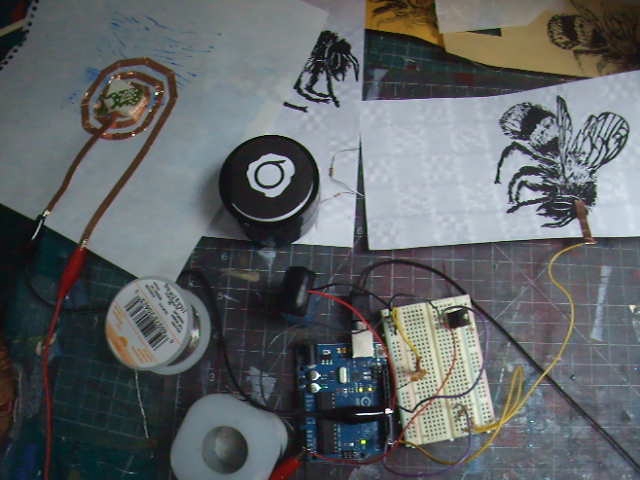
buzzing bumblebee print prototype

So, I can use my linocut on paper connected to an Arduino microcontroller as a sensor, and use the Arduino then to trigger a audio response when someone approaches the linocut. A very simple speaker can be made from a current-carrying wire in a spiral, affixed to a membrane, next to a strong magnet.** So, above I made a speaker with a piece of paper, copper tape as wire and a magnet. The next step was to carve a spiral lino block and block print a speaker on paper with electrically conductive paint, which I did. Thus an actual print, a sheet of paper, becomes both sensor and speaker. I had planned to then make a piece which had multiple bees as multiple sensors which would trigger different reponses. I created the artwork in time for my show about bees in 2013.
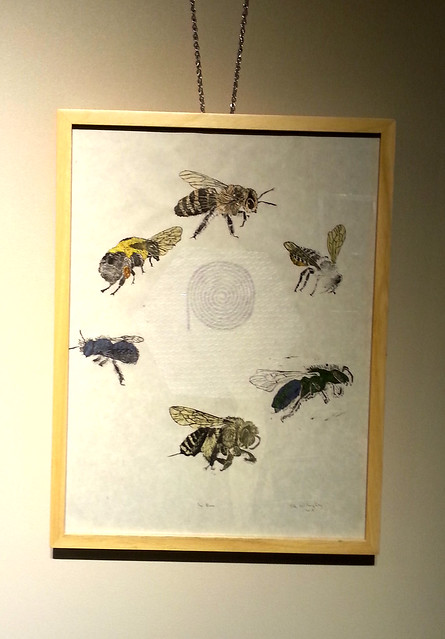
TheBees
The Bees, Ele Willoughby, linocut on various Japanese washi, 18" x 24", 2013.
I had planned to add sound to this piece, but didn't have the opportunity.

I had two issues. First, my prototype used only an Arduino. I was able to play back sound by keeping the recording length quite short and the sampling rate low. There's only so much on-board RAM. I could make multiple sensors each play the same recording, but I simply ran out of memory using only an Arduino.

Secondly, I got pregnant and chose to put electronics aside for a while. I couldn't find any reliable medical guidance about soldering electronics while pregnant or in the proximity of babies (as if there aren't in fact large numbers of engineers, scientists, artists and hobbiests who are women of child-bearing age, ahem!), but jewellers were warned to avoid lead solder, and I opted to err on the side of caution. Lead and developping nervous systems struck me as a bad combination.

So, now that my son is one and a half, I've had an opportunity to return to the idea. The obvious way to add more sound to a project is the off-the-shelf solution of adding a Wave Shield to the Arduino. This is a second circuit board which plugs into the first to let you control and play files from an SD card to a speaker. (Bare Paint has recently released their own microcontroller, the Touch board based on the Arduino, but specifically with their applications for their paint, such as capacitative sensors, in mind. This might have been an easier way to go... but I had an Arduino, so I chose to add a Wave Shield).
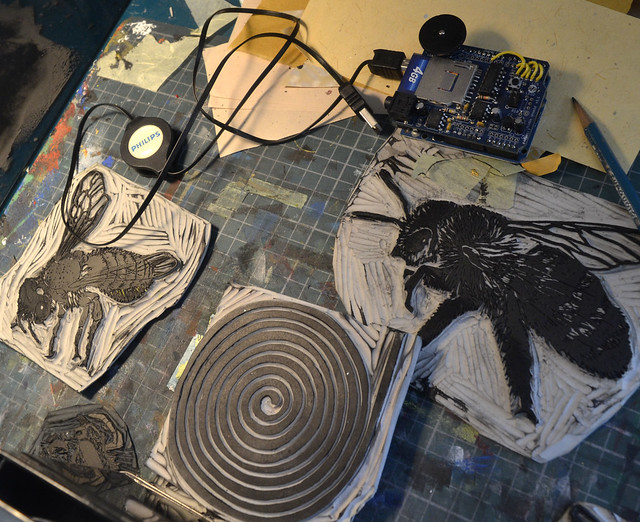
beeblocks
My bee lino blocks and spiral lino speaker block, along with the Arduino and Wave Shield. You can talk to the Arduino via serial port. I combined the open source code wavehc_play6.pde (which plays different 6 audio files when 6 different buttons are pushed) with ArduCapSenseBlinky.ino which employs a collection of capacitative sensors to trigger a collection of LEDs to flash.
beeconductive
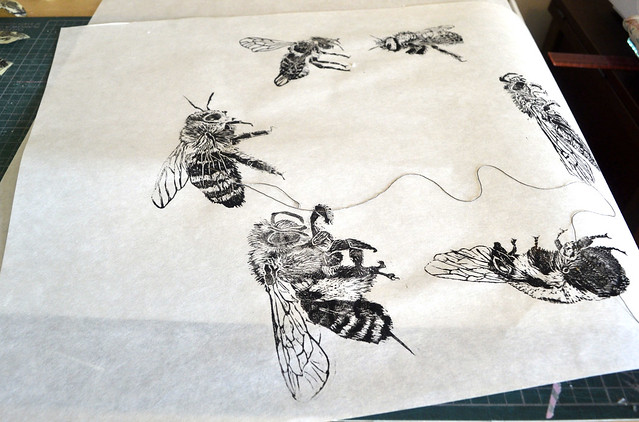
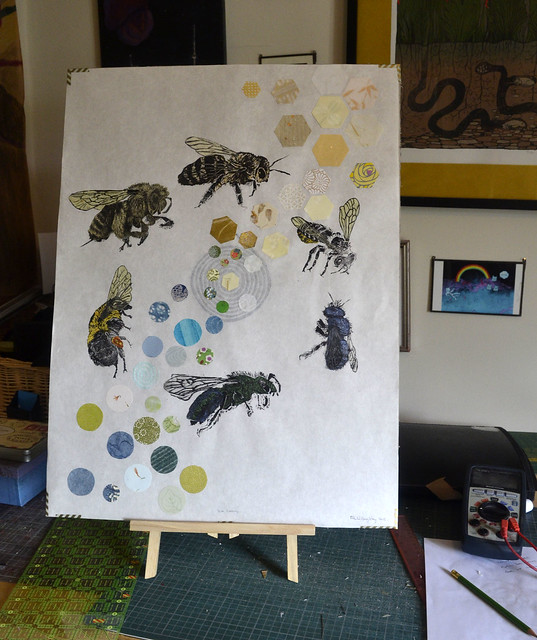
To make an electrical connection from my 6 bees (honeybee, bumblebee, leafcutter bee, long-horned bee, blue orchard mason bee and sweat bee), which I block printed in Bare Paint with block printing extender on Japanese kozo paper, I sewed through the paper with electrically conductive thread. I wanted the speaker, magnet and electronics to be behind the sheet, so I needed to pass through it. 
beeEisel
I also printed each bee block on a variety of Japanese washi papers, to get the colour and texture of the bees and wings. This also hides the stitching/electrical connections. The story I'm telling with the piece is about how bees live here. We all know the honeybee, with its hexagonal cells in its hives, but it's not native to North America. Most of our native bees live in holes and burrows. They also come in a wide range of colours. So the other collaged, handmade papers, represent how the bees live, from the hexagons with the honey bee at the top in yellows, to the circles in blues and greens at the bottom. In this shot you can also see the spiral speaker printed on the reverse. The sheet is on kozo paper which is very strong, but not at all stiff. So I backed it with book board to have something on which to mount the electronics. My trusty multimeter is there so I can check that each bee does have good connectivity through to the digital I/O pin on the Arduino.
beeElectronics
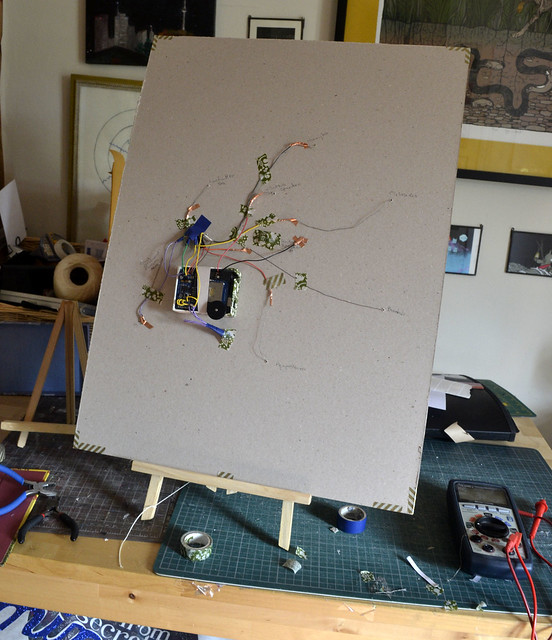
This is what's hiding behind the piece. I affixed a small box to hold the Arduino. There are six DIO pins at the top of the Wave Shield board connected to wires in purple, green, yellow, orange, red and brown. These in turn are connected using copper tape to each of the 6 conductive threads coming from the 6 bees. The threads from either end of the speak spiral are likewise connected to the speaker output and ground.
I made a short recording for each bee. I tried to find audio recordings of each different species. Back in 2012, Sarah Peebles directed me to some of her audio recordings on Reasonating Bodies. I also simply searched YouTube for videos of each type of bee. I combined these (using Audacity... which is pretty awesome freeware for simple sound applications) with my spoken words about the bees and save these as .WAV files which can be played by the Arduino Wave Shield. So I was able to say how though the honeybee might be our idea of the canonical bee, our "default" bee, it is in fact not native to North America, and many of out native bees are quite different; many are solitary, producing neither hives nor honey, and coming in all sorts of colours. You can see and hear my piece at the Graven Feather show the Bees (& the Birds), which runs June 4 through 27. I'll post a video of the piece in action later. You can find each of my bees prints separately here (and learn a little bit about each species too).

*In fact, this is how the gravimeter I used for my doctorate worked too. Picture a mass suspended on a spring such that the spring force upward is balanced by gravity downward. Should the force of gravity change as you move the sensor (due to a large buried mass below, for instance) the mass on a spring will no longer be in equilibrium. The sensor was the most extraordinary, delicate, tiny, spun quartz spring terminated with a tiny piece of quartz coated in gold between capacitative plates. When the mass moved, an electrical restoring force was applied to the plates which returned the sensor to equilibrium. This restoring force could tell you the change in gravity, or, in my case acceleration (since I kept the gravimeter still, it was the seafloor which moved up and down).

**A good source of strong magnets: old hard drives

Wednesday, May 20, 2015

SciArt meet-up

Austin Monthly for October 2014 included my linocut of
Florence Nightingale in their write-up of the 'X Marks the Spot' show
at Art.Science.Gallery
Today I got to meet-up with a group of scientists/artists: Hayley Gillespie (ecologist, artist and founder of Art.Science.Gallery), Peggy Muddles (aka the Vexed Muddler, who works on the genetics of bacteria in lungs of CF patients by day, and amazing SciArt ceramics by night) and Rovena Tey (cancer researcher on mat leave and science-inspired cardmaking genius behind Handmade By Rovena)* and have a tour behind the scenes at the Royal Ontario Museum! The ROM is a rightfully famous museum, which boasts not only a world class archeological (especially Egyptian) collection, but a proper natural history museum, which has always meant that it was a research institution as well as a public museum. One of Hayley's friends from grad school is the curator of freshwater fish, and he was kind enough to give us a tour of the freshwater fish, and mammals and enlist his colleague to show us the invertebrate collection. Sadly, photographs were not allowed for security reasons (as it's best not to publicize the inner workings of a museum which houses some very valuable artifacts).

As token physical scientist, when the conversation turned to finer details of genetics and mapping family trees (if you will) of huge datasets of species, I felt like saying, "Oh! Bayesian regression! I know what that means!" with a little wink. The physical specimen themselves and the tour was fascinating. I could certainly relate to the problems of data archiving and preserving physical specimen, as these are serious problems for earth scientists too (especially the marine ones, as some ocean bottom cores need to be frozen and pressurized to avoid essentially melting or exploding, or both). I wouldn't have guessed that most of the ROM's collection of fishes is housed outside of the city, because that many tens of thousands of alcohol filled jars is deemed too great a fire risk downtown! It really is an incredible feat for these scientists to have even gathered all these species, let alone all the work of detailing and studying them, tracing their evolution, afterwards - and an invaluable resource.

We saw a few thousand sample jars of fishes, as well as some mammals (like bats) which are stored in alcohol. We saw their large collection of mammal pelts, which sort of takes your breathe away. The ROM is a museum of a certain age; at some time in the past they were gifted a large collection of mounted mammal heads (presumably from the estate of a hunter). I saw the head of a black rhino, now on the brink of extinction. It was staggering in size, even compared to the other rhino head. There were more heads of assorted quadrupeds than I knew how to identify.

I was pleased to happen to see a giraffe weevil along with a fabulous, large bronze sculpture of a giraffe weevil, on a plinth in the hallway between offices for scientists. I had only seen photos when I made my linocut. The invertebrates curator was an expert on leeches (which yes, are gathered the hard way... as any Canadian who has portaged a canoe through swampy water will be familiar). There were marvellous and/or scary arthropods including a mantis shrimp the size of my forearm, a roughly metre long South American earthworm, delicate and beautiful shell of a paper nautilus (or argonaut), adorable slipper lobster, and all sorts of other crustaceans... as well and swapped tales of fieldwork and labwork (mis)adventure.

Afterwards we were joined by Hayley's husband Cole (a psychiatrist) for a lovely lunch and discussion about that inspiring intersection of art and science. It was a real treat!

Hayley also brought me a copy of the Austin Monthly from October 2014. They included (part of) my portrait of Florence Nightingale in their write-up of the 'X Marks the Spot' exhibit at Art.Science.Gallery. It's always great to see my artwork in print, but I especially like that they've selected the perhaps unexpected. People will know her name, but as a nursing pioneer, rather than a statistician and data visualization pioneer, but she was both. She also brought me Ada Lovelace bookmarks from the 'Go Ahead and Do It' women in STEM show. Gabriel promptly ate one when I got home.

*We missed Glendon Mellow (aka the Flying Trilobite), scientific illustrator, SciArtist and Scientific American blogger, who couldn't make it.