Showing posts with label folktale. Show all posts

Sunday, November 23, 2025

Folktale Week Illustrations: Dawn - The Firebird and the Maiden of Dawn

The Maiden of Dawn and the Firebird, 11" x 14" linocut print by Ele Willoughby, 2025

I look forward to it every year! It's time for Folktale Week. Hosts post their 7 prompts for artists and/or writers to create illustrations or tell stories on these themes inspired by folktales, folklore, fables, myth and fairytales! There’s always a lot of magic submissions and it’s open to all. Most of the action is on Instagram (see @folktaleweek for more information) but you can find artists and writers sharing on other socials too. I am going to post my new illustrations here. And now the final day, Day 7: Dawn.

Here is The Maiden of the Dawn & the Firebird inspired by Edmund Dulac's retelling of a Russian Fairytale.

A Prince is prophesied to fly away on the Firebird on his 15th birthday & marry the Maiden of the Dawn. So the King imprisons him in a luxurious tower prison & holds an elaborate 15th birthday, without him. 

Frustrated, the Prince escapes by the window to the garden, unobserved by the guards enjoying the festival. At the edge of the garden he found a cave, illuminated by a giant bird. In the crystal pool below he saw an image of a beautiful Princess & fell in love. The bird indicated that he should climb aboard & they flew thousands of miles to a beautiful crystal palace at the Home of Dawn with the beautiful Princess asleep in the garden. The prince alighted & failed to wake the Princess. They returned the next night, to no avail but on the 3rd night she awoke at dawn as the Firebird stopped to pluck & give her a feather before leaving the Prince with her. They fell instantly in love & blissfully wandered the garden together. 

But her evil jealous sister enchanted the Prince & his body fell as if dead. The sorrowful Princess kissed his lips, which trembled & she understood her wicked sister must have enchanted him. In desperation she searched the palace then remembered the feather & used it to call the Firebird & fly far west to a cave. There her sister the witch was singing by her cauldron containing the Prince's heart. The Princess rushed forward, overturning the cauldron; the icy brine splashed the witch, killing her. The Princess grasped the frozen heart to her chest & they flew home. 

As they reached their destination, the Princess realized the heart had melted & was gone! Terrified she rushed onward. The Firebird alighted on the roof & the Prince himself came out to greet them. They embraced & she understood that his heart was back where it belonged in his chest, beating against hers. The Firebird's work was done & he flew away, but returned to circle their garden for their wedding, & brought them a feather each anniversary. They ruled as King & Queen of the People of the Dawn for many years & lived joyfully together.

Friday, November 21, 2025

Folktale Week Illustrations: Charm and East of the Sun, West of the Moon

East of the Sun, West of the Moon, 8" x 10" linocut print by Ele Willoughby

I look forward to it every year! It's time for Folktale Week. Hosts post their 7 prompts for artists and/or writers to create illustrations or tell stories on these themes inspired by folktales, folklore, fables, myth and fairytales! There’s always a lot of magic submissions and it’s open to all. Most of the action is on Instagram (see @folktaleweek for more information) but you can find artists and writers sharing on other socials too. I am going to post my new illustrations here. And now Day 5: Charm.

My 8" x 10" hand-carved and hand-printed lino block print illustration of the beloved fairytale East of the Sun, West of the Moon shows the bewitched polar bear prince holding the charm, a magic silver bell along with his bride with the aurora in the night sky beyond them. Printed in dark blue ink, with fluorescent green northern lights, pink cheeks and silver bell, on lovely, delicate, Japanese paper.

The Norwegian fairytale tells of a bewitched polar bear who persuades a peasant to grant him his youngest and prettiest daughter's hand in marriage, promising riches in return. The kindly bear makes her a magnificent castle, and presents her with a magic silver bell that she can use to summon him. He is able to return to his man form at night, but only appears to his bride after she extinguishes the light, so she never gets to see his original form. Feeling homesick, she asks to visit her family; the bear grants her wish on the condition she never be alone with her mother. Her mother makes persistent attempts to speak with her privately, and when she succeeds and hears her daughter's tale, she assumes the bear must be a troll and tells her daughter to light her candle at night and check.

When the daughter examines her husband she falls in love with the handsome prince asleep in bed whom she accidentally awakes. He explains he has been cursed by his wicked stepmother the witch-queen. Had his wife not seen his true form for a full year the curse would be broken, but now he go to witch-queen's palace which is east of the sun, west of the moon and he must marry the witch's daughter. 

The young wife then goes on a long quest to find and rescue her husband and free him from the curse. It's a wonderful tale of courage, kindness and adventure and she ultimately frees her prince.

Thursday, November 20, 2025

Folktale Week Illustrations: Book - The Master and His Pupil

The Master and His Pupil, 8" x 10" hand-tinted linocut print by Ele Willoughby, 2025


I look forward to it every year! It's time for Folktale Week. Hosts post their 7 prompts for artists and/or writers to create illustrations or tell stories on these themes inspired by folktales, folklore, fables, myth and fairytales! There’s always a lot of magic submissions and it’s open to all. Most of the action is on Instagram (see @folktaleweek for more information) but you can find artists and writers sharing on other socials too. I am going to post my new illustrations here. And now Day 4: Book.

My hand-tinted linocut illustrates the English fairytale ‘The Master and His Pupil.’

A learned man of the north lands who knew all the languages of the world and mysteries of creation, had a big black book with iron lock chained to a table and forbidden to all others which contained the secrets of the spiritual world including details of angels and demons. 

His pupil and servant was a foolish lad, barely allowed into the same room as the book. One day when the master was out the curious pupil snuck into the room keen to investigate the magical and alchemical objects but he got nowhere without knowing the magical words hidden in the book. He noticed the master had forgotten to lock the book and he rushed over to read it! He could understand little but he sounded out the words and the room turned dark and there was a clap of thunder and the demon Beelzebub appears with glowing eyes, breathing fire. “Set me a task!” the demon roared, and threatened to harm him. Frantically the boy looked around and noticed the geranium. “Water yon flower!” he cried.

The demon left and returned with a barrel of water, he poured on the flower. And then he left and returned with more and more barrels, flooding the room. The boy pleaded with him to stop but he didn’t know the right words and the demon gleefully continued till the water rose so high that the boy climbed onto the table. The water continued to rise higher and higher and would have flooded all of Yorkshire had the master not recalled that he had left the book unlocked and he returned home as the water reached the boy’s chin. He spoke the right magic words and banished Beelzebub back to his fiery home!

This story has ancient roots, and can be linked to the Sorcerer's Apprentice, but I chose this version because it focuses on the book.

Folktale Week Illustrations: Rain and the Magpie Bridge

The Magpie Bridge, 11" x 14" linocut by Ele Willoughby

I look forward to it every year! It's time for Folktale Week. Hosts post their 7 prompts for artists and/or writers to create illustrations or tell stories on these themes inspired by folktales, folklore, fables, myth and fairytales! There’s always a lot of magic submissions and it’s open to all. Most of the action is on Instagram (see @folktaleweek for more information) but you can find artists and writers sharing on other socials too. I am going to post my new illustrations here. And now Day 3: Rain.

My hand-carved, hand-printed lino block print of the well-known, ancient Chinese folktale of the magpie bridge linking the lovers, The Weaver Girl and the Cowherd, separated by a great river, which is the Milky Way, is printed on lovely Japanese paper, 11” x 14”.

There are variations of the folktale across Asia, but the story tells of lovers, the Weaver Girl, symbolized by Vega, and the Cowherd, symbolized by Altair, banished to opposite sides of a heavenly great river, symbolized by the Milky Way. Once a year, on the seventh day of the seventh month of the lunar calendar, a flock of magpies make a bridge across the river to reunite the lovers.

The story is the inspiration for the Qiqiao or Qixi Festival, celebrated on the seventh day of the seventh month in China since the Han dynasty, as the Tanabata festival in Japan and the Chilseok festival in Korea.

It is said that if it rains on the day of the festival it means the river has swept away the magpie bridge or that the rain is the tears of the separated couple. 

I had planned a colourful image but sometimes the trick to relief printmaking is knowing when to stop. I took my 11 year old son’s advice and stuck to black and white.

Folktale Week Illustrations: Echo and the Yama orabi

Yama orabi, 8" x 10" linocut by Ele Willoughby, 2025
Yama orabi The Echo, 8" x 10" linocut by Ele Willoughby, 2025

I look forward to it every year! It's time for Folktale Week. Hosts post their 7 prompts for artists and/or writers to create illustrations or tell stories on these themes inspired by folktales, folklore, fables, myth and fairytales! There’s always a lot of magic submissions and it’s open to all. Most of the action is on Instagram (see @folktaleweek for more information) but you can find artists and writers sharing on other socials too. I am going to post my new illustrations here. And now Day 2: Echo.

Seeking less well-known folklore about echoes I found this Japanese echo yōkai. 

This hand-carved and hand-printed lino block print illustrates the mythical Yama orabi (山おらび) or “mountain shouter,” a small, tree-dwelling, birdlike yōkai or spirit who shouts replies, mimicking people’s voices and repeating their words creating an echo. They resemble small birds but have very large heads and sharp, pointy teeth. Any hiker in the mountains who is foolish enough to engage in a shouting match with the Yama orabi will soon die unless they can break the curse by ringing a cracked bell.

Friday, November 24, 2023

My Folklore Week 2023 Illustrations

Once again I took part in Folktale Week this year! There's fabulous and magical illustrations from artists worldwide; check out #FolktaleWeek2023 on Instagram (plus hashtags for each prompt of the form FolktaleWeek + prompt). The prompts this year were: lost, ink, sea, sleep, underground, illusion, and found. I've decided I can interpret "folktale" loosely to include fairytales, legends, myths and folklore.

For lost, I knew I wanted to make the Minotaur in his labyrinth, with the slightest hint of the first person to avoid getting lost: Theseus with his ball of string.

The Minotaur in his Labyrinth, linocut, 9.25" x 12.5" by Ele Willoughby, 2023
The Minotaur in his Labyrinth, linocut, 9.25" x 12.5" by Ele Willoughby, 2023 

Ink was a real challenge! I had a few ideas but in the end, opted for a Japanese yokai, a sort of supernatural spirit called suzuri no tamashii. Specifically it’s a type of yokai called a tsukumogami, a type of spirit which can arise from an object which is used for 100 years, when it comes alive. 

Suzuri no tamashii, linocut, 9.25" x 12.5", by Ele Willoughby, 2023


The story goes that an ink stone was used to copy the same manuscript over and over again for many generations, about the bloody Genpei War (1180-1185). The 'Akama suzuri,' a top-quality inkstone made specially in Shimonoseki City, began to take on aspects of the story itself. It became possessed by a vengeful spirit of an Ise-Heishi warrior who had been defeated at the Battle of Dannoura, where the Minamoto clan brutally wiped out the entire Taira clan. Phantom sounds like fierce battle, waves on the sea or even a voice narrating "Heike monogatari" (The tale of the Heike) could be heard. Waves rippled on the ink and illusory characters and boats from the story, arose from the ink to wreak havoc on the writing.

As many of the slaughtered Taira soldiers became vengeful spirits or onryō when they died, their grudge-curse infects many ink stones which have been used to repeatedly copy their story.

My print shows an ink stone, ink stick, jar of brushes, and the suzuri no tamashii emerging like two mounted samurai warriors crossing a river from The tale of the Heike. 

Zaratan, linocut, 11" x 14", by Ele Willoughby, 2023

I knew what I wanted to do for sea; I've long wanted to illustrate the Zaratan, a mythical giant sea turtle  that looks like a small island! There's a small campfire on the supposed beach, and a sailing ship from the age of exploration nearby. The sunset sky is in vibrant fuchsia, tangerine and purple.

"There is a story that is told in all lands and throughout all history - the story of sailors who go ashore on an unknown island that later sinks and drowns them, for the island is alive. This imaginary beast-island figures in the first voyage of Sindbad and in the sixth canto of Orlando Furioso (Ch'ella sia usa isoletta ci credemo; "We are all cheated by the floating pile, / And idly take the monster for an isle"); on the Irish legend of St. Brendan and in the Greek bestiary of Alexandria; in the Swedish curate Olaf Magnus' History of the Northern Nations (Rome, 1555) and in the passage in Paradise Lost, Book I, in which the prostrate Satan is compared to a great whale "hap'ly slumbering on the Norway foam."

    -Jorge Luis Borges, The Book of Imaginary Beings (El Libro de Los Seres Imaginarios)

Often depicted as a giant turtle, like the Turtle Island origin myth common to many Indigenous peoples of North America, the Zaratan could in fact be any large marine creature, but I love the idea of a giant turtle.

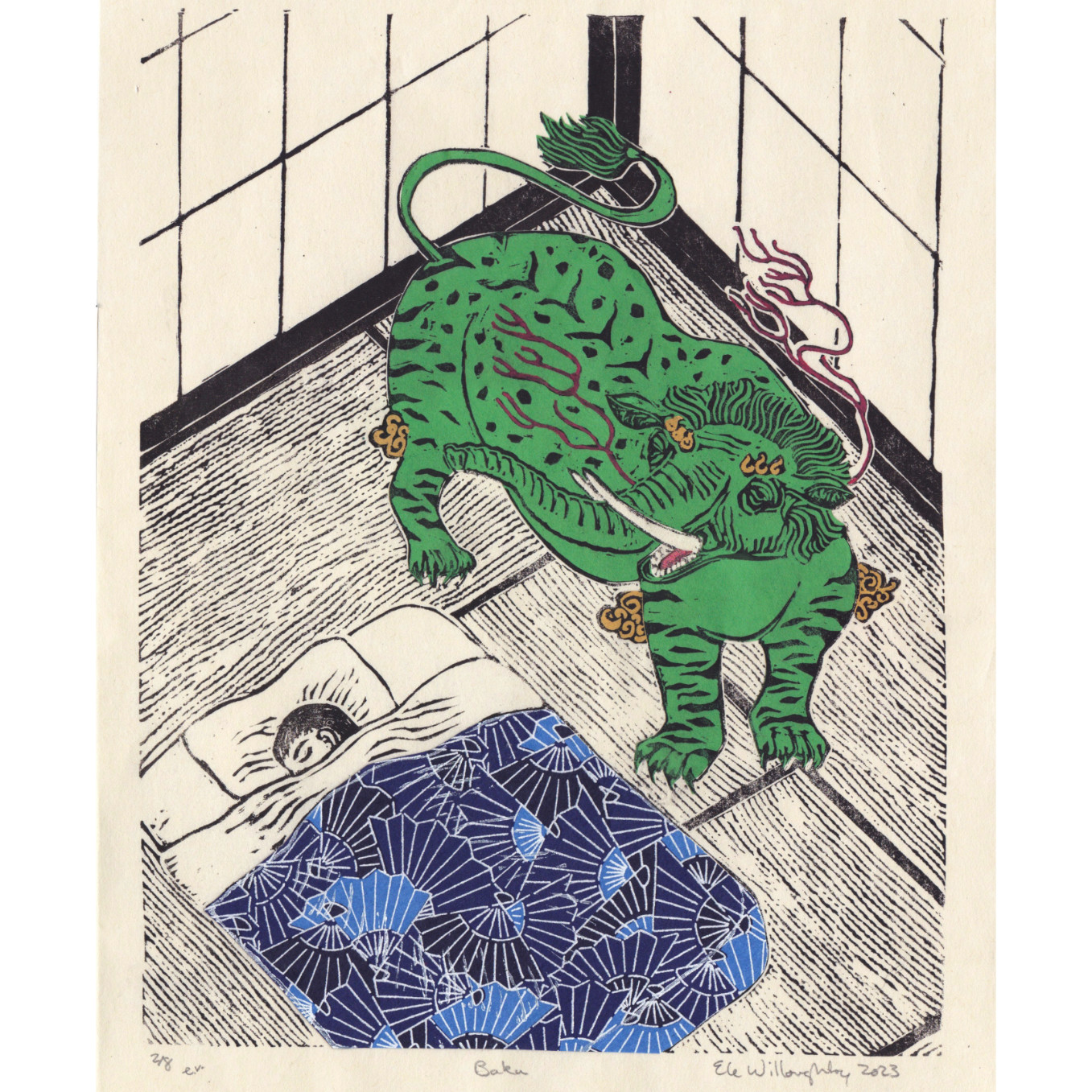
I found another great Japanese yokai for sleep: the Baku. Some stories about sleep are either familiar fairytales or in fact, a bit grim. I like the mythical Japanese chimera because despite its monstrous appearance, it is the beloved eater of nightmares. It was made from leftover parts, with the body of a bear, the claws of a tiger, the tail of a cow, the trunk and tusks of an elephant with the ears and eyes of a rhinoceros! You can call on it if you have bad dreams. A child who awakes from a nightmare will cry, “Baku-san, come eat my dream!” three times and the baku will enter their room to devour the bad dream so they can go back to sleep. They must be careful however, not too call too often, least they get a hungry baku who will also eat their dreams.

Today the word baku can also apply to a real animal, the Malayan tapir, because of its arguable resemblance to the mythical animal.

I thought my blue origami paper would make a great comforter so I made 8 different variations!

Baku, linocut, 9.25" x 12.5" by Ele Willoughby, 2023

The idea I had for underground was the Aos sí, the people of the Sidhe, the Fair Folk of Ireland, who according to legend live beneath mounds in fairy forts underground. I have not yet editioned this print, but I plan to add it to my shop soon! You may know the banshee, or Bean sídhe or woman of the sídhe. In fact the very word Sídhe is the term for earthen mounds like the one in my linocut and the Aos sí are “the people of mounds.” The Sidhe evolved from a mythological people known as the Tuatha De Danaan, powerful, magical semi-divine beings, who feature in many early Irish tales. When the ancestors of the Irish, the Gaels arrived they battled over the Emerald Isle. The way the story was told to me was that neither force could conquer the other and they decided to divide Ireland evenly between them. If you look at Ireland it’s quite an irregular shape and the only way to split it evenly was top and bottom with the Gaels occupying the upper world and the Tuatha De Danaan taking the lower world.

They’re known as the daoine sí or daoine sìth in Scots Gaelic and we get the the idea of fairies from the fair folk, but our inherited Victorian ideas and images of fairies are much gentler, sweeter and cuter than these fierce beings who are benevolent if treated with respect but are known to react cruelly if mistreated. 

The Sidhe, linocut, 11" x 14" by Ele Willoughby, 2023

For illusion, I chose a beautiful French fairytale: La Chatte Blanche, published by Madame d’Aulnoy in 1698.

A king is worried about succession and sends his three sons on quests to determine who will inherit the kingdom (or rather to distract them on that pretence, to avoid being deposed by an impatient prince). First they must find the smallest and most beautiful dog. They each go their own way and the youngest finds a fantastical castle filled with intelligent talking cats. He is quite taken by their beautiful white cat queen who mysteriously wears a locket with a image which looks just like him. He stays a full year and she gives him an acorn for his quest. Returning home he opens the acorn for his father and inside is the tiniest dancing dog. Despite clearly having won the contest, the king starts another: find the finest muslin which can be drawn through the eye of a needle. The princes go out again; the youngest returns to the white cat for another year and she gives him a walnut with nested series of smaller seeds, the tiniest containing magically fine and beautiful muslin. His magical muslin is clearly the winner. The king sets a third task to find the most beautiful princess bride. After a third stay with the cats, the beloved white cat convinces the prince, to his horror, to chop off her head. But when he does the fairy enchantment is broken and she is revealed as a beautiful princess cursed by fairies so that she and those in her kingdom must live as cats unless her forbidden lover’s doppelgänger cuts off her head. It was all an illusion!

She reigned over six kingdoms so after the triple wedding of the three princes, succession is solved as she grants brothers and father each kingdoms to rule and she and her husband the youngest prince rule the remaining three.

La Chatte Blanche, linocut, 9.25" x 12.5", by Ele Willoughby, 2023


I wanted to make sure I included a Canadian folktale this year. So often the folktales we hear are from Europe, but I wanted one from closer to home. I selected the Mermaid of the Magdalenes for the prompt "found." I loved that the found thing as something as prosaic as a tin of sardines, that this is a fairytale about my May Day birthday and about the perils of not preserving marine ecology. I still have to print an edition of this print, but I plan to do so soon.


The Mermaid of the Magdalenes, linocut by Ele Willoughby, 11" x 14", 2023

The rugged east coast Magdalene Islands are all but barren of grass and trees, but the waters are rich in fish and people called it the “Kingdom of Fishes”. Traders could grow rich off the bounty of the sea. Long ago when sardines were first canned they were wildly popular. There was a great slaughter of sardines by greedy traders, who packed them in tiny boxes and shipped them all over the world. The tiny sardines were helpless against the onslaught. They saw their fellow sardines killed and their numbers were dwindling. They cried out for help, calling a meeting of all the fishes. There, they convinced their brethren to stand with them and punish those who fished and ate sardines.

On May Day a ship filled with sardine cans was wrecked on the rocks of the Magdalene Islands, its cargo strewn on shore. The daughter of a fish trader found a tin and was delighted, hoping to eat them. But, she was unable to get the can open sang a song of lament.

“I love sardines when they’re boiled with beans
And mixed with the sands of the sea.
I am dying for some.
Will nobody come and open this box for me?”

A disgusted skate heard her but was too timid to punish her. A merman wanted a land wife but he left her ashore because of his oath to the sardines. Finally the black lobster heard her and remembered his oath. He cunningly offered his help only to trick her and he grasped her with his strong claw and dragged her out to sea.

It’s believed he sold her to the merman. But on the 1st of May you can see her off the coast of the island, her glass in hand, looking longingly at shore as she brushes her hair, each year more and more a fish. The fishermen hear her lonely mournful songs and stay ashore least she drag them out to sea for company. 

 I found this story amongst the Canadian Folktales published by Cyrus MacMillan in 1922.