Showing posts with label Sophie Kovaleskaya. Show all posts

Friday, February 21, 2014

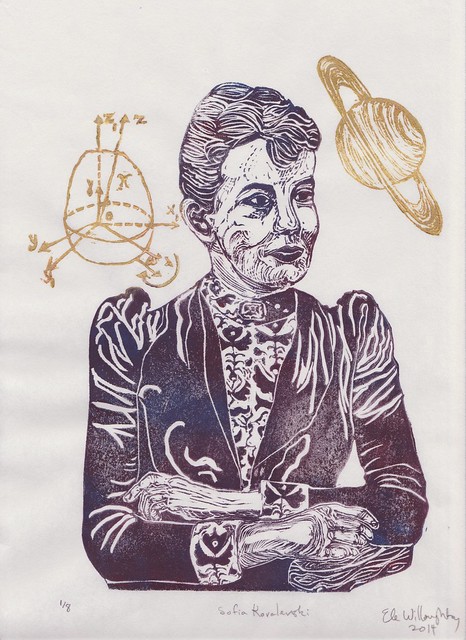
Sofia Kovalevski linocut

Sofia Kovalevski linocut

This linocut portrait is of the great Russian mathematician and writer, Sofia Vasilyevna Kovalevski (1850-1891). The linocut is printed on Japanese kozo paper 9.25" by 12.5" (23.5 cm by 32 cm) in an edition of eight. Also known as Sofie or Sonya, her last name has been transliterated from the Cyrillic Со́фья Васи́льевна Ковале́вска in a variety of ways, including Kovalevskaya and Kowalevski. Sofia's contributions to analysis, differential equations and mechanics include the Cauchy-Kovalevski theorem and the famed Kovalevski top (well, famed in certain circles, no pun intended). She was the first woman appointed to a full professorship in Northern Europe or to serve as editor of a major scientific journal. She is also remembered for her contributions to Russian literature. All of this despite living when Russian women were still barred from attending university. Her accomplishments were tremendous in her short but astonishing life.

Born Sofia Korvin-Krukovskaya, in Moscow, the second of three children, she attributed her early aptitude for calculus to a shortage of wallpaper, which lead her father to have the nursery papered with his old differential and integral analysis notes. Her parents nurtured her early interest in math, and hired her a tutor. The local priest's son introduced her to nihilism. So both her bent for revolutionary politics and passion for math were established early.

Unable to continue her education in Russia, like many of her fellow modern, young women including her sister, she sought a marriage of convenience. Women were both unable to study at university or leave the country without permision of their father or husband. Men sympathetic to their plight would participate in "fictitious marriages" to allow them an opportunity to seek further education abroad. She married the young paleontology student, Vladimir Kovalevsky, later famous for his collaboration with Charles Darwin. They emigrated in 1867, and by 1869 she enrolled in the German University of Heidelburg, where she could at least audit classes with the professors' permission. She studied with such luminaries as Helmholtz, Kirchhoff and Bunsen. She moved to Berlin and studied privately with Weierstrass, as women could not even audit classes there. In 1874, she present three papers, on partial differential equations, on the dynamics of Saturn's rings (as illustrated in my linocut) and on elliptic integrals as a doctoral disertation at the University of of Göttingen. Weierstrass campaigned to allow her to defend her doctorate without usual required lectures and examinations, arguing that each of these papers warranted a doctorate, and she graduated summa cum laude - the first woman in Germany to do so. 

She and her husband counted amongst their friends the great intellectuals of the day including Fyodor Dosteyevsky (who had been engaged to her sister Ann), Thomas Huxley, Charles Darwin, Herbert Spencer, and George Elliot. The sentence "In short, woman was a problem which, since Mr. Brooke's mind felt blank before it, could hardly be less complicated than the revolutions of an irregular solid." from Elliot's Middlemarch, is undoubtedly due to her friendship with Kovaleski. Sofia and Vladimir believed in ideas of utopian socialism and traveled to Paris to help those the injured from the Paris Commune and help rescue Sofia's brother-in-law, Ann's husband Victor Jaclard.

In the 1880s, Sofia and her husband had financial difficulties and a complex relationship. As a woman Sofia was prevented from lecturing in mathematics, even as a volunteer. Vladimir tried working in business and then house building, with Sofia's assistance, to remain solvent. They were unsuccessful and went bankrupt. They reestablished themselves when Vladimir secured a job. Sofia occupied herself helping her neighbours to electrify street lamps. They tried returning to Russia, where their political beliefs interfered with any chance to obtain professorships. They moved on to Germany, where Vladimir's mental health suffered and they were often separated. Then, for several years, they lived a real marriage, rather than one of convenience, and they conceived their daughter Sofia, called Fufa. When Fufa turned one, Sofia entrusted her to her sister so she could return to mathematics, leaving Vladimir behind. By 1883, he faced increasing mood swings and the threat of prosecution for his role in a stock swindle. He took his own life.

Mathematician Gösta Mittag-Leffler, a fellow student of Weierstrass, helped Sofia secure a position as a privat-docent at Stockholm University in Sweden. She developed an intimate "romantic friendship" with his sister, actress, novelist, and playwright Duchess Anne-Charlotte Edgren-Leffler, with whom she collaborated in works of literature, for the remainder of her too short life. In 1884 she was appointed "Professor Extraordinarius" (Professor without Chair) and became the editor of the journal Acta Mathematica. She won the Prix Bordin of the French Academy of Science, for her work on the rotation of irregular solids about a fixed point (as illustrated by the diagram in my linocut) including the discovery of the celebrated "Kovalevsky top". We now know there are only three fully integrable cases of rigid body motion and her solution ranks with those of mathematical luminaries Euler and Lagrange. In 1889, she was promoted to Professor Ordinarius (Professorial Chair holder) becoming the first woman to hold such a position at a northern European university. Though she never secured a Russian professorship, the Russian Academy of Sciences granted her a Chair, after much lobbying and rule-changing on her behalf.

Her writings include the memoir A Russian Childhood, plays written in collaboration with Edgren-Leffler, and the semi-autobiographical novel Nihilist Girl (1890).

Tragically, she died at 41, of influenza during the pandemic. Prizes, lectures and a moon crater have been named in her honour. She appears in film and fiction, including Nobel laureate Alice Munro's beautiful novella 'Too Much Happiness', a title taken from Sofia's own writing about her life. 

Monday, November 14, 2011

Reading is sexy XLVII

(image by Mladen Penev)
Goodness. From reading this blog, you would think that I have given up on the pastime of reading. I haven't posted a thing since August. Usually, I aim for 50 and hit about 40 books in a year. This year, I'm nowhere near that. Though, on the other hand, I've read a couple of epic books, which probably should count for at least three normal books (and in fact, one of them does, in the original Japanese). The trouble though, with not posting promptly, is that it is less fresh in my mind. In fact, I might omit an entire book! Ah well...

17. Too much happiness by Alice Munro. This is an excellent collection of short stories and the titular novella. (It won the 2009 Man Booker International Prize). I sought it out because I am interested in Sophie Kovaleskaya (there are various spellings and means of transliterating from Cyrillic characters, Со́фья Васи́льевна Ковале́вская) the nineteenth century master of mathematics and literature, and first female university professor in Northern Europe. Like the other (fictional) characters in these stories, her real life and marriage was complex, and she sought love in the wrong places. The stories have stayed with me; the people seem real, with faults and virtues, interacting in ways they don't foresee any more than the reader would. Several stories are overshadowed by violence, or the threat thereof. The collection is capped with the novella based on the facts of Kovaleskaya's turbulent life (her nursery wallpapered with her father's old calculus notes, her introduction to nihilism, her initially sham marriage as a means to escape Russia and pursue a higher eduction, her fight to study mathematics and her relationship with her thesis supervisor Karl Weierstrass, her return to Russia, the birth of her daughter, the complexity and end of her marriage, her writing, her life and professorship in Sweden, her lover, her premature death) and her ironic last words, 'Too much happiness.' Beautifully crafted and plotted stories.

18. The Crying of Lot 49 by Thomas Pynchon. I managed to read another Pynchon novel, but this early one is a mere 126 pages. Though, he packs those pages with more life, conspiracy, insanity, radio DJs, dead millionaires, secret codes, illegal underground mail systems, engineer bars complete with Lissajous figures on an oscilloscope for a sign, dive motels, psychiatrists doling out LSD to housewives, skeletons, a teenage band called the Paranoids, clues in bloody Jacobean Revenge Plays, stamp collecting, and one sex scene of more slapstick hilarity than can be imagined without reading the book. Oedipa Maas gets more than she bargained for when she agrees to be the executor of her former lover's estate.

19. Travels in the Scriptorium by Paul Auster. Well, if I can read one book with a complicated relationship to reality as we know it, why not two? Mr. Blank, an old man, awakes each day in a simple room: door, window, bed, desk and chair, but no memory or understanding of where he is or why he's there. He doesn't know if he is being imprisoned or is free to leave. A couple of people visit him, and he is given some clues to understand his fate. This odd, post-modern yet grounded, novel feels like one of the parables of José Saramago. It is a game between the author and the reader and the characters, but it is not only a game. It will be more rewarding if you read the New York Trilogy first.

20. The Woodcut Artist's Handbook by George A. Walker This was a thorough and enjoyable resource on 'everything you wanted to know about relief printing'. I've had it for some time and am glad I finally read it. Though intended to serve as a textbook or reference for printmaking students, it is very readable - especially since it includes a large collection of illustrations of relief prints from many artists, most of whom are also quoted describing their own techniques and preferences.* In terms of woodcut, he focuses on Western methods of engraving and woodblock printing, which is useful to me, in that I've only studied Japanese moku hanga methods. Though, that would be the one criticism; to be truly comprehensive, the book might have included more on Japanese and Chinese approaches to relief prints.

21. ghost by Alan Lightman. I've read a few of physicist-turned-novelist Alan Lightman's books and articles. I really enjoyed Einstein's Dreams, which was genuinely new and innovative. I have found some of his writing less to my taste. I wasn't sure what I was getting into with ghost. As it turns out, it's compelling and subtle novel about a man struggling to cope with something that defies characterization. David was always smart, but did not finish law school. He finds himself, divorced from a wife he adored and mystified how he lost his job at the bank. He takes a job at a mortuary, temporarily he thinks, because he needs a salary. There, in the resting room, he sees something. That is where his problems begin. How does he process what he's seen? What should he say or not say to the people in his life (his girlfriend, the people in his apartment building, his colleagues, and ultimately, the press and scientists who become embroiled in the story). This is a very earnest character-driven story, and the relationships between the characters are quite something. It's also a meditation on knowledge, the bounds of knowledge and superstition.

22. 1Q84 by Haruki Murakami I am a huge fan of Muraki; I've read every book which has appeared in translation: novels, short stories, non-fiction, even anthologies he's edited and a book about him by Jay Rubin (one of his main two translators into English).

1Q84 did not disappoint me; this is the hard-boiled, fantastic, supernatural Japan full of high and low culture (from ad slogans, to under-appreciated jazz clarinettists, to fashion, to cooking and to Proust and Chekov) like only he can write. The title is a play on words. In Japanese, 9 is kyu, and the title alludes to Orwell's 1984 and the setting, a strange version of 1984 Japan, where our heroine Aomame (literally her family name means 'green peas') finds more and more things are not what they were. She begins the novel stuck in traffic on an elevated expressway, to the sounds of Janáček's Sinfonietta, and her cabbie informs her that she could only make her meeting if she takes the unusual move of abandoning the cab, and climbing down the emergency staircase (in her designer suit and heels). He warns however, that things may change, and that there is only one reality. Not really remarking on his words, she takes the staircase to her important meeting, and finds herself in a different version of 1984, which she dubs 1Q84. The police have new uniforms and guns, since breakfast. She was somehow unaware of a big news story: a shootout between a militant faction of an organic-farm-cum-religious cult Sakigake and the police. Most damning, the moon now has a new smaller, greenish companion moon. Aomame's story is interwoven with that of Tengo Kawana, mathematics cram school teacher and budding novelist. Tengo is convinced to take part in a shady scheme to act as ghostwriter, for a strange 17 year old girl Fuka-Eri's stranger story 'Air Chrysalis'. As the novel unfolds we learn of the bond between Tengo and Aomame, though separated for 20 years, they fell in love at 10, before either really knew what that meant. Though Tengo excels in school and sports, he has an unhappy boyhood with his undemonstrative, demanding father who drags him door to door while he collects fees for the national NHK TV broadcaster. Aomame is likewise dragged door-to-door in the hopes of using guilt to get better treatment, by her mother, a devout follower of the Society of Witnesses. They intuitively recognize their akinness as children they spend the rest of the novel increasing seeking each other out.

This is a dark novel for Murakami. Though previous novels included occasional graphic violence or the terrors of war, this novel focuses more attention on domestic and sexual violence and abuse. Aomame goes from fitness and self-defense instructor to becoming involved in vigilante assassinations. There are a series of suicides, and several murders in this novel. Murakami is also investigating the nature of the religious cult in this fiction (after his extensive non-fiction investigation of members of the Aum Shinrikyo cult following their notorious sarin gas attack on the Tokyo subway system in 1995). Fuka-Eri, it turns out, based her 'Air Chrysalis' on her childhood experiences in the Sakigake compound. This being a Murakami novel, involves a dead, blind goat, the Little People and an air chrysalis, doppelgangers/alter egos and running away. Soon in Aomame's parallel story, she too finds herself embroiled with Sakigake. The 925-page novel (published as 3 books in Japanese) drags the reader into the 1Q84 otherworld. It is compelling, exciting, moving, disturbing, sad and hopeful. I couldn't put it down.**

I certainly recommend this novel; it is quite amazing. However, if you haven't previously read Murakami, start with A Hard-Boiled Wonderland at the End of the World or A Wild Sheep-Chase. I do think a caveat is necessary; this is a darker and more violent novel than his others. It also features various depictions of sex and sexuality (though the violence is mercifully 'off-stage'). It isn't a book for young people. I read three articles in The New York Times about it. One was a wide-eyed sort of interview, marveling at the inventiveness, strangeness and scope of the novel. The other was a mixed review, which criticized the moral ambivalence (after all, sexual abuse isn't a metaphor) but conceded that this book made the reviewer think much more than most. I think in some ways the lack of moralism is a strength because it forces the reader to grapple with hard questions (what is the solution to domestic violence, is vigilante justice warranted, what can and cannot be allowed as part of religion, what is evil). So I enjoyed the novel more than she, but her criticism seems just. The third article is a poor review, but someone with little patience for loose ends is perhaps reading the wrong novelist. I think this book is amazing, but I do recognize that it won't appeal to all.

{Series so far: books read, more books read, books read, books read continues, more books read, I, II, III, IV, V, VI, VII, VIII, IX, X, XI, XII, XIII, XIV, XV, XVI, XVII, XVIII,XIX, XX, XXI, XXII, XXIII XXIV, XXV, XXVI, XXVII, XXVIII, XXIX, XXX, XXXI, XXXII, XXXIII, XXXIV, XXXV, XXXVI, XXXVII, XXXVIII, XXXIX, XL,XLI, XLII, XLIII,
XLIV, XLV, XLVI}

*Because the world is very small, amongst the artists is 's father.
**If you wondered where I was last week, my world was coping with an ear infection and 1Q84.