Wednesday, September 17, 2014

Go Ahead and Do It

Go Ahead And Do It show at Art.Science.Gallery (photo: M. Weinstock)
For those of us, myself included, who weren't able to be in Austin for the Opening of Go Ahead and Do It: Portraits of Women in STEM at Art.Science.Gallery, our guest curator and science journalist Maia Weinstock shared some of her photos of the art installation.

Go Ahead And Do It show at Art.Science.Gallery (photo: M. Weinstock)

Go Ahead And Do It show at Art.Science.Gallery (photo: M. Weinstock)

Go Ahead And Do It show at Art.Science.Gallery (photo: M. Weinstock)
If you are in Austin, do be sure to check out the show and let me know!

Wednesday, September 10, 2014

Go Ahead and Do It


If you are in the Austin, TX area be sure to visit Art.Science.Gallery! I am really excited to take part in their show of portraits of women in science, technology, engineering, and math, which begins this weekend. It's called Go Ahead and Do It and I wish I could be there to see it. If you are able to go, let me know and then tell me all about it!
"The pioneers portrayed in this collection offer an encouraging look at what women can achieve in the STEM fields despite persistent obstacles. “If it’s a good idea,” computer scientist and U.S. Rear Admiral Grace Hopper once quipped, “go ahead and do it.” A portion of the proceeds from this exhibition benefit GirlStart, a non-profit that provides opportunities for girls to become involved in STEM fields."

Opening Reception Saturday September 13, 2014 7-10pm
Images of Women in Science Wikipedia Edit-A-Thon Monday October 13, 2014 6-9pm
Ada Lovelace Day Party Tuesday October 14 6-9pm featuring a brief talk by guest curator Maia Weinstock at 6:30pm


Thanks for the ♥'s

Merci

Oh, I do love those ♥'s. Just a quick note of thanks: today, things from secret minouette places passed 2500 ♥'s which is truly amazing to me! Thank you!

It seems apt to say thank you in French. Though I know my French isn't perfect and I do occasionally make the accidental sin of the anglicisme like many anglophones, I do make a point to run a bilingual shop, to the best of my abilities. Now, most of my traffic comes from the US, Canada and France even ahead of the UK and Australia - which is statistically a bit unusual for an Etsy shop, and the sales do follow suit. So, I would also like to say merci à vous!

While I'm at it,  I'd like to take a moment to thank the 920 Etsy followers, 1020 twitter followers, 2677 pinterest followers, 645 fans of the things from secret minouette places fanpage, and last but not least, anyone who follows this blog!

Æeolian Jellyfish

Æeolian Jellyfish, linocut with chine collé and glow-in-the dark in, 18 cm x 18 cm, by Ele Willoughby, 2014
This is a whimsical mini lino block print of the Æeolian Jellyfish, a widely unknown, and quite possibly, completely imaginary creature. Unlike other jellies, the Aeolian Jellyfish floats in the upper ocean of air, which blankets our planet.

The printed area is only 10 cm (3.9 inches) squared. The jellies have collaged or chine collé fine translucent white Japanese paper with visible fibres. The jellies are printed in UV-activated glow-in-the-dark ink. If exposed to ultraviolet light, including direct sunlight, the jellies glow. Each sheet is 18 cm (7.1 inches) squared and printed on white Japanese kozo (or mulberry) paper. There are 15 prints in this first edition.

The Aeolian jellyfish (Æolia noctiluca) looks much like its sea-borne cousin Pelagia noctiluca (where "Pelagia" means of the sea, "nocti-" refers to night and "luca" to light). Similarly "Æolia" and Aeolian come from the Greek Æolus, the keeper of the winds, and refers to its air- or wind-borne nature. Also, both jellies are bioluminescent. That is, they have the ability to glow in the dark. There are some important differences between the two, including, of course, habitat. While both animals have radial symmetry, the Pelagia noctiluca has a single body cavity, called the gastrovascular cavity. In contrast, the Aeolian jellyfish has both an outer gastrovascular cavity and an inner air bladder. This latter organ performs analogously to the swim bladder found in some variety of fish (though more closely related to the swim bladder found in Siphonophore colonies like the Portuguese man o' war). It is essentially an enclosed, impermeable, gas balloon, which can expand and contract to allow the Aeolian jellyfish to rise or fall in the air column by adjusting its shape such that the pressure in the air bladder matches that of ambient pressure. The Aeolian jellyfish also has a special adaptation to evade predators like birds; it can rapidly metabolize any food to produce a flash of heat in the gastrovascular cavity wall, lining the swim bladder. This allows the trapped air balloon to be heated, causing it to rapidly expand and the Aeolian jellyfish to rise. To move laterally, the Aeolian jellyfish employs its tentacles to ride the winds.
Æeolian Jellyfish, glowing in the dark


As you might expect for a bioluminescent animal, the Aeolian jellyfish is noctunal. During the day the jelly passive rises as it warms in the sun and its air bladder heats and expands. Thus it spends the heat of the day in the stratosphere, out of reach of predators. As temperature falls at sunset, so does the Aeolian jellyfish, disguised as a twinkling star to the flying insects who are its prey. Hence, while lulled to complacency by this lovely light display, it's death from above for these unsuspecting insects.

Like many jellyfish (but not the Pelagia noctiluca), the Aeolian jellyfish begins its life as a bottom-dwelling polyp - where "bottom" refers not to the seafloor, but the ocean-air interface. They have been found on certain recently-discovered very shallow seamounts in the Pacific. Thus the polyps rest with their holdfast on these plateau-like features, bathed in seawater, while their "mouths" reach out into the air. When they metamorphose into the medusa form, the jellies float up into the sky.


Sunday, August 24, 2014

Hammerhead Hedgehorse

Hammerhead Hedgehorse
Hammerhead Hedgehorse, by Ele Willoughby, 2014,
Linocut mini print (printed area 10 cm x 10 cm or 4" x 4", on 18 cm by 18 cm sheet of Japanese kozo paper with chine collé blue Japanese tissue)

Some believe that the hammerhead hedgehorse is imaginary. Who am I to say?

Though it appears to be an extraordinarily tall hedgehog, with hoof-like feet and uncanny peripheral vision, the hammerhead hedgehorse is not closely related to the hedgehog. Its nearest neighbour, genetically speaking, is the pygmy hippo. They may appear to have horse-like hooves, but they do in fact have four toes and are hence even-toed ungulates, like the hippo family. Over the millenia, the taller proto-hedgehorses proved more successful at scanning the rivers for predators. Likewise, through the process of natural selection, those animals with increasingly shorter, wider snouts and greater peripheral vision afforded by wider spaced eyes, were better able to spot and escape predators and hence more likely to pass on their genes. Their name, in fact, is inspired by their unlikely ressemblance to the hammerhead shark - also, not a close relative. The hammerhead hedgehorse is a semi-aquatic mammal, not a fish, despite the well-known folktale about the fisherman and the bag of hammerhead hedgehorses. It is believed that the folktale is the source of the collective noun for these animals: "a bag" and the expression "as crazy as a bag of hammerhead hedgehorses".

Adult males can grow to 15 cm in height (or 6 inches) and females are somewhat smaller at 14 cm (or 15.5 inches). They are covered in spines made of keratin, much like a hedgehog and can vary in colour from blue-greens to brown.

_________________________________________
In other news, the pop-up sale at Hunt Club in Little Italy has been post-poned until further notice. I'll let you know when they have an opportunity to reschedule.

Tuesday, August 5, 2014

Go Ahead and Do It

Florence Nightingale portrait
'Florence Nightingale', 2nd ed., 12" x 12" on Japanese kozo paper with chine collé, by Ele Willoughby, 2014

I made a second edition of my portrait of Florence Nightingale. I wanted a simpler, darker colour scheme and to print it on larger sheets to allow more negative space around her. I'm gathering up and framing my female scientists you see, for 'Go Ahead and Do It: Portraits of women in Science, Technology, Engineering, and Mathematics', a group exhibit at Art.Science.Gallery in Austin, September 13 through October 14! This is the perfect exhibit topic for me and I'm pretty excited about it. I only wish I could be there. If you're in Austin, there's an Opening September 13, and a party on October 14th, which will be Ada Lovelace Day. The show is curated by science writer and photographer Maia Weinstock, who will be hosting a Wikipedia edit-a-thon for images of women in STEM on October 13, as well as gallery owner, scientist and artist Hayley Gillespie. Maia, Hayley and about 10 other artists will also be showing their scientist portraits in all sorts of media. The title of the show is a quotation from computing pioneer Grace Hopper, whom I've yet to portray, but who is on the to do list.

Speaking of going ahead and doing it, I'm also preparing for the Hunt & Gather pop-up market at Huntclub gallery in Little Italy, August 22nd to 24th, and the In the Round show at Graven Feather on Queen West this November. Not to mention the big one: I'll be doing the One of a Kind Show from December 2 to 7th! I have a 5 foot by 10 foot booth, which we have to design and build as well as all the preparations of things to sell. But, before that, there's Etsy:Made in Canada Toronto Edition at MaRS, which I'm organizing with my trusty TESTy & 416Hustler leaders, and where I'll also be selling. Cause nothing says "taking a year off for mat leave" like organizing a show for 120 vendors after a successful 30-vendor show, doing 4 art shows in two countries, 3 pop-ups,  giving a couple of invited public lectures, running a small art business, creating art, writing, blogging, and teaching on-line. Basically, I'm almost as busy as I was previously, but now with less sleep and greater likelihood that I have a baby-related stain somewhere on my person. 1


1 When the baby was first born we watched all of Kingdom on Netflicks, cause other than baby care and attempting to feed ourselves, watching a gentle English TV series was about all we could muster. Basically it's Stephen Fry as tiny market-town solicitor being charming, and assorted English character actors trying to upstage him. Phyllida Law succeeds. Anyhow, there's one season with a baby where I heard the best approach to these issues. Young articling solicitor tells his boss Kingdom (Fry) that he has baby-sick on his suit. Fry's response? "Yes."

Wednesday, July 16, 2014

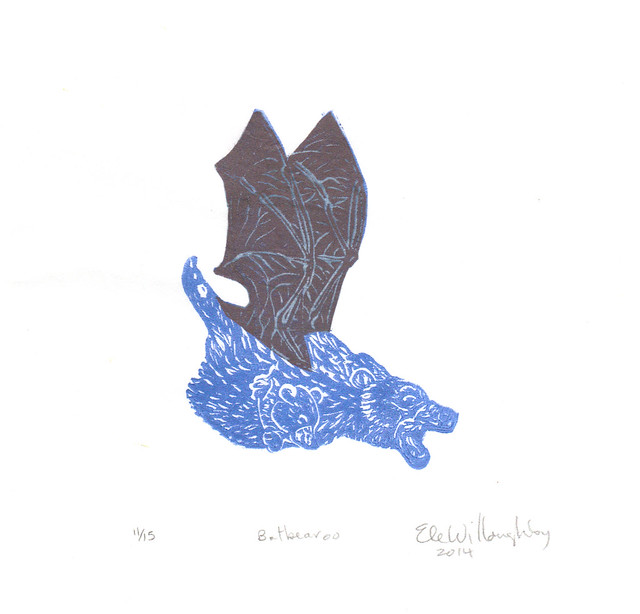
The Batbearoo

Batbearoo linocut

Batbearoo (Dasychiroptera ursus)
The Batbearoo shares a common ancestor with the marsupial quoll family of Australia, and diverged from the quoll line in the mid-Miocene. While glider possoms are well-known, until the discovery of the rare Batbearoo in the wild and the fossil record, bats were believed to be the only true flying mammals. Unlike the glider possoms, but like the bats, the Batbearoo forelimbs form webbed wings and it does indeed fly, rather than simply glide, by flapping the outspread digits of its forelimbs - or, essentially, wing. This is an instance of convergent evolution; the Batbearoo fills a similar niche to the bats and hence their ressemblance, despite the lack of any close relation to placental mammals.

Batbearoos can grow to 25 cm (10 inches) in length and weigh up to 1 kg (2.2 pounds) and are usually mistaken for various members of the bat family.

Like all marsupials, the Batbearoo carries its young in a pouch, like this female. The young are born quite immature and spend up to 24 months being carried in their mother's pouch. When sufficiently grown to fly on their own, the mother batbearoo tightens her abdominal muscles and dives from a great height, causing the young to slip out of the pouch and instinctively spread its wings. It can safely glide for great distances before venturing to flap its wings and truly fly. The Batbearoo parents can be seen spiralling around, roaring and perstering their young to encourage them to flap their wings.

The Batbearoo is most active in the evening. Like their cousins the quolls they are carnivorous, preying on small mammals and insects. Their variable blue colouring makes them virtually invisible against the sky and rarely spotted in the shadows of the evening forest.