Saturday, February 27, 2010

Chilean earthquake and tsunami hazard


A friend pointed out that there was a magnitude 8.8 thrust-fault earthquake, where the Nazca plate is subducting below the South American plate, offshore Maule, Chile, and the subsequent tsunami watch. Another friend followed up with questions about tsunami hazard, so I thought I would try to shed some light on this.

This news saddened me; I spent one month there and made many friends. Shaking along the coast would have been severe and a long aftershock sequence is to be expected. We were in the twin cities Valparaíso and Viña del Mar, west of Santiago, and sailed south towards Concepcíon (115 km NNE of Maule). We were invited by the Catholic University of Valparaíso to do a controlled-source electromagnetic survey to map gas hydrate deposits. Their interest was tsunami hazard. Chile is prepared for earthquakes and tsunami. They still remember the magnitude 9.5 earthquake of May, 1960 – the largest earthquake worldwide in the last 200 years or more. (It's important to remember that the magnitude scale is logarithmic.) Gas hydrates are stable under certain pressure and temperature conditions. If there is upwards movement or shaking of the seafloor, it is possible that they might become destabilized and lead to submarine slumps and slides (imagine a landslide underwater). This in turn might increase the risk of tsunami. The good news was we found little evidence for gas hydrates in this area.

If you see stories about earthquakes or tsunami in the news and find the facts bewildering (or worse, of dubious veracity) a good place to look for information is the USGS website (or for events in Canada, the GSC website - the USGS has the best worldwide coverage combined with public outreach).

The animated image above is an Tsunami Model for Chilean earthquake produced by the Earthquake Research Institute, Tokyo (another place where I've spent one month of my life). You can see that the maximum amplitude of the the waves induced are on the order of centimeters. Tsunami (Japanese for 'habour wave') are defined by the source (a displacement of a large volume of water, due, for instance to earthquake - especially subduction earthquakes, volcano, land- or submarine slide), but they also have some consistent properties in terms of the physics of the waves produced in the oceans themselves. This includes a small amplitude and very long wavelength (like the gravity waves I use in my experiment). They are not defined by height. Heights of centimeters are most common. In fact, in the ocean basin, if you are not using very specialized, high precision instruments (pressure gauges and accelerometers, like those used in my research), you are unlikely to notice a tsunami. There are two main issues which can lead to death and destruction: harbour geometry and the seemingly relentless nature of the waves. As the seafloor shallows at a coast, the waves shoal - they are compressed, slow down and increase in amplitude. Depending on the geometry of the seafloor, the effect can be severe.

This second animation shows this effect schematically. The second problem is also evident: duration. Even a small increase in relative sealevel (run up) can cause a lot flooding of damage. Though these waves are slow moving in shallow water, they are propagating and some structures will fail with continual force of this nature.

We all remember the 2004 Indian Ocean Earthquake and tsunami, but this does not mean that is what you should imagine every time you here the word tsunami. The 2004 event was a magnitude 9.3 which is barely conceivable. During today's event 4.7±0.9 x 10¹⁶ Joules of energy was released. During the 2004 event, 20 x 1017 Joules which is forty times more (source: USGS). Wave heights were up to 250 centimeters in the ocean itself - clearly a entirely different situation. Further, there has been an active tsunami-monitoring system in the Pacific for decades - not so in the Indian ocean. The Indian ocean event was a megathrust earthquake. While we can expect megathrust earthquakes in other subduction zones around the Pacific, today's event was not one.

So while this event was large enough to warrant tsunami alerts, the real concern, as is generally the case, is the nature of the housing near the epicenter. The death toll will be considerably less (likely by a factor one thousand) than the much smaller Haitian earthquake six weeks ago, largely because of building standards.

Wednesday, February 24, 2010

Ada Lovelace Day - March 24, 2010

One month from today, on March 24, 2010, the second anual international day of blogging to celebrate the achievements of women in technology and science, Ada Lovelace 2010 (ALD10).

Women’s contributions often go unacknowledged, their innovations seldom mentioned, their faces rarely recognised. We want you to tell the world about these unsung heroines, whatever they do. It doesn’t matter how new or old your blog is, what gender you are, what language you blog in, or what you normally blog about – everyone is invited. Just sign the pledge ... and publish your blog post any time on Wednesday 24th March 2010.


Over on the Mad Scientists of Etsy blog- many of whom are women in science or technology (or both) I'm hosting our own Ada Lovelace Day mashup! I hereby pledge to blog to draw attention to the achievements of women in technology and science on March 24th. Further, I will link to my team mates ALD10 posts and we will cross-post all our various entries here, on the Mad Scientists of Etsy Blog. Last year's event was a great success (my own post from 2009 is here) and this year, I'm looking forward to learning about other female innovators and heroines of my fellow Mad Scientists.

So, please get involved!
1. Go sign the pledge.
2. Read the MSOE ALD10 Mashup.
3. Blog on March 24th, 2010.


Ada, Countess Lovelace

The Enchantress of Numbers is calling on you


p.s. For the raving comix consumers/steam-punk fans: check out The Thrilling Adventures of Lovelace & Babbage.

Tuesday, February 23, 2010

other printmaking

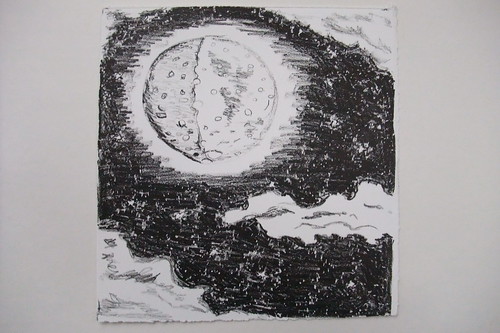
moon litho

As promised, here is my first (and only) lithographic print. It is one of four. I forgot to measure it, but it's roughly 6" x 6.5". I just drew free-hand onto the stone. The process is rather involved and based on the antipathy of oil and water. After polishing, I drew on the stone using grease pencils of different hardnesses. These pencils also contain wax, so much like a wax crayon, they can pick up flecks of drawn lines, as well as add new lines. I used this effect purposes, so the lifted flecks could be stars. Our instructor took care of the stone-sensitizing (called 'etching' though this is now known to not be chemically accurate). An acid is applied to the limestone base to 'sensitize' it. There are all sorts of subtleties in the selection of the acidity (or 'etch'), and differ values can and are applied to different regions of the stone. These are selected as a function of media applied, darkness, intensity, line density, and basically experience. Like purposely over-exposing a photographic negative, one can also 'burn' out a region of a drawing for tonal effect. The stone is wet, and because the grease and water are immiscible, when ink is applied, it only covers the greased/drawn areas of the stone. The prints are pulled on a special press, such that weight is applied directly down. It is no mean feat to pull a print. I tried one: it involved another student wetting the stone, followed by me inking the stone, back and forth iteratively, about six times, and then releasing the clutch and lowering the arm (clearly designed for someone taller and stronger than I).

The potential of the method is amazing, but so is the fact that we managed to pull any prints whatsoever within 3 hours.

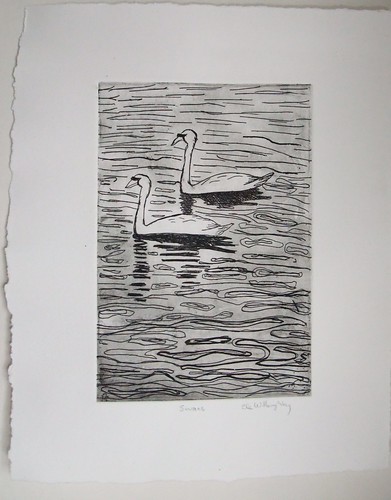
swans


Yesterday we did etching, something I haven't done in years. This is also something challenging to do within 3 hours, in particular, since we began with industrial quality zinc plates, rather than prepared plates. Though it was good to learn these steps of the process, as they were new to me. So first, we had to polish them and then apply a hard ground (a waxy substance). We had about 45 minutes to draw/scratch into the hard ground. I got a bit caught up in making sure I was scratching hard enough and did not feel I had a flexibility of line. In this amount of time, there was no chance to correct any mistakes. My swans have weird heads. My drawing style is sketchy and this time, my first, imperfect lines had to be preserved. But, knowing the method, I did plan my subject so that I could take advantage of "plate play" (the discretion of the artist in what ink to remove or not from the plate) and built this into my design. Once the hard ground is scratched, the plates are submerged in acid; also, in 3 hours, there was no time for discretion here, and all plates were exposed to acid for the same amount of time (mine could have done with less). We then cleaned off the hard ground and inked the plates. I wanted to have the lines inked (the entire point of intaglio) and also to have a gradient in tone from top to bottom, with highlights of white swans (of course) and various ovals within the water. I think this worked well, though I could have left even more ink on the plate. We only had time for a single print.

Sunday, February 21, 2010

Feathers and Snowflakes

feather on lapel
This month the Mad Scientists of Etsy challenge is the Feather. As some of you know, I am allergic to feathers. I made a block printed Guinea fowl feather fabric (feather-free, vegan even) brooch.

feather brooch

two snowflakes
Meanwhile, the Trans-Canada Etsy Team chose the theme of snow. Bizarrely, we currently have no snow. It felt like spring out there today (though, I'm not sure I believe it... it might change at any moment). I carved two snowflakes (based on microscopic photographs of individual flakes) and printed them on irridescent silk. Here's a sneak peek of a two-brooch set in the works.

Sunday, February 14, 2010

guided, illustrated city tours

Dufferin graffiti
It's been a little while since I've shared my view of Toronto, so here we are. First, it's Dufferin and Dupont, where there are some amazing graffiti murals. What I love, in particular, is the inexplicability of the subject matter. Woolly mammoth? West-coast native Sun mask? Why not.

Dufferin Mammoth with Sun

As we continue south towards Queen, we encounter the cyber-kitties. Secretly, I feel that the chrome cats would be a useful judge of character. Do you feel that robokitty is inherently awesome or a wanton destruction of private property? Maybe this should be a question on Faunalia's imaginary "Are you a soulless or soulful hipster?" quiz. I think Minouette would like a cyborg assistant, to help her with whatever mischief she gets up to in my absence.

cyberkitty & tags

electro-kitty

So this wonderful mural has been on Queen West for a long time, and, Murphy's Law, when I finally get my act together and bring my camera to the mural, someone has placed an ugly 'Art Sale' sign in front of it. However, I confess that some of the art amused me, no matter how juvenile the humour.

fish graffiti mural

hand & fish

fish mural

graffiti and photos

yellow mitten

The entire Dufferin & Dundas Portuguese village area is painted in this colour scheme, which is great. The fact that I timed this 'drive-by' photograph exactly wrong, such that the sun-face is behind the street-light also amuses me.

dufferin & dundas

I love that this Koreantown mural is so similar in spirit to the Parkdale world map, except, now with more Korean food! Also, considering the stylized, low-resolution character of the world map, I love that the artist has clearly depicted the Great Lakes - because that's important.
maps, masks, food

globe with Korean food

little Korea mural

Cherry St amazes me, how it can always look simultaneously picturesque and desolate.
Cherry st

So apparently, The Distillery District is the largest, in-tact, region of Victorian industrial architecture, anywhere in North America. Hence, it is a boon to the movie industry. Cleverly, the City opted to fill it with art galleries and artists' studios, simulateneously preserving it, and supporting the arts. And yet, I never go there. It's not the most public-transit-friendly destination and I suspect it is filled with tourists (and yet, I think to myself, really? in February! What sort of ill-informed tourist comes to Toronto in FEBRUARY?). From a historical perspective, I find it intriguing that so much of Toronto-the-good was clearly occupied with making whiskey.

rooftops

distillery

Gooderham & Worts

New to Queen W, an optimistic graffiti artist:
change pun

I love the plastic bag + chain link fence = mural equation. I believe this one, in Trinity-Bellwoods park reads, "Where is the Love?"

tennis court fence graffiti

view from park

Tuesday, February 9, 2010

Registration Owls

horned owl
owl questions
mis-registered owl
owl linocut
registration pupil echo
Owl Query
owl proof

So last night, I had my second class of 'Power Printmaking'. This time it was, well, my specialty, relief printing. So, I wanted, in particular, to do something I was unlikely to do at home. As I suspected, this was easy because the teacher had planned a reduction print, which is something I rarely do. Also, we used stiffer lino than I would choose, oil-based inks (which I avoid, like the plague, though I confess their slower drying time and viscosity are enviable, but like a good scientist I abhor VOCs and prefer the more environmentally-friendly water-based inks), and of course, printed these on a press - actually two. So I got to play with presses. There are a couple of reasons I avoid the reduction print: 1) it's self-destructive (you carve a block, print a colour, irreversibly carve it some more, print a second colour, etc., and may end up with very little lino left) and 2) registration is tricky. Registration is the process of lining up successive printmaking marks so they are properly aligned. There are various tricks one can employ. The best I've seen is the Japanese method of kentos. With these prints, we employed a map (like a jig). The shape of the paper, and of the block was traced unto paper, under plexiglass on the bed of the press. So, in theory if your paper and block were lined up, registration of successive colours would naturally ensue. Of course, that rarely happens, as the photos testify. Though, that can be viewed as part of the beauty. I mean, owls with (accidental) red retinas, have a certain appeal. Even the one f*ck up is interesting. I include also a proof, lacking the yellow flat, because I like it. I should point out: attempting to print a three-colour lino reduction print, even if this small (photos are approximately life-sized on your screen), within 3 hours is dementedly ambitious.

What do you do to keep fit ? RELIEF PRINTING. Seriously. Carving, rushing about, working the presses is hard, physical labour. Soon, my right arm will have a measurably bigger diameter than the left.