Wednesday, March 19, 2014

Reflection, Moon and Ocean Linocut & a Tattoo


ReflectionTattoo


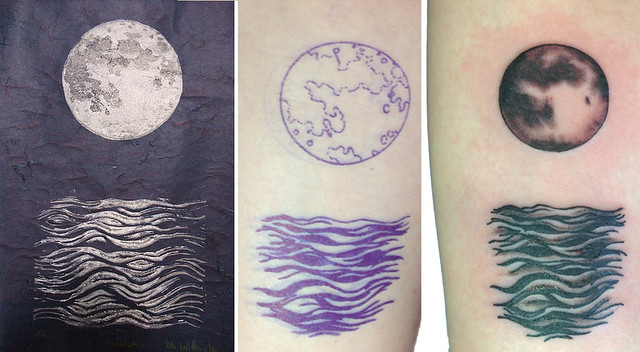
Last fall, Tina Gleason contacted to ask my permission to get a version of my 'Reflection' linocut tattooed on her arm. She lamented that the linocut itself is no longer available. It's unusual for me, but Reflection was a reduction linocut. That means that I first carved the block to produce the 'background' silver layer and printed it on lovely dark blue Japanese washi with silk fibres. Then I carved further to produce the upper white layer. That means that 'Reflection' is limited edition. I cannot print more since the block for the silver layer exists no more. You may recall that another of my prints once inspired a tattoo, which I take as a great compliment. I was glad to hear she wanted my blessing and very flattered that she felt so strongly that she wanted the image permanently tattooed on her body - her first tattoo! She wrote today to say she finally found the right tattoo artist and had the image tattooed on her forearm by Deirdre Doyle in Cambridge, MA. Above you can see the original linocut, the sketch on her arm and the final tattoo. I love how this sort of transmission of artistic ideas, where the translation to another medium means that something altogether new is created. To me this sort of reinvention, especially for something non-commercial, and in fact personal and intimate, is using the image as inspiration to create a derivative work which I can and do welcome!


Monday, March 10, 2014

Cosmos on the Etsy Blog

https://www.etsy.com/ca/listing/178998272/astronomer-jocelyn-bell-and-the-lgm-1
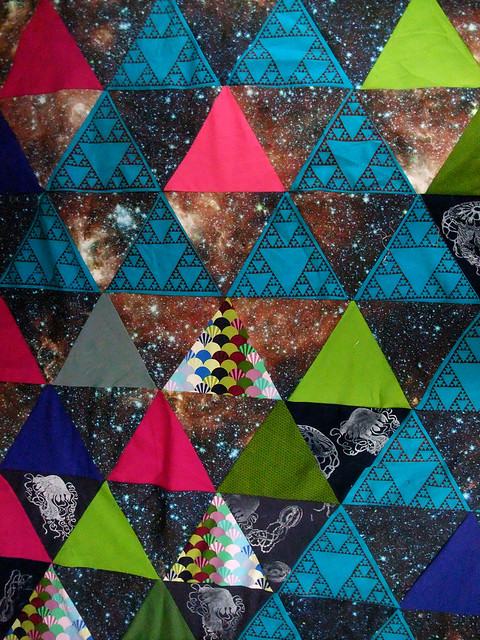
I was reading the Etsy blog this morning and enjoying their collection inspired by the reboot of Carl Sagan's Cosmos: A Personal Voyage - Cosmos: A Spacetime Odyssey hosted by  Neil Degrasse Tyson, director of the Hayden Planetarium at the American Museum of Natural History. I was busily adding items to my favorites lists (not just my collection of science-themed items, but my collection of things I want myself, for the befuddled gift-buyers in my life), when I scrolled down and saw my own portrait of Jocelyn Bell Burnell! I'm flattered to be in this company. And yes, you should buy me the Mars globe and the screenprinted moon pillowcases with glow-in-the-dark constellations cause they would go perfectly with my own quilt with NASA imagery and glow-in-the-dark stitching. I mean really.

spacejellyfishtrianglequilt9


https://www.etsy.com/blog/en/2014/editors-picks-cosmos/

Friday, March 7, 2014

Women Scientist Portraits on Scientific American.com

Inge Lehmann print
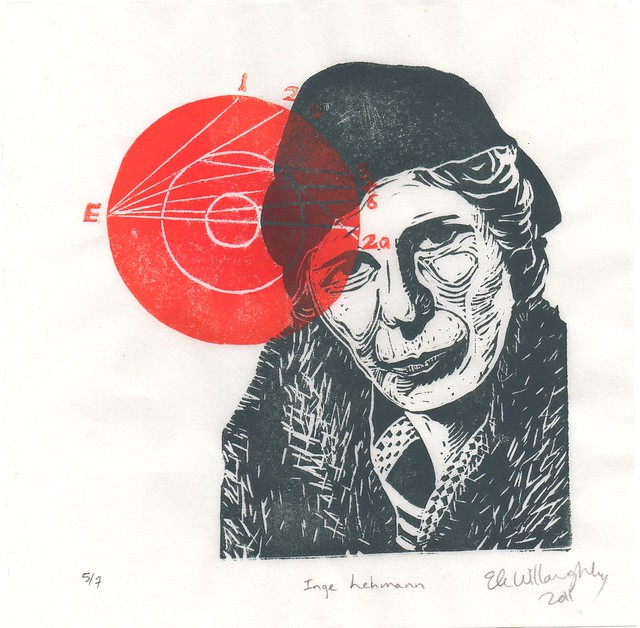
Inge Lehmann and the Earth's Inner Core linocut on Japanese kozo paper, 2011, 20.5 cm x 20.5 cm

Just in time for International Women's Day, Scientific American has published Maia Weinstock's photo essay about female scientists portrayed in art: 15 Works of Art Depicting Women in Science; Visualizing notable women in the STEM fields through the lens of fine art. There are some really wonderful portraits of great scientists. She writes about each artist and their inspiration. I'm flattered to be included, along with my portrait of the great Danish pioneer of whole Earth seismology, Inge Lehmann. Lehmann is an apt selection; not only did she make the revolutionary discovery of the Earth's inner core (and find the evidence in what others had mistaken for noise), but she wasn't shy about frankly discussing how women's contributions to science were all too often overlooked.

I love also how she points out that the idea that science and art are divorced is only recent, and the contemporary move to go from STEM (science, technology, engineering and math) back to STEAM (science, technology, engineering, art and math). If you read carefully, you'll also glean the inspiration for my most recent portraits of female scientists: Maia will be curating a women-in-STEM art exhibit at the Art.Science.Gallery. in Austin, Texas, from September 13 through October 15, 2014, which will include some of the works and artists from her article, like me!

Tuesday, March 4, 2014

Did you say park?

DogPark

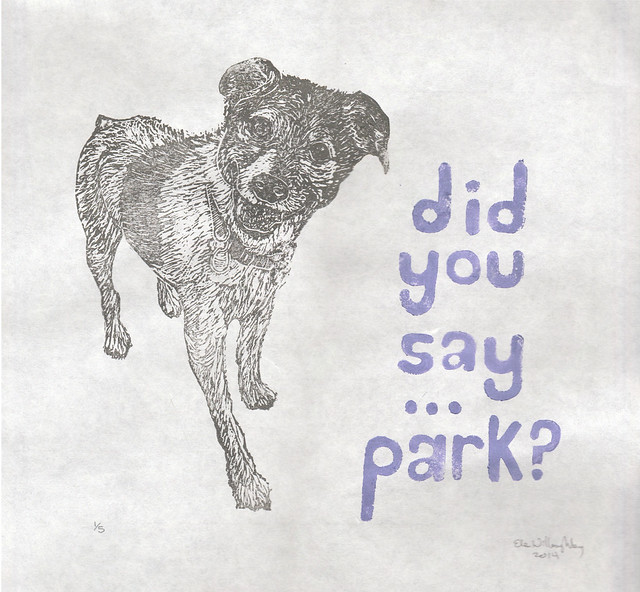
I made a custom order pillow for the husband of a lovely customer, of their delightful looking dog. He really did appear to have the sweetest nature in all the photos. So, I wanted to use the block with the dog's portrait, and I could only imagine I'd captured that moment the dog heard the word, "park".

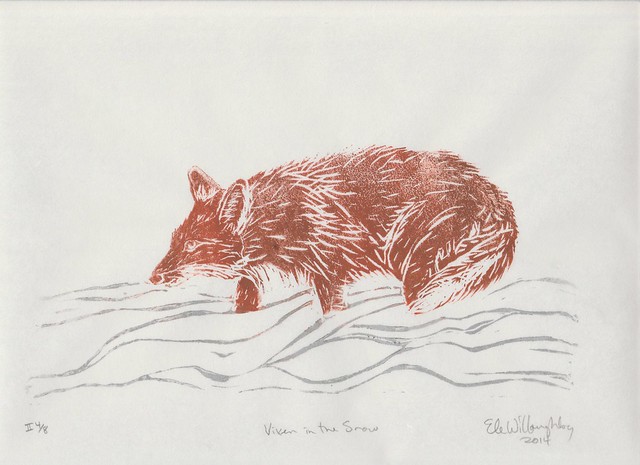
Lately, I've been printing second editions of popular prints, if I've run out of stock. Like my Vixen in the Snow, Aurora Borealis with the polar bear, and screech owl. Next, I plan some quail and maybe portraits of Minouette, herself.

Vixen In The Snow

Friday, February 21, 2014

Sofia Kovalevski linocut

Sofia Kovalevski linocut

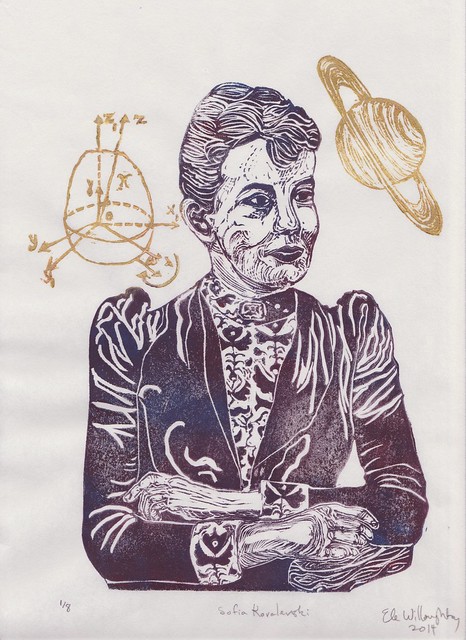
This linocut portrait is of the great Russian mathematician and writer, Sofia Vasilyevna Kovalevski (1850-1891). The linocut is printed on Japanese kozo paper 9.25" by 12.5" (23.5 cm by 32 cm) in an edition of eight. Also known as Sofie or Sonya, her last name has been transliterated from the Cyrillic Со́фья Васи́льевна Ковале́вска in a variety of ways, including Kovalevskaya and Kowalevski. Sofia's contributions to analysis, differential equations and mechanics include the Cauchy-Kovalevski theorem and the famed Kovalevski top (well, famed in certain circles, no pun intended). She was the first woman appointed to a full professorship in Northern Europe or to serve as editor of a major scientific journal. She is also remembered for her contributions to Russian literature. All of this despite living when Russian women were still barred from attending university. Her accomplishments were tremendous in her short but astonishing life.

Born Sofia Korvin-Krukovskaya, in Moscow, the second of three children, she attributed her early aptitude for calculus to a shortage of wallpaper, which lead her father to have the nursery papered with his old differential and integral analysis notes. Her parents nurtured her early interest in math, and hired her a tutor. The local priest's son introduced her to nihilism. So both her bent for revolutionary politics and passion for math were established early.

Unable to continue her education in Russia, like many of her fellow modern, young women including her sister, she sought a marriage of convenience. Women were both unable to study at university or leave the country without permision of their father or husband. Men sympathetic to their plight would participate in "fictitious marriages" to allow them an opportunity to seek further education abroad. She married the young paleontology student, Vladimir Kovalevsky, later famous for his collaboration with Charles Darwin. They emigrated in 1867, and by 1869 she enrolled in the German University of Heidelburg, where she could at least audit classes with the professors' permission. She studied with such luminaries as Helmholtz, Kirchhoff and Bunsen. She moved to Berlin and studied privately with Weierstrass, as women could not even audit classes there. In 1874, she present three papers, on partial differential equations, on the dynamics of Saturn's rings (as illustrated in my linocut) and on elliptic integrals as a doctoral disertation at the University of of Göttingen. Weierstrass campaigned to allow her to defend her doctorate without usual required lectures and examinations, arguing that each of these papers warranted a doctorate, and she graduated summa cum laude - the first woman in Germany to do so. 

She and her husband counted amongst their friends the great intellectuals of the day including Fyodor Dosteyevsky (who had been engaged to her sister Ann), Thomas Huxley, Charles Darwin, Herbert Spencer, and George Elliot. The sentence "In short, woman was a problem which, since Mr. Brooke's mind felt blank before it, could hardly be less complicated than the revolutions of an irregular solid." from Elliot's Middlemarch, is undoubtedly due to her friendship with Kovaleski. Sofia and Vladimir believed in ideas of utopian socialism and traveled to Paris to help those the injured from the Paris Commune and help rescue Sofia's brother-in-law, Ann's husband Victor Jaclard.

In the 1880s, Sofia and her husband had financial difficulties and a complex relationship. As a woman Sofia was prevented from lecturing in mathematics, even as a volunteer. Vladimir tried working in business and then house building, with Sofia's assistance, to remain solvent. They were unsuccessful and went bankrupt. They reestablished themselves when Vladimir secured a job. Sofia occupied herself helping her neighbours to electrify street lamps. They tried returning to Russia, where their political beliefs interfered with any chance to obtain professorships. They moved on to Germany, where Vladimir's mental health suffered and they were often separated. Then, for several years, they lived a real marriage, rather than one of convenience, and they conceived their daughter Sofia, called Fufa. When Fufa turned one, Sofia entrusted her to her sister so she could return to mathematics, leaving Vladimir behind. By 1883, he faced increasing mood swings and the threat of prosecution for his role in a stock swindle. He took his own life.

Mathematician Gösta Mittag-Leffler, a fellow student of Weierstrass, helped Sofia secure a position as a privat-docent at Stockholm University in Sweden. She developed an intimate "romantic friendship" with his sister, actress, novelist, and playwright Duchess Anne-Charlotte Edgren-Leffler, with whom she collaborated in works of literature, for the remainder of her too short life. In 1884 she was appointed "Professor Extraordinarius" (Professor without Chair) and became the editor of the journal Acta Mathematica. She won the Prix Bordin of the French Academy of Science, for her work on the rotation of irregular solids about a fixed point (as illustrated by the diagram in my linocut) including the discovery of the celebrated "Kovalevsky top". We now know there are only three fully integrable cases of rigid body motion and her solution ranks with those of mathematical luminaries Euler and Lagrange. In 1889, she was promoted to Professor Ordinarius (Professorial Chair holder) becoming the first woman to hold such a position at a northern European university. Though she never secured a Russian professorship, the Russian Academy of Sciences granted her a Chair, after much lobbying and rule-changing on her behalf.

Her writings include the memoir A Russian Childhood, plays written in collaboration with Edgren-Leffler, and the semi-autobiographical novel Nihilist Girl (1890).

Tragically, she died at 41, of influenza during the pandemic. Prizes, lectures and a moon crater have been named in her honour. She appears in film and fiction, including Nobel laureate Alice Munro's beautiful novella 'Too Much Happiness', a title taken from Sofia's own writing about her life. 

Friday, February 14, 2014

Happy Valentine's Day

bullseyevalentine

Hope you have a lovely Valentine's Day!

I made this linocut Valentine with my husband the archer in mind. He has to work late this evening, but we got to spend this morning together. He and Gabriel got me flowers and they got the Valentine and kisses. Gabriel seems fascinated with the bouquet.

Best of all; soon there will be a surplus of cinnamon hearts in all the stores. That's something I think we can all appreciate, even if you aren't into the other aspects of this day.

Mmmm! Cinnamon hearts. I love cinnamon hearts.


Thursday, February 13, 2014

Koi

KoiOrange

I printed my koi block on this lovely, handmade, deep orange kozo paper I found, with a deckle edge.

I also made a new print of a JRT (Jack Russel Terrier, for those who aren't into dogs). Since it's based on a custom order, I'm going to keep it under wraps for a little while. It seems unlikely, but I would hate to spoil the surprise, should the gift recipient see the image before he receives his gift.

I've been doing some research and making notes on planned future prints.

Other than that, Gabriel has been keeping me pretty busy. His grandmother popped by unannounced today during Canada's men's hockey game, which she watched with her grandson on her knee. She's a raving tennis fan, so during the second period when she was unsure if the puck had gone in she asked whether Canada had in fact scored. Then she said, "So, it's 2-love Canada? Er.. well... in my language?"