Friday, December 9, 2011

Panda Family

Pandas - detail

This is my linocut portrait of a harried mama giant panda and two unruly cubs. They are magnificent, if funny, creatures, whose expressions make them easy to personify. They remind me of people I know. This print is made in black block printing ink, on white Japanese kozo (or mulberry) paper, 10.5 inches by 12.5 inches (27 cm by cm by 31.8 cm), in an edition of six.

Pandas

I looked at a lot of photos of pandas, and I must say, they are most improbable. Sort of riddiculously cute, and by appearance at least, lazy. Most photos show them semi-prone, munching. Apparently their heads are so round because of their bamboo-diet. But they actually do have much more of a 'teddy bear' shape anatomy than any of the North American bears I know. Perhaps that, and their colouring, explains their popularity.

Minouette on designwali

Fly AgaricThis morning, my prints and minouette etsy shop are featured on a lovely local blog, with a desi flavour, designwali! Sundeep of designwali is keen to display some local talent and is hosting a give-away. Check out this post to learn how you can win one of my 'Fly Agaric' block prints. The contest is open to anyone, worldwide, not just Toronto residents, by the way. :)

There are some great local artists and jewelry makers who you can find in recent posts, and lots of design and decor goodies to be found on designwali. Check it out! Sundeep has an eye, a sense of humour to go with the sense of colour and writes in a conversational tone, which makes her blog lovely to look at and fun to read.

Saturday, December 3, 2011

1200 Hearts!

scan of multimedia valentine ♥♥♥♥♥♥♥♥♥♥♥♥♥♥♥♥♥♥♥♥♥♥♥♥♥♥♥♥♥♥♥♥♥♥♥♥♥♥♥♥♥♥♥♥♥♥♥♥♥♥♥♥♥♥♥♥♥♥♥♥♥♥
I don't know why I'm so silly about hearts, but I really do love watching the number of People who have favorited minouette. It broke 1200 today! Yay! A sincere thanks to each and every one.
♥♥♥♥♥♥♥♥♥♥♥♥♥♥♥♥♥♥♥♥♥♥♥♥♥♥♥♥♥♥♥♥♥♥♥♥♥♥♥♥♥♥♥♥♥♥♥♥♥♥♥♥♥♥♥♥♥♥♥♥♥

Friday, December 2, 2011

Feed My Paper Habit


So, one of my favorite haunts, The Paper Place is having the 2nd annual chiyogami giveaway.. You know that I need 700 sheets of 8.5 x 11 chiyogami, but if you would like to enter too, just check out their blog for more details.

Dear Paper Place,

If you give me the loot, I promise to make lovely things like these:
polar bear multimediashe has no titleDarjeelingdinosaur portraitdinosaur portraitclose-up of girl with hornsUnicorn Amongst Umbrellas IThinking of You Valentine VIIUnicorn amongst umbrellas III detailtag for pink tip-in swapArctic wold & narwhal semaphorship X

Maybe I can convince someone to help me make a video for 50 extra entries, because I think I probably do qualify as chiyogami super-fan. You might notice that this blog even has both a chiyogami and a washi tag.

Most Sincerely,

Tuesday, November 29, 2011

Monoprints

I had one final screenprinting class yesterday, so I thought, since I had only 3 hours of time, to make some monoprints. This is not a method I've used before. The word 'monoprint' can be applied to unique prints made with a variety of printmaking methods (so long as there are not multiples). In this instance, I mean screenprints made by applying a pigment directly to the screen and then lifting and disolving it and printing with the squeegee as if one were printing with ink. You can do this with, say, silk paints and screenprinting medium, or even wallpaper paste. Any sort of decent medium which can disolve water-soluble pigments, and has good printing properties (like viscosity - not too thin or too gloopy) will work. I printed all of the following on heavy weight paper with a deckle edge (moreorless 10 inches by 14 inches). I experimented with the silk paints:
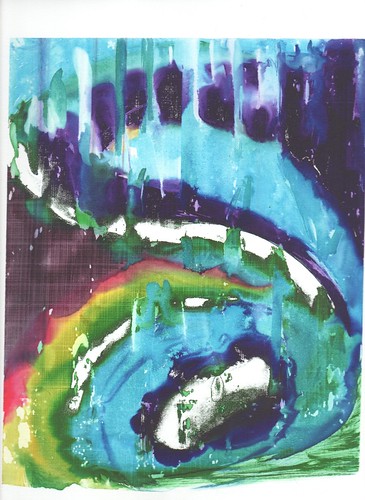
monoprint590

There are white areas where the pigment was too thick, and actually blocked the screen - but I like them.Also, you can see the mesh, which is interesting to me. I also tried paper stencils (snowflakes) combined with a silk paint + wallpaper paste monoprint:
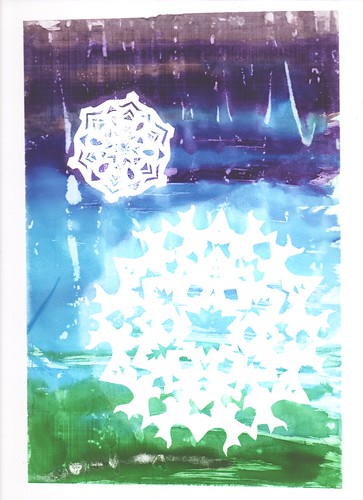
snowflake-silk-monoprint584

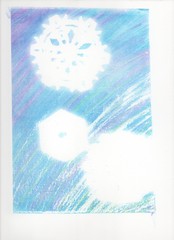
snowflake-monoprint583Then, I tried the crayons (also with cut-paper snowflake stencils). My first attempt wasn't quite what I intended (but still sort of pretty I think). The instructor pointed out that there was still pigment on the screen, and with more medium and pressure (a recurring problem for me, I feel like a weakling) that I might be able to get another print. He gave it a try and got much better results:
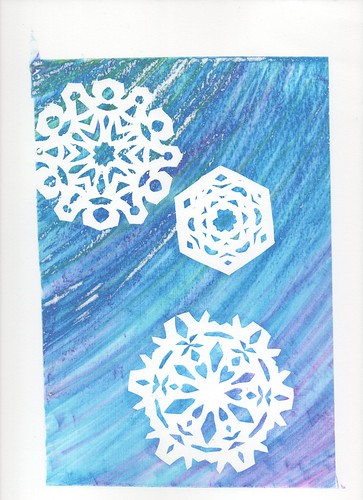
snowflake-monoprint577

Lastly, I drew a discomedusa jellyfish directly onto the screen with colour pencils and crayons. This proved harder than expected. The screen itself is not an ideal medium for drawing. The mesh tends to hinder smooth, curved lines (which are sort of necessary, at least if you are me, and you are attempting to draw the least rectilinear animal in the world). Here's my first attempt, which is pale, but appeals to me:
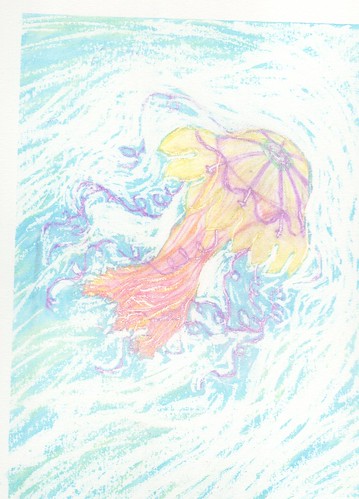
jellymonoprint576

Again, there are places where the pigment blocked the mesh, but I think it works. There is white, often, within water, and I think it helps give a sense of movement. Here's the no-nonsense instructor's 2nd attempt:
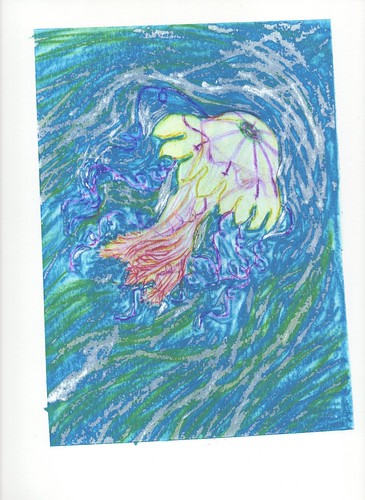
jellymonoprint571

which shows hom much more can be transferred with more strength and experience. I also like the surviving snowflake stencils. The ones made from strong Japanese kozo paper survived:
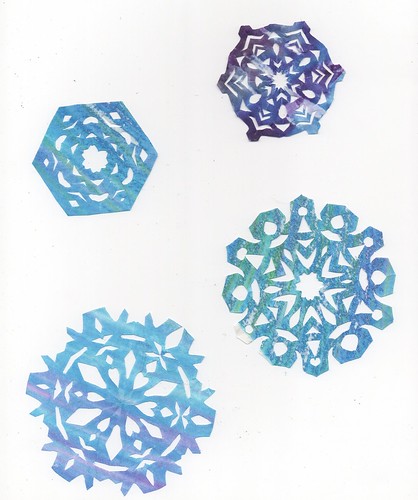
snowflakes591

I feel I should do something with the screenprinted snowflakes, but I'm not sure what.

Friday, November 25, 2011

Shang Yang, the Bird that Makes the Rain

Shang Yang the Bird that Makes the Rain

This linocut shows how I imagine Shang Yang, 'The Bird that Makes the Rain'. I found a description of this marvellous creature in Jorge Luis Borges' (and poor, forgotten Margarita Guerrero's) 'The Book of Imaginary Beings'. It explains that Chinese farmers called upon Shang Yang to bring the rain:

It had but a single leg; in ancient times children would hop on one leg, wrinkle their foreheads, and shout, "It will soon rain, for Shang Yang is frolicking in the yard!" It was said that the bird drank water from the rivers and dropped it on the land.

In ancient times, a wise man domesticated this fowl, and he would walk about with it on upon his sleeve. Historians say that one day the Shang Yang, flapping its wings and hoping on its one leg, passed before the throne of Prince Ch'i, who, alarmed, send one of his ministers to the court of Lu, to consult with Confucius about the event. Confucius predicted that the Shang Yang would cause floods in the principality and in the lands nearby, and he advised that dikes and canals be built. The prince followed Confucius' advice, and thereby avoided great disasters.


Shang Yang the Bird that Makes the Raindetail

Interesting, isn't it, that even the lengend explains that water rose from rivers, to the sky, to produce rain, as it does according to more modern understanding of the water cycle. Apart from hopping about on his single leg, and bringing the rain, Borges provides little clue as to Shang Yang's appearance, so I was free to imagine this strange creature myself. RJH says he looks like a cross between a stork and a turkey; perhaps he's right. I wanted to make sure the single leg looked sturdy; it is much to thick for a stork, with a solid knee and strong thigh for more springy and comical bouncing. I couldn't resist the the stylized, Chinese Buddhist sort of swirling cloud.

Shang Yang is printed in Payne's gray, a bluish, dark gray like rain, on Japanese kozo, or mulberry paper. Each sheet is 6 inches by 12.5 inches (15.2 cm by 31.8 cm). There are 12 prints in this edition.

Tuesday, November 22, 2011

Imaginary Antarctic

Antarctic559
One of the most marvellous things I've seen are Pacific harbour seals at night, surfacing at night in water rich with bioluminescent bacteria. They glow in the dark! This inspired this print. I imagined glow-in-the-dark seals, a Pygmy Right Whale, a mysteriously forming submarine miniature galaxy, between two icebergs, below a starry sky and the aurora australis. This is one of a (variable) edition of 20 screenprints (22.5 cm by 33 cm/8.6 inches by 13 inches). The south polar sky does vary from print to print. The seals, stars (in the sky and the sea) and the aurora are all printed in glow-in-the-dark ink. It's very hard to take a photo in the dark... but they really do glow!

In screenprint class, we took some of the prints into the dark room to have a better look. I don't know how to capture this in a photo... you'll have to take my word for it.

glow in the dark seal screenprintAntarctic558