


 |
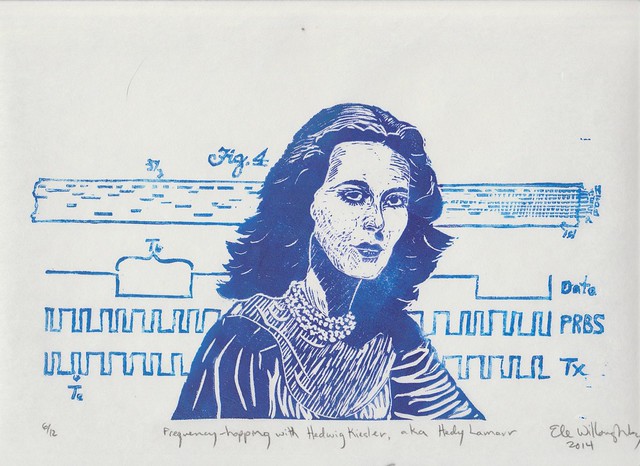
| Frequency-hopping with Hedwig Keisler, aka Heday Lamarr, linocut by minouette |
This linocut portrait is of inventor and actress Hedy Lamarr (9 November 1914 – 19 January 2000), best known as a star of Hollywood's Golden Age. The linocut is printed in indigo and blue on Japanese kozo paper 9.25" by 12.5" (23.5 cm by 32 cm), inked à la poupée in an edition of 12.
Born Hedwig Keisler in 1914 in Vienna, Hedy became famous after her risqué and notorious starring role in Gustav Machatý's 1933 film Ecstasy. Friedrich Mandl, her first of six husbands (to whom she was married at the time), objected to what he felt was exploitation of his wife, including shots of her nude and simulating an orgasm. He tried unsuccessfully to buy up all copies of the film. Hedy objected to her husband, the munitions manufacturer, dealing with fascists including Mussolini and Hilter, despite the fact that she and her husband were both of Jewish heritage. Hedy had learned that the secret of her beauty was to, in her words "stand there and look stupid” though she was in fact highly intelligent, a mathematics prodigy, and an astute innovator. So while Axis leaders and arms dealers attended lavish parties at their castle home, Hedy gained a great deal of sensitive military intelligence, including intimate knowledge of the problems associate with radio-control of torpedoes. She decided to leave her controlling husband. She made her escape by disguising herself as her own maid (by drugging her and stealing her clothes), just in time to avoid the annexation of Austria. She took this intelligence with her to Paris, and on to London. In London she met Louis B. Mayer, who renamed her 'Hedy Lamarr' and hired her to work for MGM. She went on to make dozens of Hollywood films opposite all the big stars of the Golden Age, and was known as one of the most beautiful women in the world.
In 1940, spurned by the tragic sinking of a boatload of refugees, by a German U-boat torpedo, Hedy put her mind to the problem of national defense. She knew that torpedoes were guided by radio signals, of a single frequency, which were vulnerable to interference or "jamming". She had the idea that if multiple frequencies were employed, like a radio station which varied its channel unpredictably, it would not be possible for the enemy to find and interfere with the signal. This way the signal could be encoded across a broad spectrum. The difficulty would be in synchronizing the transmitter and the receiver, so they would be set at the appropriate frequency at all times. She met her neighbour, the avant-guard musician and composer George Antheil at a party. He had been working on automated control of musical instruments, including his music for Ballet Mécanique which involved synchronizing his melodies across twelve player pianos (or pianolas)! Is that not an excellent example of the wonderous region where art and science intersect? This was the answer. Together they developed Hedy's frequency-hopping idea, encorporating George's technology for synchronizing pianolas, and on the 11th of August, 1942, US Patent Number 2,292,387 for the "Secret Communications System" was granted to Antheil and to “Hedy Kiesler Markey”, which was her married name at the time. This early version of frequency hopping used a piano-roll to change among 88 frequencies (like the keys on a piano). Though the US navy did not adopt the method until 1962 (during their blockade of Cuba), and there other patents and inventors whose work contributed the modern methods, today, we recognize Hedy Lamarr as an important pioneer of wireless technology! Lamarr's and Antheil's frequency-hopping idea serves as a basis for modern spread-spectrum communication technology, such as Bluetooth, COFDM (used in Wi-Fi network connections), CDMA (used in some cordless and wireless telephones) and 4G LTE communications. You are probably using a device right now which relies on these ideas.
In the print, I show a portrait of Hedy in 1941, along with Fig.4 from Lamarr and Antheil's patent, which relates to the use of the piano roll. Below this, I show a diagram of how the modern the frequency-hopping code division multiple access (FH-CDMA) scheme works. The wide square wave labelled 'Data' is a signal to be encoded, with pulse width Tb. 'PRBS' means pseudo random binary sequence. It's the way the changes in frequency are introduced and plays the role of the piano roll today. It runs at a much higher rate than the data to be transmitted, with pulse width Tc. Data for transmission is combined via bitwise XOR (exclusive OR) with the faster code. This means that that if the two waveforms, the data and the PRBS are unequal, the transmitted signal (labelled Tx) will be high. Otherwise the transmitted signal will be low. The transmitted signal is spread across a spectrum of frequencies by a factor determined by the ratio of the two pulse widths; the bandwidth is increased by a factor of Tb/Tc. Since the PRBS, known as the "pseudo-noise" (PN) code can be can be reproduced in a deterministic manner by the intended receiver (which is equivalent to reproducing the imaginary piano roll), it can decode the signal. This spread spectrum encoding is at the heart of all our contemporary telecommunications and is only possible using the kind of frequency hopping that Hedwig Kiesler, also known as Hedy Lamarr, invented.
Born Hedwig Keisler in 1914 in Vienna, Hedy became famous after her risqué and notorious starring role in Gustav Machatý's 1933 film Ecstasy. Friedrich Mandl, her first of six husbands (to whom she was married at the time), objected to what he felt was exploitation of his wife, including shots of her nude and simulating an orgasm. He tried unsuccessfully to buy up all copies of the film. Hedy objected to her husband, the munitions manufacturer, dealing with fascists including Mussolini and Hilter, despite the fact that she and her husband were both of Jewish heritage. Hedy had learned that the secret of her beauty was to, in her words "stand there and look stupid” though she was in fact highly intelligent, a mathematics prodigy, and an astute innovator. So while Axis leaders and arms dealers attended lavish parties at their castle home, Hedy gained a great deal of sensitive military intelligence, including intimate knowledge of the problems associate with radio-control of torpedoes. She decided to leave her controlling husband. She made her escape by disguising herself as her own maid (by drugging her and stealing her clothes), just in time to avoid the annexation of Austria. She took this intelligence with her to Paris, and on to London. In London she met Louis B. Mayer, who renamed her 'Hedy Lamarr' and hired her to work for MGM. She went on to make dozens of Hollywood films opposite all the big stars of the Golden Age, and was known as one of the most beautiful women in the world.
In 1940, spurned by the tragic sinking of a boatload of refugees, by a German U-boat torpedo, Hedy put her mind to the problem of national defense. She knew that torpedoes were guided by radio signals, of a single frequency, which were vulnerable to interference or "jamming". She had the idea that if multiple frequencies were employed, like a radio station which varied its channel unpredictably, it would not be possible for the enemy to find and interfere with the signal. This way the signal could be encoded across a broad spectrum. The difficulty would be in synchronizing the transmitter and the receiver, so they would be set at the appropriate frequency at all times. She met her neighbour, the avant-guard musician and composer George Antheil at a party. He had been working on automated control of musical instruments, including his music for Ballet Mécanique which involved synchronizing his melodies across twelve player pianos (or pianolas)! Is that not an excellent example of the wonderous region where art and science intersect? This was the answer. Together they developed Hedy's frequency-hopping idea, encorporating George's technology for synchronizing pianolas, and on the 11th of August, 1942, US Patent Number 2,292,387 for the "Secret Communications System" was granted to Antheil and to “Hedy Kiesler Markey”, which was her married name at the time. This early version of frequency hopping used a piano-roll to change among 88 frequencies (like the keys on a piano). Though the US navy did not adopt the method until 1962 (during their blockade of Cuba), and there other patents and inventors whose work contributed the modern methods, today, we recognize Hedy Lamarr as an important pioneer of wireless technology! Lamarr's and Antheil's frequency-hopping idea serves as a basis for modern spread-spectrum communication technology, such as Bluetooth, COFDM (used in Wi-Fi network connections), CDMA (used in some cordless and wireless telephones) and 4G LTE communications. You are probably using a device right now which relies on these ideas.
In the print, I show a portrait of Hedy in 1941, along with Fig.4 from Lamarr and Antheil's patent, which relates to the use of the piano roll. Below this, I show a diagram of how the modern the frequency-hopping code division multiple access (FH-CDMA) scheme works. The wide square wave labelled 'Data' is a signal to be encoded, with pulse width Tb. 'PRBS' means pseudo random binary sequence. It's the way the changes in frequency are introduced and plays the role of the piano roll today. It runs at a much higher rate than the data to be transmitted, with pulse width Tc. Data for transmission is combined via bitwise XOR (exclusive OR) with the faster code. This means that that if the two waveforms, the data and the PRBS are unequal, the transmitted signal (labelled Tx) will be high. Otherwise the transmitted signal will be low. The transmitted signal is spread across a spectrum of frequencies by a factor determined by the ratio of the two pulse widths; the bandwidth is increased by a factor of Tb/Tc. Since the PRBS, known as the "pseudo-noise" (PN) code can be can be reproduced in a deterministic manner by the intended receiver (which is equivalent to reproducing the imaginary piano roll), it can decode the signal. This spread spectrum encoding is at the heart of all our contemporary telecommunications and is only possible using the kind of frequency hopping that Hedwig Kiesler, also known as Hedy Lamarr, invented.


