Wednesday, April 6, 2022

Movements in Art History Inspired Prints

 I haven't yet posted all the prints I made for #PrinterSolstice so here are some of the others!


Dada inspired linocut with spherical cow, eye, bubbles and text
Dada-inspired linocut by Ele Willoughby
This one of a kind lino block print combines multiple lino blocks in a Dada-inspired original artwork. Dada was a cultural movement post-WWI in response to the horrors of the war which often was satirical or nonsensical, breaking down all previous standards. Combining unrelated elements was common, as was the appearance of text, including of course, the repeated use of the word "Dada". It was a precursor to surrealism.

This print combines my spherical cow print, an eye and a skeleton with the repeated word "Dada" and is unique... but I made a second print with some of the same elements, but a tardigrade, rather than a skeleton.

Dada-inspired linocut by Ele Willoughby


This is a minimalist print inspired by the transit of Venus. Much like a solar eclipse, when our moon's orbit brings it between the Earth and sun, the transit of Venus occurs when the planet Venus passes directly between the sun and us (or any other planet) partially obscuring or occulting the disk of the sun. Venus is much larger than our moon, but much farther away, so it blocks a much smaller portion of the sun, for a much longer period; it typically appears like a small black dot slowly moving in a line across the face of the sun over the course of several hours. These transits are rare, but predictable. The separation between transits is: 121.5 years, 8years, 105.5 years. There have been two this century (in 2004 and 2012) and there will not be another until 2117. Historically such transits have been vital to astronomers in their efforts to gauge the size of our solar system. Astronomers travelled to remote sites across the globe to get multiple simultaneous observations of the event, and improve distance and size estimates using parallax of the various observations. 


The Transit of Venus, linocut by Ele Willoughby, 9" x11", 2022

The design of this print is inspired by Minimalism, an art movement post-WWII which espoused geometrical abstraction, and cutting away extraneous details, and sometimes even colours in favour of monochrome compositions. A hemicircle represents the solar disk and the series of smaller excised circles represent the path of Venus.

Goethe's Theory of Colours, Linocut by Ele Willoughby, 8" x 10", 2022

This print, inspired by the boldly coloured Fauvism paintings, is a hand-printed, limited edition, reduction block print portrait of writer, statesman and polymath Johann Wolfgang von Goethe (1749-1832). While best known for his contributions to German literature, he was pursued natural sciences, studying morphology, did work which presaged evolution, discovered the human intermaxillary bone, performed Galvanic experiments, studied anatomy with Alexander von Humboldt, formulated a theory of plant metamorphosis, gathered the largest private collection of minerals in Europe, and popularized a barometer he built based on Torricelli’s principle. What he considered his most important work was his Theory of Colours (Farbenlehre, 1810). 

Goethe rejected Newton’s description of colour and analytic approach. He wanted to portray rather than explain colour. He was a careful observer and claimed, “The human being himself, to the extent that he makes sound use of his senses, is the most exact physical apparatus that can exist.” He felt colour came from the interplay of light and dark through a turbid medium (like air, dust and moisture). He included aesthetic qualities such as the allegorical, symbolic, and mystic use of colour. His physics were not sound but he was the first to probe human colour perception and his insights inspired the art world (especially J. M. W. Turner) and philosopher Ludwig Wittgenstein to write ‘Remarks on Colour’. 

My portrait is based on contemporary portraits, particularly a painting of Goethe in 1828 by Joseph Karl Stieler.

Horus and Seth, mono print by Ele Willoughby, 8" x 10", 2022

This is a one of a kind mono print about the Ancient Egyptian gods Horus and Seth, representing the struggle between order and chaos. My print is inspired by the Harlem Renaissance paintings of Aaron Douglas in particular, his layers of translucent colours, silhouettes and use of ancient Egyptian (and other African) culture, myth and imagery. 

This print shows Horus battling his uncle Seth. The story of their fight is NSFW as they say, but what I like in particular is that the ancient Egyptians believed both the god Horus, who represented order, amongst other things, and Seth (or Set), who represented chaos were necessary components for life and creativity.

This print was the first one I made with my new gel plate and stencils!

Flamboyant Wormhole, linocut by Ele Willoughby, 

This is a hand-printed Lino block print of an astrophysical wormhole, linking two locations in spacetime, inspired by Op Art. A wormhole, also called an Einstein-Rosen bridge, may exist, linking points in space-time like a sort of tunnel from one space and time to another. We don't know if they actually exist, but they are consistent with General Relativity and have been the subject of a lot of theoretical physics research and sci-fi. Space time is 4D, but if we represent it on the page, we can imagine it like a flat surface and then a wormhole would be a sort of tube from one area to another with a blackhole like a sort of drain leading to a white hole. If such structures exist, they may or may not be traversable, but it's conceivable they could allow time travel or faster than light travel or travel between different universes depending on the location of each end.  

Theia, linocut print by Ele Willoughby, 8" x10", 2022

This 6 colour hand printed linocut print illustrates the formation of the Earth’s Moon in a comic book influenced pop art style. The favoured model of Moon formation is that 4.5 billion years ago, early in the history of our solar system, a Mars-sized astronomical body called Theia crashed into the early proto-Earth. Large amounts of projectiles from this catastrophic collision, both rocks from Theia and the proto-Earth’s own mantle, coalesced under gravity to form this planet’s own satellite: the Moon. The giant-collision theory is supported by moon rock samples gathered during the Apollo missions and lunar asteroids found on Earth; these rocks so similar to the Earth's chemical and isotopic make-up suggest that the Earth and Moon have some shared history and that the Moon was not simply a capture object from elsewhere. But variations in the types and proportions of minerals found in Moon rocks versus here on Earth suggest that there's more to the story and it was not simply formed simultaneously with the Earth. The Moon is rich in minerals formed at high temperatures like we would expect from a massive impact event.

We can thank this catastrophic event, sometimes called 'The Big Splash' for the world as we know it, with stable orbit and climate thanks to having such an unusually large satellite in our Moon.

Wednesday, February 2, 2022

As we warm the Arctic

As we warm the Arctic, thermochromic linocut, 9.25" x 12.5" by Ele Willoughby, 2022


I was a bit flummoxed by he #printersolstice prompt conceptual art. Then I remembered an idea I had toyed with for some time.


"This is the Arctic with the range of the polar bear: its habitat. And this is what happens when we heat it.”


This is an interactive lino block print which changes colour! A map of the Arctic looking down on the North pole is handprinted in a delicate cream colour on white Japanese kozo (or mulberry) washi paper. On top of the map, I have printed the range of the polar bear in blue complete with a polar bear and the aurora (or Northern Lights) and the word habitat in fuchsia. I have mixed the blue and fuchsia inks myself: they are made with thermochromic temperature sensitive pigments. If these inks rise about 30 degrees Celsius (70 degrees Fahrenheit) they turn colourless, so if you heat the print, for instance with a hair dryer, the range, polar bear and word habitat all disappear. The print is called “As we warm the Arctic” and is about habitat loss due to climate change.

Thursday, January 27, 2022

Poincaré, Cubism, Non-Euclidian Geometry and Special Relativity

Cubist Poincaré, linocut, 8" x 8" by Ele Willoughby, 2022


This is a hand-printed lino block portrait in the Cubist style of mathematician Henri Poincaré. It’s one of a variable edition printed on Japanese kozo (or mulberry paper), 8” x 8” or (20.3 cm x 20.3 cm). The latest prompt for #printersolstice is Cubism.

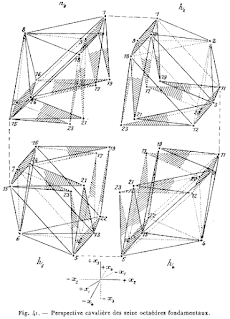
Jouffret diagram
Diagram from Jouffret's 'Traité élémentaire de géométrie à quatre dimensions'


This print is about how movements in art can be connected with contemporary math and physics (and other sciences). Specifically, the way Cubism breaks from a single favoured perspective or absolute frame of reference and attempts to break down subjects into geometrical shapes from multiple points of view can be tied to advancements in non-Euclidian geometry in mathematics, special relativity (published by Einstein in 1905) and the revolution in early 20th century physics. Picasso and his circle were specifically introduced to the mathematics of the fourth dimension and Non-Euclidian geometry by his actuary and enthusiastic amateur mathematician friend Maurice Princet, who gave him the book 'Traité élémentaire de géométrie à quatre dimensions' (Elementary Treatise on the Geometry of Four Dimensions) by Esprit Jouffret, a popularization of Henri Poincaré's 'La Science et l'Hypothèse' (Science and Hypothesis). Jouffret's book includes many diagrams of four dimensional objects like hypercubes projected on the 2D surface of a page. Princet also spoke to Picasso about the work of polymath Henri Poincaré. Picasso realized that this approach to 4D geometry captured the how he wanted to depict two points of view simultaneously and art historians can trace the influence of this geometry in his earliest Cubist paintings. So I have made a Cubist style portrait of mathematician, physicist, engineer and philosopher of science Henri Poincaré (1854-1912).

Henri Poincaré 
(photograph published in 1913, via Wikipedia)


Pointcaré was called "The Last Universalist" since he excelled in such a wide range of mathematics including pure and applied math, mathematical physics and celestial mechanics. Chaos theory and the idea that deterministic systems can have sensitive dependance on initial conditions (colloquially known as the butterfly effect) seemed to explode on the scene with increasing applications in the 1980s but in fact some foundations were laid a century earlier by Poincaré. He was the first person to discover a deterministic system which exhibits chaos in the three-body problem (or how a system of  3 masses behave over under Newton's Law of Universal Gravitation). The three circular shapes in the background allude to the 3-body problem and the spiral is a hint at the chaos in the trajectories. He is considered a founder of the study of topology (how geometric properties are preserved under deformations) and stressed the importance of the invariance of physical laws under various transformations. Special relativity tells us that light speed is the universal speed limit, and that space and time are not absolute. As things approach this speed limit they experience length contraction and time dilation. We use Lorentz transformations to compare length and duration in differing frames of reference. It was Poincaré who wrote the Lorentz transformations in their modern form. He discovered the Lorentz transformations for velocity and the invariance of Maxwell's equations (for electricity, magnetism and light), which was vital part of special relativity. He published a short paper in 1905 which Einstein did not see until after he had published his own independent and revolutionary paper on special relativity. Poincaré also proposed gravitational waves, travelling at light speed from masses. It's hard to over-state his importance to 20th century math and physics.

Pablo Picasso, Portrait of Ambroise Vollard, spring of 1910 (Pushkin Museum, Moscow)

Poincaré himself worked quite intuitively and wrote, "It is only through science and art that civilization is of value."

One of the ways in which Special relativity is strange is that we discovered the problem of simultaneity. If there is no absolute frame of reference, there is no simultaneity; observers in different inertial frames of reference (that is going different speeds*) will not agree on the sequence of events or even whether two things happen at the same time. This problem of simultaneity, it can be argued, is exactly what interested Picasso, when he chose to paint two different points of view on the same canvas. This is the argument made by Miller, author of 'Einstein, Picasso: Space, Time and the Beauty That Causes Havoc' makes. Leonard Schlain, in 'Art & Physics' makes the case that Picasso in painting all sides of an object simultaneously as if he was seeing space as all here in the everlasting now, was depicting what a viewer would see astride a beam of light at the universal speed limit when time has reached its maximum dilation to the present (and only the present). 

Earlier art historians, and in fact Einstein when asked, argued that Cubism wasn't connected to relativity or non-Euclidian geometry but I think each under appreciated the other. The art historians argued the artists had no knowledge of Einstein, or Minkowski (who combined space and time into the 4D spacetime), equations or pure math. Einstein preferred earlier classical painting and argued "This new artistic 'language' has nothing in common with the Theory of Relativity" but then, he felt contemporary art and music had both degenerated. If we are less literal, I think the connection between the two movements is quite clear. There is no absolute frame of reference and both art and physics were revolutionized by this realization.

Schlain makes a further argument connecting Cubism with relativity but noting that colours also change with speed, as length contracts (including the wavelengths or colours we would observe), and colours would be merge as what is in front and behind become one. He argues we would be left with neutrals at the speed of light: white (of white light), black (of its absence),  and muddy tones of mixed colours brown and grey. These are precisely the colours Picasso and Braque used in their early Cubist paintings, and the colours of my palette for my portrait of Poincaré.


*without acceleration and/or far from large masses, so we can ignore general relativity

References

William B. Ashworth, Jr., Scientist of the Day - Esprit Jouffret, Linda Hall Library blog, March 15, 2021.

Arthur I. Miller, Henri Poincaré the unlikely like between Einstein and Picasso, The Guardian, July 17, 2021

Did Picasso know about Einstein?, Physics World, November 1, 2002

Leonard Schlain, Art & Physics, Quill William Morrow, New York, 1991

Henri Poincaré, Wikipedia, accessed January, 2022

Wednesday, January 12, 2022

Prints inspired by art history

I am trying to participate in the #PrinterSolstice again this year. They have created a series of prompts for each of 13 weeks starting with the (northern hemisphere) winter solstice. This year the themes are based on 20th century movements in art. It's been challenging to find time; we're once again sheltering at home and schools have gone remote here. Facilitating remote school takes a lot of my time and I cannot print at the same time, though I can plan, draw and carve. 

We started with Abstract Expressionism, which is really outside my wheelhouse, since my prints are representational. But it gave me a chance to work intuitively to create a mono print with scraps of lino.

monoprint by Ele Willoughby, 2022


Next was Art Deco. I looked at a lot of Art Deco artworks. The frequent clamshell motif and the keyhole shape in Art Nouveau works, plus seeing a number of mermaid illustrations reminded me I had long wanted to illustrate the story of Mélusine, the legendary half-fairy ancestor of the House of Lusignan and royals including the Plantagenets, whose lower half became a serpent when she bathed. She marries a nobleman but insists he must never observe her in the bath; of course he does, and she leaves him - so the keyhole shape works just right to tell the story! There are many versions, like most folklore. Sometimes she has two tails, or a fishtail or wings. There are different versions of her name and various stories are found in different regions especially France, Luxembourg and the Low Countries. I first learned of her from Manuel Mujica Láinez’s The Wandering Unicorn, which tells her story through the centuries. Her story also appears in A.S. Byatt’s Possession amongst many other places from operas to video games.

Mélusine linocut, 8" x 10" by Ele Willoughby, 2022


These art history prompts have been a challenge to link to my art practice. I've  been seeking a connection to things like science art. The third prompt was Bauhaus. In looking at Bauhaus paintings I was reminded of nothing so much as Feynman diagrams, and the exuberance action on the quantum scale, so I decided to combine quantum physics with the Bauhaus vocabulary of lines, shapes and colour palette. 

I was thinking more of the paintings of Kandinsky than the regular geometric shapes in Bauhaus design: a welter of black straight, wavy and curly lines, stripes of colour, triangles, circles and concentric rings and washes of pale colour, often on a cream coloured background. 

The Feynman diagrams are a tool of particle and quantum physics to both denote a particle interaction and also can be used to make calculations of probabilities and physical properties. Straight lines denote particles (quarks and leptons like electrons). Wavy lines denote photons. Curly lines are gluons and the dotted line is a Higgs particle. I wanted to include an electron spontaneously giving off a virtual photo and particle-antiparticle pairs, production of a Higgs particle, one diagram of the sort of we see if we smash protons together, and one hilariously named penguin diagram (in this instance producing a gluon).

Feynman Diagram Bauhaus, linocut, variable edition, 8" x 10" by Ele Willoughby, 2022

Looking at all these prints as I try to plan ahead and link them to my art practice and science art I am reminded of Leonard Shlain's book Art and Physics. It should be around here somewhere but I can't find it on my bookshelves. (Aside: this house needs a librarian.) In the book Schlain linked major movements in art with advancements in physics. I am not sure I can agree with his thesis that movements in art presaged new physics (which feels like it violates causality to me) but I greatly enjoyed the book. Others have drawn parallels between art and physics and it's clear that both math and physics were an influence of some of these major modern movements in art. In fact, this has been true for centuries; consider for instance the development of artistic perspective, or the camera obscura. One of the obvious connections is between cubism and the math of the fourth dimension and the physics of relativity. So that is something I'm thinking about for an upcoming print.

Some of the other prompts (colour field, Dadaism, Fauvism, Harlem Renaissance, Minimalism and surrealism) are less obvious for me, but I'm thinking ahead. Op Art is rather clearly related to mathematics. I have a scientific idea for Conceptual art and the seed of an idea for Pop Art. Stay tuned for more!

Friday, December 3, 2021

Somewhat sinister holiday cards

 I decided to add to my collection of darker yuletide folklore cards, to go with the Yule Cat and made:


linocut Krampus card by Ele Willoughby, 2021

 
The relief print on each card shows Krampus, the scary horned counterpart to Santa of Alpine folklore, complete with birch rods, and naughty child in a basket.  The origins of this character are debated but there are traditional parades called the Krampuslauf or Krampus run, where young men dressed as Krampus and attempt to scare the audience with their antics in many Alpine towns, and  Krampus is featured on holiday greeting cards called Krampuskarten (which often read "Gruss von Krampus" or "Greetings from Krampus"). Krampus is usually hairy, horned, has cloven feet, a lolling long tongue and fangs. The bundle of birch branches or ruten links back to pagan times.

linocut Mari Lwyd card by Ele Willoughby, 2021

This lino block printed card shows Mari Lwyd, a traditional Welsh hobby horse in a field. As part of a wassailing tradition from South Wales, a hobby horse made of a horse skull on a pole, decorated with buttons and ribbons, with sack cloth shrouding the poll and porter is carried through the local area at Christmas time. The men performing with Mari Lwyd at dusk and into the night would request entrance to houses through song, and if admitted must be given food and drink. 

The name Mari Lwyd (pronounced "lood") might come from Holy Mary or grey mare. The source of the tradition is debated but can be linked to various British hooded animal traditions.

linocut Joulupukki, or the Yule Goat, card by Ele Willoughby, 2021

The relief print on each card shows the Yule Goat, Joulupukki of Finland, carrying his parcels, staff with lantern, and bedecked with bells and ribbons in this nighttime scene. Each card is 4.25" by 5.75" (11 cm by 15 cm) and the envelopes are 5.12" x 7.12" (13.5cm x 18.5 cm).

Joulupukki is a Finnish Christmas figure whose name translates as Yule or Christmas Goat. Pukki comes from the Teutonic root "bock", which is a cognate of the English "buck", and means "billy-goat". There is an old tradition of men dressing as a goat at Yule in Finland. These nuuttipukki were evil spirits who would go from house to house demanding gifts and leftovers from the Yule feast. But over time the concept of nuutipukki merged with the idea of Santa Claus and became the benevolent Joulupukki who gave out gifts, rather than claim them, to well-behaved children. But in some areas, nuuttipukki still make visits on Nuutinpäivä, or St. Knut's Day, January 13. 

Yule goats (Julbocken) are common in Nordic countries, as small decorative straw or wicker ornaments decorated with red ribbon or giant ones like the Gävle goat in Sweden, a frequent target of arson. Some argue they are linked to Thor, who rode in a goat-pulled chariot. But others argue it is even more ancient and links to proto-Slavic beliefs where Koliada or Yule honors the god of the fertile sun and the harvest who was represented by a white goat. So Koliada festivals always had a person dressed as a goat, often demanding offerings in the form of presents.

linocut Perchta card by Ele Willoughby, 2021

This linocut card shows Perchta or Berchta (or Bertha in English), a figure from Alpine folklore, who visits during the 12 days of Christmas. Her name may come from "the bright one" or the German word for the feast of the Epiphany and her history is linked to white robbed goddesses like Holda who oversaw spinning and weaving or the goddess Frigg and she emerged from Germanic and Celtic traditions in the Early Middle Ages. She has two forms, both shown in my print: young and beautiful and as white as snow, or an old crone with a long knife and often a beak-like nose. She sometimes has one large, possibly goose foot. Jacob Grimm (of fairy tale fame) thought this indicated she was a shapeshifter or swan maiden. She is associated with birch trees and looked over the forest and wildlife. She was said to visit homes during the 12 days of Christmas and enforce cultural taboos, such as not spinning on holidays. If young people were good (and completed duties like spinning their flax or wool) she would leave a silver coin. But if not, she would slit their bellies open and stuff them with straw or refuse! Between the beautiful and ugly forms of Perchta I include a spindle. In her beautiful form she was known as Grandmother Winter, the bringer of snow

Some legends associate her with the Wild Hunt, and claim she rides through the night sky with her Perchten. 

In contemporary alpine festivals she is accompanied by an entourage, the Perchten, either beautiful and bright Schönperchten who bring luck or ugly Schiachperchten with fangs, tusks and horse tails (resembling Krampus) who are supposed to drive out ghosts and demons. She is viewed as the one who rewards generosity and punishes bad behaviour. 


Thursday, October 21, 2021

Bioluminescent Firefly Squid and some borbs

 A couple of other recent prints which actually came from the weird and wonderful AI-generated #Botober2021 art prompts for "Firefly squid" (a surprisingly normal suggestion for an actual existing animal) and "impossibly cute pudgy birds".


Firefly Squid, linocut, 8" x 8" by Ele Willoughby, 2021

This is a linocut print of the firefly squid (Watasenia scintillans), also called sparkling enope squid or hotaru-ika in Japan. These tiny squid live at depth (200 to 400 m) and they are bioluminescent and emit blue light from photophores. The print shows the squid against a white background so you can see the whole animal and then its reflection is shown against dark blue so you can see how its bioluminescence would appear underwater with fluorescent blue spots. Each print is 8" x 8" (20.3 cm x 20.3 cm) on white Japanese kozo (or mulberry) paper. When they spawn on the shores of Japan visitors come to see the blue glow and they are a boon to fishermen who collect the dying squid. 


Tufted titmouse linocut holiday card by Ele Willoughby, 2021


Wednesday, October 6, 2021

The Icelandic Yule Cat Jólakötturinn

So every year for several years now, a lot of artists do all the Inktober daily art prompts, and there are now a whole slough of various prompts. There are even a fairly large number of #sciart prompts. I thought I would do the "AI weirdness" neural net generated prompts by Janelle Shane called #Botober2021. I think the only way to manage daily brand new art is to keep it low key, so I'm keeping it simple, posting to Twitter (@minouette) and my Instagram stores (@the.minouette) only. Mainly there's pen and ink sketches. I am going to try and fit in a couple of linocuts. There's an upcoming prompt which made recall a mythological creature I have previously considered. I rather like all the various holidays (many pagan and ancient) which coincide roughly with Christmas time and how some of them are more spooky than festive, as we, in the northern hemisphere, approach the solstice and the longest nights. The prompt is "way too much cat" and what came to mind was the Icelandic Yule Cat, Jólakötturinn.


Linocut of the Yule Cat
Linocut print Yule Cat, by Ele Willoughby, 2021

The first written accounts of Jólakötturinn, enforcer of good behaviour leading up to Christmas, date to the 19th century but the stories of the monster cat likely date to the Dark Ages. In Iceland, good children who did their chores received new clothes, but the lazier ones risked meeting the giant Yule Cat, who towered over houses. If there were no new clothes amongst their gifts the Yule Cat would eat them! The Yule Cat was intended to also inspire generosity and encourage giving clothing to the less fortunate.

I have added a couple of sets of hand printed Yule Cat cards to my shop. I think I might get some digitally printed so I can make more cards.

You can find Bjork singing a carol about Jólakötturinn here, and if you haven't already done so, do yourself a favour, and check out Luke Pearson's Hilda graphic novels or the animated Netflix series - where you'll also find the Yule Cat and other trolls and Yule lads from Icelandic folklore.