


Wednesday, June 29, 2016
Minouette

Sunday, June 5, 2016
Moss Piglets and Cameras - Some Etsy News
 |
| Voting ends tomorrow! If you haven't yet had a chance, please take a moment to vote for my mighty Tardigrade for the #EtsyAwards! |
| Right now, Canon is partnering with Etsy! As part of their #EtsyXCanon promotion, Canadian Team Captains can share a promo code which adds a special quarterly promotional discount to your overall sale price on purchases in the Canon eStore! So if you are in the market for any Canon cameras or other products, be sure to take advantage by applying my promotional code at the checkout: ETSYXCANON1689 |

NB: promo code only works on the Canadian Canon website
Tuesday, May 24, 2016
Tardigrade for Etsy Awards!

I hope you're having a fabulous Victoria Day! I had a wonderful surprise this morning. I've been selected as one of the @EtsyCA #EtsyAwards finalists! My linocut Tardigrade stuffie is in the running in the Kids & Baby category!

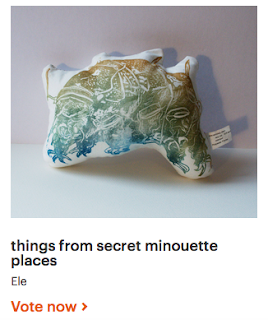
I hope you'll vote for me! You only get one vote, but you'll want to support the nearly indestructible, microscopic water bear (or if that isn't cute enough, the moss piglet). Ever finalist is in the running for the Community Choice award, worth $10,000!
Friday, May 20, 2016
Bees & Stars: Opening, Book Launch and Album Cover
 |
| The 'Bees of Toronto' and the page featuring my bee art |
I might not have gone to City Hall, but I was tickled by the idea of having a day where I could swan around from book launch to art opening, and was intrigued to meet some of the others involved in this great series of books. I think the City does have reason to be proud that they have manage to bring together a this collaboration with natural historians at the Royal Ontario Museum, as well as local academic scientists (particularly from York University for the bee book), the Toronto Public Library and the TDSB, as well as artists, writers and other contributors. I got a chance to meet some of the researchers involved, as well as artist Charmaine Lurch. When we got to talking, I figured out that I have seen her bee sculptures at Nuit Blanche. Because the world is very small, we also figured out that we have a couple of friends in common in Sarah Peebles (who got me involved in this book in the first place) and Christine Pensa (who curated the bee show as well as being part of our TEST & Made in Canada team). Charmaine ended up walking with me from City Hall to Graven Feather and we talked about balancing family life with working in the arts, whether my experience avoiding corrosion at the bottom of the ocean could help her make more weather-proof wire sculptures and some of the great projects she's working on including an illustrated historical novel set in Toronto, and bring STEAM teaching into the schools using both her bee works and knowledge and also talking about Henrietta Lacks and HeLa cells.
Some of the biologists who were at City Hall also came to the art show and I heard that Prof. Packer (who leads the bee lab at York) approved of the message of my piece. It was very crowded so while I managed to speak with his wife (a bird researcher) he actually gave a friendly thumbs up from across the room.
 |
| Some of the 'Bee (& the Birds)' show including Japneet Kaur (or Story of a Seed)'s ceramic plates and my mixed media 'Solitary bees don't dance'. If you aren't following Japneet's instagram you are missing out - and I don't say that lightly! Her drawings and ceramics are magic and her feed is filled with whimsical stop-motion animations. |
 |
| Some more favourites: at the bottom left is my friend Michelle Reaney's recognizable bold, graphic style and the four tiny paintings on the right look like trails made by bees by bookbinder Carolyn of Sprout's Press Designs. Oh... and the one which looks like a black and white photo is in fact drawn in ballpoint! I must find the artist's name because it's the most amazing thing. There were many others I didn't get a chance to photograph well. Don't miss Christine's own work, all the fabulous prints (relief prints, serigraph and etchings), and clever textile works by Michelle and Katie Sorrel. |

 |
| My Taurus constellation linocut in the album art for 'Lay Low Butterfly' by Anton Vezuv |
yes, well, bull is usually visualized with head down. like your artwork. because bulls are fightin like this. BUT, with heads down they look kinda sad and vulnerable also. so for me this figure show strength and sensitivity. that's why I wanted a bull figure, and our producer found your artwork somehow, and it has a cool style, kinda handmade-vintage-illustration stuff which fits to the art concept.so I'm pleased to be involved, and I love the idea of my art making its way out into the world and into unexpected places, like schools in Toronto, or albums in Budapest.
Tuesday, March 29, 2016
Dance of the Honeybee
 |
| Honeybee Dance, 9.25" x 12.5", linocut by Ele Willoughby, 2016 |
Years ago I read the most marvellous speculative essay by Ursula K. Le Guin, 'The Author of the Acadia Seeds' (written in 1974) about therolinguistics, the scholarly study of communication in non-human animals. There is translation of fragmentary ant texts, a discussion of a glossary of Penguin and its assorted dialects with comparisons to Dolphin and other Cetacean languages, Fish texts and so forth. The essay culminates with an editorial calling for the study of possible plant communication or art... but warning, "For it is simply not possible to bring the critical and technical skills appropriate to the study of Weasel murder mysteries*, or Batrachian erotica, or the tunnel sagas of the earthworm, to bear on the art of the redwood or the zucchini," - to give you a taste of this wondrous fiction. What I particularly love is that it is written not as science fiction so much as speculative science, much in the same way that I am trying to write about my imaginary miniature linocut menagerie in progress. And of course, in the 40 some odd years since Le Guin wrote her essay, there has been a lot of actual scientific progress on animal communication - and in fact language. Not only are there non-human primates who have been taught to sign, but there is evidence that animals have words (including evidence of prairie dogs who "describe" humans by size and clothing colour, or gibbons who have specific words for cloud leopard or snake, and of course the incredible complexity observed in whale song, as explained in this great blog I stumbled upon while trying to recall the name of Le Guin's essay). For that matter, there has been significant progress in studying plant communication too!
You may have heard about honeybee communication and how they pass information from one another through dance. One of the sorts of dance is the subject of my print. A worker bee can return to the hive and through the way it aligns itself with respect to the sun and the honeycomb, the waggles and loops of its movement convey information on the location in terms of distance and direction of tasty flower pollen sources to its fellow bees.
 |
| 'Bees of Toronto' and description and images of some of my bee art. |
I am considering making a more complex piece which incorporates this print along with other types of bees, to submit to the show. Part of my motivation is to "think locally". Honey bees are not native to North America. While the Colony Collapse Disorder is of great concern and honey bees are very popular, if our aim is to protect pollinators, we should perhaps focus attention on native bees. In fact, as York University's Prof. Sheila Colla points out, European honey bees are in fact "fierce competitors for pollen and nectar and can transmit diseases to our wild bees" and that we should encourage biodiversity of pollinators for ecosystem health, rather than encouraging the honey bee. I've been thinking about all this particularly since I recently received copies of 'Bees of Toronto,' which has been in the works for a few years now. Part of their ongoing series about biodiversity in the city, it includes information about the hundreds of bee species who live here, where and when you can see them and what you can do to help our beleaguered pollinators.
It also includes some cultural history of bees in Toronto and features
the work of local artists (visual art, sound and poetry) inspired by
bees, including my linocut and multimedia bee series. I especially love the gorgeous photos from the bee researchers at York University. If you're interested in our urban wildlife and conservation you should check this series out! Full pdf of released volumes can be found online. Complete with introduction by Margaret Atwood (and I am chuffed to think my words are published in the same book as hers).
*This also makes me happy because as a child, my mother kept my brothers and I occupied by telling us stories on long car trips, and I'll always remember the lengthy gopher murder mystery she spun as we slowly crossed the Prairies.
Tuesday, March 8, 2016
SciArt, women and wunderkammers
 |
| my linocut portraits of women in STEM, left to right, top to bottom: Hypatia, Skłodowska-Curie, Nightingale, Atkins, Leavitt, Jemison, Merian and Lamarr |
 |
| my linocut portraits of women in STEM, left to right, top to bottom: Anning, Wu, Lovelace, Lehmann, Kovalevski, Tharp, Bell (Burnell), Meitner, Herschel |
I'm sharing my women in STEM portraits for International Women's Day today. We're fresh off the second annual #SciArt tweetstorm, which is rapidly becoming a fabulous institution on Twitter. For the second year, the first week of March has been a celebration of the place where art and science intersect - everything from technical drawings and data visualizations to comics to fine art in all media to textiles and fashion and basically, whatever you can imagine. It's a great way to find like-minded creators and share your work, brought to us by the great team at the Symbiartic blog on Scientific American.
Like other participants I'm really thankful for this opportunity to connect with a greater audiance. This just blows my mind. I've shared my leaf prints before and usually get great feedback, a few favorites and retweets, but during the tweetstorm this was the response:
Leaf colour chemistry: my leaf prints & linocut organic molecules which cause colour #SciArt https://t.co/ibXr4AGlHb pic.twitter.com/AIXMcsZ9T0
— Ele Willoughby (@minouette) March 5, 2016
Though my friend @faunalia likes to think I'm some sort of craft celebrity, I'm not remotely famous and 107 retweets and 130 favorites are astronomical numbers for me! The tweetstorm brought my art to the eyes of chemists and plant scientists. It really has the power to help bring people together and forge a SciArt community.
 |
| Some SciArt from TEST teammates: The Vexed Muddler, Slashpile Designs, nanopod, The Chemist Tree, Honey Thistle, HOPSCOTCH, Tanya Harrison Photo and Wild Whimsy Woolies |
 |
| This is a photo I took of the window of Evolution, NYC, June 18, 2011 |
Tosca said she would like more stuffed things and I think I really must make tardigrades. By the way, I printed a linocut tardigrade last week. If you don't know, these mighty microscopic creatures of 0.5 mm (0.02") maximum in length are found in environments from mountaintops to the deep sea, from tropical rain forests to the Antarctic, and can survive conditions leathal to most other animals including: temperature ranges from near absolute zero 1 K (−458 °F; −272 °C) to about 420 K (300 °F; 150 °C); roughly six times the pressures found in the deepest oceanic trenches on Earth; ionizing radiation at dosages hundreds of times what would kill a mere human; the vaccuum of space. That's right; these animals have been to outer space and lived to tell the tale (or, at least lived and had someone tell the tale). The can go without food for 30 years, dehydrate, and then just rehydrate and go about their lives.
 |
| Tardigrade, linocut 8.5" x 11" on Japanese paper, Ele Willoughby, 2016 |
Tardigrades have short, plump legs and are prevalent in mosses and lichens and feed on plant cells, algae, and small invertebrates, hence their second nickname in case "water bear" isn't cute enough for you: the moss piglet. Tardigrades have been around at least 530 million years to the Cambrian. Don't you think it would make a cuddly plushie?
When you're done catching up on the #SciArt hashtag on Twitter, be sure to look up #5womenartists - another great one for this #WomensHistoryMonth. It occurs to me that all the work I'm writing about here today are all by women artists, and if you like what I do, you'll love their work too.
Friday, February 12, 2016
Snowflake Beetle
 |
| Snowflake Beetles, linocut with chine collé 18 cm x 18 cm, Ele Willoughby 2016 |
Both their minute size and their successful camouflage adaptation have long hid the Snowflake Beetle from discovery. The Coleopterans include more species than any other order, and the diversity of beetles is very wide. Yet, the Snowflake Beetle is exceptional in several ways. At a typical size of 1.5 m (0.06"), they belong to the Ptiliidae, a highly diverse yet poorly known group of minute beetles, and are amongst the smallest beetles anywhere in the world. Like other ptiliids they have feathery wings and are colourless to white throughout their lifecycle. But unlike any other beetles, they thrive in high latitudes, high altitudes and polar regions where snow is abundant. Other arthopods do live in snow, including mites, snow fleas and some spiders, but insects and beetles in particular were previously unknown in such cold conditions. It is believed that they make a warm little burrow or igloo in the snow and farm fungus for food. Like aquatic beetles, it is believed they hold a pocket of air between their abdomen and elytra (the snowflake shield) to breathe when "diving" in snow.
*It should be noted that the adage "no two snowflakes are alike" is in fact just an adage. It is virtually impossible to prove the non-existence of any naturally occuring snowflake twins. Simple hollow collumn snowflakes are quite common and observers do report (subjectively) identical flakes. Essentially identical snowflakes - even complex ones with hexagonal plate symmetry and elaborate dendrites - have been produced in the lab. While photographic evidence of naturally occurring identical snowflakes may be lacking, it's actually unlikely that they never occur. So, strictly speaking it is more precise to say that Snowflake Beetles are as variable in pattern as snowflakes in nature. Familiar snowflake forms including hexagonal plates, triangular patterns, 12-point star patterns, sectored plates, radiating dendrites, simple stars, stellar dendrites and fern-like stellar dendrites have all been observed on Snowflake Beetle shields. The six-fold symmetry, as in snowflakes themselves, is generally not perfect... though it may appear so at a glance.
________________________________________________________________________
An aside: Okay... the joy of my producing my "quite possibly imaginary" cryptozoology creature series is in inventing the fictional science and I would love to produce a book of them where I never explicitly stated this is SF. The point is to make a sort of scientific pastiche. The reader isn't literally supposed to be hoodwinked**... but needs to suspend disbelief to enjoy it. But, allow me to stop being coy and tell you a bit about the process of creating creatures. Hitting the balance of 'not quite plausible enough to fool' but 'real enough for us all to pleasurably pretend it's out there' is harder than I imagined, for an unexpected reason. Namely, the animal kingdom is a hell of a lot weirder and more varied than most of us know. For instance, I can safely assume that my far-out hybrids, like the Cactibou, Winged Walrus and Mandriltee, will be recognized as unreal animals. Though, hybrids are more common than I realized when I started this project. Merely playing with scale, habitat and amping up more unusual skills like biomimicry on the other hand, may not be enough. I think I inadvertently fooled someone with my Iceberg Squid. Likewise, I imagined the Snowflake Beetle, only to later learn that, of course, there are arthopods who live in snow... luckily for me, they happen to have the wrong number of legs to be insects or beetles in particular. I shouldn't be too surprised. A recent study which got a lot of press, showed that even our homes are complex biomes filled with thousands of insects and other arthopods. They're everywhere! Sometimes, like here, I rely on one peculiar, someone would say magical, attribute to indicate that the animal in question is "quite possibly imaginary". In this case, the idea that each one has its own pattern, as unique as a snowflake, may be the only thing which is unlikely enough to be untrue. Other "facts" are indeed true of existing beetles, including the surprising act of fungus farming or holding air bubbles under their elytra wing covering to breathe if submerged. The beetle igloo though might also be a tip-off.
**Friends will tell you I'm generally horrified when anyone is hoodwinked by pseudoscience, whatever its intentions.
Subscribe to:
Posts (Atom)