Wednesday, February 1, 2023

Jack Frost, astronomers Kepler and Lepaute and bees in snail shells

 I haven't kept up with posting all my recent prints, so today, we're playing catchup! I've been doing #printerSolstice so I have managed to make a print weekly tie to their prompts. This year the prompts are elements of art and design: value, form, line, balance, texture and upcoming are space, shape, contrast, proportion, unity, pattern and variety. I'm trying to interpret these prompts in light on my ongoing series of prints of various sorts. The first one, value (or the lightness and darkness of colours), I applied to another slightly sinister winter folktale: Jack Frost and made a print in tints and shades of cobalt blue.


Jack Frost, linocut on cardstock, 5" x 7" by Ele Willoughby, 2022

For form, I thought of Kepler and how he arrived at his laws from thinking about music and then the Platonic Solids!

Johannes Kepler, linocut by Ele Willoughby, 2023
Johannes Kepler, linocut, 11" x 14" on Japanese kozo paper, by Ele Willoughby 2023

This is my linocut of mathematician and astronomer Johannes Kepler (1571-1630). We remember him for his role in the Scientific Revolution, and his three laws of planetary motion in particular. His laws modified Copernicus’ heliocentric model; he replaced the circular orbits with elliptical ones & described velocities of planets. Today we know them as:

1) Planetary orbits are ellipses with the Sun as one of the foci (top magenta ellipse)

2) A line from Sun to planet sweeps out equal areas in equal time periods (middle ellipse)

3) The square of the planet’s orbital period (or year) is proportional to the cube of the semi-major axis (shown as the horizontal arrow in the bottom ellipse).

But, I find it fascinating- & important to note- that he came to these laws exploring mystical ideas about music, geometry and congruence with physical phenomena. Sometimes we tell simple, but misleading stories about scientific progress. 

First he argued that the spacing of the 6 known planets from the Sun were related to the 5 Platonic solids, each encased in a sphere and nested one inside another. He had to order them selectively: octahedron, icosahedron, dodecahedron, tetrahedron and cube. He then related the size of the spheres to the  orbital periods of the planets (Mercury, Venus, Earth, Mars, Jupiter and Saturn). But this formula was not precise enough…. But we can see this as the seed of his 3rd law. The gold shapes are the nested Platonic solids from his Mysterium Cosmographicum. 

He also took the medieval idea of the “music of the spheres” literally and translated planetary angular speed as measured from the Sun as musical notes and finds that the minimum and maximum speeds of neighbouring planets approximate harmonies. Though unrelated to our modern ideas about our solar system these explorations of geometry and music ultimately lead to his correct models, which in turn were a significant steps towards Newton’s Law of Universal Gravitation.

Next came line, and I made it about the line traced by an eclipse:

Nicole-Reine Lepaute, linocut by Ele Willoughby, 2023
Nicole-Reine Lepaute, linocut, 11" x 14" on Japanese kozo paper, by Ele Willoughby, 2023

This is my linocut portrait of Nicole-Reine Lepaute, née Étable de la Brière, (5 January 1723 – 6 December 1788). She was a French astronomer, mathematician and human computer. My print celebrates how she calculated the path of the solar eclipse of 1764. She also worked with Alexis Clairaut and Jérôme Lalande to much more precisely calculate the date of the return of Halley’s Comet. This is no mean feat when you realize this was essentially solving the notorious three-body by hand (as the gravitational pull of Jupiter and Saturn affect its orbit around the sun). They worked in parallel, calculating for 6 months straight, barely stopping to eat! She also produced astronomical almanacs from 1759 to 1783 and was also a member of the Scientific Académie de Béziers.

Some of the historic women of science whose names and achievements were recorded, are known to us because of their wealth and privilege. Though Nicole-Reine Lepaute was born in Luxembourg Palace, she was not an aristocrat; she was the sixth of nine children of the valet of the duchess de Barry and her sister. A bright child, she was self-taught and devoured all the books in the library. Her later friend and long-time collaborator, astronomer Jérôme Lalande wrote that she had "too much spirit not to be curious." 

She married the royal clockmaker Jean-André Lepaute, in the Luxembourg Palace, in 1764. She became responsible for the household accounts but her marriage also allowed her to pursue her interest in mathematics and astronomy. She applied her skills to document, observe and calculate the workings of all her husband's inventions. The Académie des Sciences sent Lalande to inspect her husband's new type of pendulum clock. The three worked on the theory of clockmaking and added to her husband's "Traité d'horlogerie," which he had published in 1755. Though she was not included as a co-author, Lalande was nothing but praise for her, writing, "Madame Lepaute computed for this book a table of numbers of oscillations for pendulums of different lengths, or the lengths for each given number of vibrations, from that of 18 lignes, that does 18000 vibrations per hour, up to that of 3000 leagues"

Though Newton's Law of Universal Gravitation, published in 1687, allowed astronomers to calculate planetary orbits around the sun, to do so they considered only the two bodies: the mass and position of a single planet and the sun. The truth is more complex, because all masses exert gravity, and as soon as we introduce even a third mass there is no general closed-form solution and some systems are even chaotic. The first problem studied was the Sun-Earth-Moon 3-body problem, which Newton could not solve and succeeding generations continued to pursue. Early physicists became so frustrated that they began to doubt Newton's Law of Universal Gravitation. Renown mathematician Leonard Euler even wrongly argued against the inverse square law. Being able to accurately predict the Moon's orbit had huge implications for navigation and determination of longitude at sea. Competing polymaths Jean le Rond d'Alembert and Alexis Clairaut each presented their analyses of the problem to the Académie Royale des Sciences in 1747. Clairaut had found a brilliant approximate solution to the 3-body problem for which he received the 1750 prize of the St Petersburg Academy for his essay "Théorie de la lune". 

In 1757, Lalande decided he improve on the predictions of a different 3-body problem: the return of Halley's Comet, last seen in 1682. Because the gravitational pull of Jupiter and Saturn cannot be neglected, Halley himself was only able to calculate that the comet would return "around the end of the year 1758 or the beginning of the next." He enlisted the help of Clairaut and Lepaute.  The divided up the calculations required and worked in parallel for more than 6 months, barely even stopping to eat! They were in a race to make their prediction before the comet itself arrived. By November 1758 they gave a two-month window for comet's perihelion (closed point to the sun) of the 15th of March to the 15th of May, centered around the 13th of April 1759.  They missed the comet's arrival, the 13th of March, 1759 by only a couple of days. Sour grapes Jean d'Alembert griped that their work was "more laborious than deep". In fact, their heroic efforts were a huge technical feat and ten-fold improvement on Haley's vague two-year window. Their error was only due to employing the less-than-accurate accepted masses for Jupiter and Saturn. Notorious ladies' man Clairaut unfortunately removed any mention of Lepaute from his 1760, "Théorie du mouvement des comètes", alledgedly to please another woman, whereas in Lalande's "Théorie des Comètes" he insists they could never have made the calculations without her. 

Lepaute went on to collaborate with Lalande and his calculations for decades. In 1759 Lalande became the director of the  Académie des Sciences astronomical almanac Connaissance des Temps (Knowledge of the times) and appointed Lepaute as his assistant. He prepared computing plans and she did the calculations for the almanac. Her work included calculations on a 1762 comet, and a table of parallactic angles, work on the Éphémerides, annual guides for astronomers and navigators, calculating the daily position of Saturn from 1775 to 1784 (for the seventh volume, in 1774). She calculated on her own the daily positions of the Sun, Moon and planets for the eighth volume (in 1784).

In 1762 she calculated the exact time and path of the annular solar eclipse of 1st of April, 1764. Under her own name, she published a map which showed the eclipse's extent over Europe (shown in green in my print), as well as the its successive phases in 15-minutes intervals as would be visible over Paris (shown in blue in my print).

She and her husband were childless but adopted his nephew, Joseph Lepaute Dagelet in 1768 and she trained him as a mathematician and astronomer. He became a professor and was inducted in the French Royal Academy of Sciences in 1785.

Despite how vital, and Lalande's vocal appreciation, her work remained largely unrewarded and unrecognized during her lifetime. She worked as computer for Lalande for 15 years while he was a professor and director of the Paris Observatory. She did became a member of the distinguished Scientific Academy of Béziers in 1761, and calculated the ephemeris of the 1761 transit of Venus for them. Her eyesight after decades of calculation deteriorated to the point that she had to retire in 1783. She spent the end of her life caring for her terminally ill husband. After her death in 1788, Lalande wrote a biography of her contributions which he included in his Astronomical Bibliography. Both an asteroid (7720 Lepaute) and a lunar crater have posthumously been named in her honour.

For Balance, I made my portrait of Zhang Heng (see previous post).

For Texture, I made a print of an Eastern Snail Shell Mason Bee, Osmia conjuncta. 

Eastern Snail Shell Mason Bee, linocut by Ele Willoughby, 2023
Eastern Snail Shell Mason Bee, linocut 8" x 8" on Japanese kozo paper, by Ele Willoughby, 2023

The Packer Lab at York University posted an image of this mason bee, Osmia conduct, and explained that these adorable little blue snail shell nesting bees had now been observed in Canada (southern Ontario) and to be honest, I'm completely obsessed with the idea. I think it's the cutest thing I've ever heard. Apparently, they think these bees have become more common here because there are now so many of the Cepaea snails, introduced from Europe. So, while I couldn't find any images of this bee nesting, I illustrated it with a Cepaea shell. You can find images and video of other Osmia bees nesting in snail shells online. Many thanks to the friendly and helpful Entomology Twitter folks who helped me track down the right type of snail shell and even introduced me to researchers who said they would try to get video of these cuties next field season!

I will miss Science Twitter when it's gone.

References for scientist bios

Johannes Kepler, Wikipedia, accessed January 2023

Nicole-Reine Lepaute, Wikipedia, accessed January 2023

Jérôme Lalande, Wikipedia, accessed January 2023

Alexis Clairaut, Wikipedia, accessed January 20223

Lynn, W. T. (2 January 1911). "Madame Lepaute". The Observatory. 34: 77–78. Bibcode:1911Obs....34...87L. 

Bernardi, Gabriella (21 March 2016). The Unforgetten Sisters: Female Astronomers and Scientists before Catherine Herschel. Springer. pp. 121–127. ISBN 9783319261270.

De La Lande, Jérôme (1803). Bibliographie astronomique avec l'histoire de l'astronomie depuis 1871 jusqu'à 1802 (in French). Paris: Imprimerie de la République. ISBN 978-2329549170. Archived from the original on 4 May 2010. 

Connor, Elisabeth (November 1944). "Mme. LePaute, An Eighteenth Century Computer". Astronomical Society of the Pacific Leaflets. 4 (189): 314–321. Bibcode:1944ASPL....4..314C.

Friday, January 20, 2023

Ancient seismology and Chinese polymath Zhang Heng

Detail of linocut 'Zhang Heng' by Ele Willoughby, 2023 on 9" x 12" washi paper. 

This is a linocut print about the ancient Chinese Han Dynasty polymath and statesman Zhang Heng (78-139) who invented a device (a seismoscope, like a simplified seismometer which does not make a record of earth motions) to detect distant earthquakes and indicate their direction, 2000 years ago! I have shown him in blue with a reconstruction of his seismoscope, and a schematic of how it might have worked in bronze, as well as horizontal earthquake surface waves, and Rayleigh waves in particular, in pale pink.

A career civil servant in Nanyang, Zhang Heng (sometimes formerly written Chang Heng) was also an astronomer, mathematician, seismologist, hydraulic engineer, inventor, geographer, cartographer, ethnographer, artist, poet, philosopher, politician, and literary scholar. He was a bit of a controversial figure politically, sparing over calendar reform and with rivals amongst the palace eunuchs. But both his poetry and famous inventions are still remembered. He also improved the Chinese approximation for π and made an extensive star catalog. He understood that the Sun and Moon are spherical, and that the Moon merely reflects the light of the Sun. He also explained the nature of solar and lunar eclipses. He invented the world's first water-powered armillary sphere for astronomical observation; improved the inflow water clock by adding another tank; and, as celebrated here, he invented the world's first seismoscope, which recorded distant earthquakes and their origin (in terms of 8 cardinal directions).

China is a seismically active place, and while the cause of earthquakes remained misunderstood, in 132 Zhang Heng was able to design a device to detect seismicity from distant sources. It was named "earthquake weathervane" (hòufēng dìdòngyí 候風地動儀), and it could roughly indicate where the earthquake came from. According to the Book of Later Han (compiled by Fan Ye in the 5th century), his bronze urn-shaped device, with a swinging pendulum inside, was able to detect the direction of an earthquake hundreds of miles/kilometers away. The outside of the device was described as having 8 dragons with balls in their mouths and 8 open-mouthed frogs around the base which could catch fallen balls (and indicate direction to the source). If there was an earthquake the dragon facing its location would drop a ball into the mouth of a frog below. The Book of Later Han claims that the device was triggered by an event, which was too subtle for people to feel but that the west-facing dragon drop its ball. Officials doubted the device worked as intended, but several days later a messenger arrived from the west and reported that an earthquake had occurred in Longxi (modern Gansu Province). So, the court acknowledged it in fact worked.

Unfortunately, no ancient Chinese seismoscopes have survived and details of the mechanism are sparse. The description of the detected earthquake was written much later. So, we cannot be certain about how it worked precisely; some even doubt that it did. Later Chinese inventors were not able to reconstruct the device. However, a series of modern seismologists have put forward a series of reconstructions. There are several ways a pendulum could trigger a ball to fall. Some of the questions include: was it a regular pendulum? Was it an inverted pendulum? How was its motion transferred to the appropriate dragon and not to any other dragons? How it avoid "false positives" due to other sources of shaking? 

As a geophysicist myself, I find the contemporary reconstructions of Feng Rui and others pretty convincing, so that's what I have illustrated. These scientist argue that the device would have detected horizontal motions due to surface waves which would only be due to earthquakes, and would not be set off by vertical motions (which can be caused by earthquakes or nearby shaking, say, due to people). So they built a reconstruction which they argue is consistent with the description, but detects Rayleigh surface waves. They argue by adding a second ball inside the device, it could have avoided having two opposing dragons triggered. In their model, illustrated in my print, when there is an incoming wave, for instance, from the west, the pendulum would move from west to east. They made a hollow inside, so the pendulum would drop a ball, falling on the west side as it moves off-centre. The ball follows one of 8 radiating tracks, then pushes a lever connected to the dragon mouth and the west-side ball - and no others - would fall. This would correctly identify the direction.

They also make arguments explaining that some reconstructions are not the right style of urn or dragon, arguing that Han Dynasty dragons would have been much simpler than the fancy Ming Dynasty ones shown on some reconstructions. So my illustration tries to respect the archeology of ancient Han artifacts, as well as a mechanism which apparently avoids the pitfalls of previous reconstructions. I also included a waveform, which seismologists will recognize as a horizontal Rayleigh wave (detected by a modern seismograph).

Sources

Zhang Heng, wikipedia, accessed January 2023

Feng, Rui and Yu Yan-xiang, Zhang Heng's Seismometer and Long earthquake in AD 134, Acta Seismologica Sinica, 19, 704-719 (2006)

Feng, R., Wu, Y. Research on history of Chinese seismology. Earthq Sci 23, 243-257 (2010). https://doi.org/10.1007/s11589-010-0720-z

Hong-Sen Yan, Kuo-Hung Hsiao, Reconstruction design of the lost seismoscope of ancient China, Mechanism and Machine Theory, Volume 42, Issue 12, 2007, Pages 1601-1617, ISSN 0094-114X, https://doi.org/10.1016/j.mechmachtheory.2007.01.003.

Zhang Heng Seismoscope, Atlas Obscura 

Jamie Rigg, The ancient earthquake detector that puzzled modern historians, engaged, September 28, 2018

Andrew Robinson, The world's first seismometer used a toad to catch an earthquake, New Scientist, 30 November 2016


Tuesday, November 29, 2022

Barrel Cortex, and more Cyanotypes

Hendrik van der Loos linocut portrait by Ele Willoughby
Hendrik van der Loos, linocut print, 11" x 14" by Ele Willoughby, 2022


This was a custom order I made earlier this fall: A linocut of neuroscientist Hendrik Van der Loos (1929-1993) and his discovery (along with medical student Thomas Woolsey), of the barrel cortex, along with the mouse head & whiskers linked directly to it.

Some species of rodents have a region of the somatosensory cortex that was named the #barrelcortex after its shape, and which contains the barrel field. The 'barrels' of the barrel field stain darker than neighbouring regions (within cortical layer IV) when stained to reveal the presence of cytochrome c oxidase. These dark-staining regions are a major target for somatosensory inputs from the thalamus of the #brain, & each barrel corresponds to a region of the body! Most distinctively, the whisker barrels, structures were first discovered by Woolsey & Van der Loos in 1970, come in an array, similar to the way whiskers are arrayed & they hypothesized that they could be matched up & each barrel represents 1 whisker. Due to this distinctive cellular structure, organisation, & functional significance, the barrel cortex is a useful tool to understand cortical processing & has played an important role in neuroscience. The majority of what is known about corticothalamic processing comes from studying the barrel cortex, and researchers have intensively studied the barrel cortex as a model of neocortical column. The whisker barrels are the focus of the majority of barrel cortex research, and 'barrel cortex' is often used to refer primarily to the whisker barrels.


Cyanotype skeleton by Ele Willoughby
Cyanotype skeleton


Cyanotype skeletons by Ele Willoughby

I made several cyanotypes of my skeleton linocut on acetate along with leaves and wildflowers. A couple turned out quite pale and ghostly with the skeleton barely visible. So I made a linocut on top. I like the effect. It's a little eerie or dreamlike.


Folktale Week Prints

 I have been neglecting the old blog of late! It's been a busy fall, but I thought I would update you on some of the work I have been making. This year, I decided to participate in Folktale Week. There's always so much wonderful art posted. You should check out @FolktaleWeek on Instagram, or the hashtag #FolktaleWeek2022 to see all the art artists worldwide have created. They create a yearly prompt list for a week in November every year. 

Here's the art I created!

FOOL


An illustration of the fairytale ‘The Three Feathers’ for the first prompt for Folktale Week 2022: Fool. Retold by the Brothers Grimm amongst others, the story tells of a King who needs to decide which of his 3 sons should inherit the crown. The youngest, Dummling (or sometimes even Simpleton) is considered quite the fool by his brothers. The King sends the princes on a series of quests. He drops 3 feathers into the air, telling his sons to take their landing site as a direction to follow. The elder two go off but the 3rd feather falls straight down. First they are tasked with finding a carpet of the finest craftsmanship. The older prices assume any rug they find can beat what Dummling can find in the pond at the base of the tower. But Dummling meats a magical talking toad (King of the Frogs or Toads, depending on the version) who provides a wonderous carpet that the King declares the winner. The older princes insist on more trials; 3 more feathers are dropped & once again Dummling brings a beautiful ring from the magical toad while his brothers underestimate him with their simple rings from farther afield. Again the King chooses Dummling’s offing. The older princes protest that he can’t choose Dummling the Fool, so the King agrees to a 3rd quest: most beautiful bride. The older brothers go follow their feathers but Dummling’s feather goes straight down to the pond where the magical toad has a plan: select a toad. Place her in a hollow turnip as a carriage, pulled by 6 mice. These of course magically become a beautiful (and winning) princess in horse-drawn carriage. The brothers insist on acrobatic trials for the 3 brides. The Frog Princess wins; Dummling becomes a just and peaceful king.

The story begs the question about who were truly the fools! The frog princess in mouse-drawn turnip was an irresistible image!

TREE

Linocut print of Little Elder Tree Mother by Ele Willoughby
Linocut print on washi paper 8" x 10" of the Little Elder Tree Mother by Ele Willougby, 2022


For the #FolktaleWeek2022 prompt “tree” I made a linocut print illustrating ‘The Little Elder Tree Mother’ by Hans Christian Andersen.

In the story a little boy has caught a cold and is sick in bed and his mother brings him a pot of elder tree blossom tea. A kindly old man visits and the boy asks him for a story. The man says he has no stories to tell, and that the stories must come to you. When the boy is impatient the man reassures him that there's a story in the teapot. As they look an elder tree grows out of the teapot, full of blossoms. In the tree appears a kindly looking elderly woman whose dress looks like the blossoms and leaves. The old man tells the story of an elderly couple meeting under an elder tree and revisiting their long life together. The boy complains that this was no fairytale, so the old man suggests he ask the elder tree mother. The elder tree mother takes the boy up into the tree and he experiences the entire dream-like story of life and love of the old man's life. Afterwards the boy doesn't know if he was told the story or dreamed it. His mother says he slept while she argued with the old man about whether the tale was a fairytale. When the boy asks where is the elder tree mother, his mother says she is in the teapot, where she'll remain.

The idea of the Elder-mother, a guardian of elder trees, comes from English and Scandinavian folklore, known as the Danish Hyldemoer ("Elder-Mother") and the Lincolnshire namesake Old Lady and Old Girl. You must ask her permission before using the elder and sometimes she is benevolent but sometimes she is a witch. The elder wood in some folklore is able to ward off lightening or evil.

STAR

Linocut with collaged washi, 11" x 14", 'Kolędnicy' by Ele Willoughby, 2022


My linocut embellished with collaged washi paper for the #FolktaleWeek prompt: Star. This is a procession of Kolędnicy, or Kolęda carollers going through the woods to honour the sun at Winter Solstice. The tradition, also known as Koliada or kolędowanie, dates to pre-Christian times but is now become associated with Christmas and usually celebrated Christmas Eve to Epiphany. This print is inspired by Polish festivals but there are different versions of this across a wider region. It is known for instance in Ukrainian ("Коляда", Kolyadá), Belarusian (Каляда, Kalada, Kaliada), Polish (Szczodre Gody kolęda), Bulgarian, Macedonian, Serbo-Croatian (Коледа, Коледе, koleda, kolenda), Lithuanian (Kalėdos, Kalėda), Greek (Koleda, Κόλιντα, Κόλιαντα), Russian (kolyadovanye, Колядования) and Czech, Slovak, Slovene (koleda). Groups of carollers go singing from house to house with a homemade star on a pole held high and in several traditional costumes.

In Polish folklore, the Turoń, which is the black, horned and shaggy animal with a flopping jaw is common at folk events including Kolęda, in times of Carnival and before Lent begins. The name comes from the word tur, meaning aurochs, an extinct ancestor of modern cattle. Carolling with the star on a pole was called “gwiazdory” from the word for star. Other common costumes include forest creatures like the bear and bird here and devil, and other characters (like Death, Angels, Goats, Foxes, Dziad - an old man, Wise Men and modern ones associated with Christmas).

Each print is 9.25" by 12.5" on Japanese washi paper with collaged paper for colours. You can find both the print and sets of cards with this image in minouette.etsy.com.

REBEL

Sun Wukong linocut by Ele Willoughby
Sun Wukong and the Peaches of Immortality, linocut on washi 8" x 10"


For #folktaleweek2022 prompt “rebel” my favourite irrepressible, chaotic hero of folklore: Sun Wukong, the Monkey King himself!

This is a linocut print of the Monkey King, Sun Wukong, hero of Chinese folklore (and throughout Asia) as well as the 16th century novel by Wu Cheng’en, ‘Journey to the West’.

Before embarking on his humorous epic adventure (and ultimately helping to recover Buddhist sutras) this irrepressible was born from a stone, becomes a King of monkeys, acquires immortality through Taoist practices and his staff-like weapon, phoenix-feather cap, and cloud-walking boots (through extorting the Dragon Kings) and wrecks a lot of mayhem. He defies a death sentence and Hell’s attempt to gather his soul by wiping his name (and those of his monkey friends) out of the Book of Life and Death (once again gaining immortality).

In an attempt to make him more manageable the Jade Emperor invites him to Heaven as ‘Protector of the Horses’ but Monkey realizes he’s being patronized and this just means stable boy, so he sets the horses free and declares himself The Great Sage, Heaven’s Equal. Gold Star advises the Jade Emperor accept the title and try to placate Monkey with another job: Guardian of the Heavenly Peach Garden. Peach-loving Monkey accepts. The Queen Mother’s maidens come to fetch peaches for her Royal Banquet for gods and goddesses to which Monkey was not invited and he turns defiant. He not only eats the Peaches of Immortality, he crashes the party and steals and eats Laozi’s Pills of Immortality. And he’s just getting started! Between his guile and martial prowess, whole armies fail to stop the Monkey King. Being cooked in a crucible for 49 days only makes him stronger. Finally Buddha imprisons him for 500 years, until he is given the opportunity to be let out as protection for the monk Tang Sanzang making a pilgrim to India for the Buddhist sutras (the Journey to the West). 

COSTUME

Selkie linocut by Ele Willoughby
The Selkie, linocut on washi, 9.25" x 12.5", by Ele Willoughby


I like the idea of a selkie for the #FolktaleWeek2022 prompt costume because selkie folktales turn the idea of a costume on its head: this is a mythological being (maybe a fairy or elf, depending on whether you’re in Scotland or Iceland) which disguises itself by removing its skin, rather than covering it up.

This is a hard-carved and printed lino block print of a selkie shedding her skin, seated on rocks, surrounded by harbour seals. Each print is made on lovely Japanese washi paper, cream-coloured paper with bark inclusions, 9.25” x 12.5”.

In Celtic, Norse, Faroese and Icelandic mythology, selkies (also spelled silkies, sylkies, selchies) or selkie folk meaning 'seal folk' can change from seal to human form by shedding their skin. The legends tell of seal fairies or elves who choose to come ashore in human form, and sometimes have human families. Like the swan maiden stories, if a human hides the selkie's seal skin, they cannot return to the sea, but if they find their skin, nothing, not love, nor their own human children (with telltale webbed feet, and sometimes a greenish tint and fishy smell) can keep them on land and they will return to the sea. There are stories of men stealing selkie skins (left ashore, for instance when selkies come to dance naked under the moon) and compelling the female selkie to marry them, but she always longs for the sea (and ultimately escapes when she or her offspring finds her skin). One story though tells of a selkie-wife by choice, who loves her fisherman husband and life ashore. But, when he doesn't heed her advice and ventures out in a storm, she is forced to resume her seal form to rescue him, even though she knows she will loose her comfortable human life on land. Male selkies were known as handsome and seductive, who sought out dissatisfied and neglected human women like fishermen's wives. Women could summon their silkie-husbands by shedding seven tears into the sea.

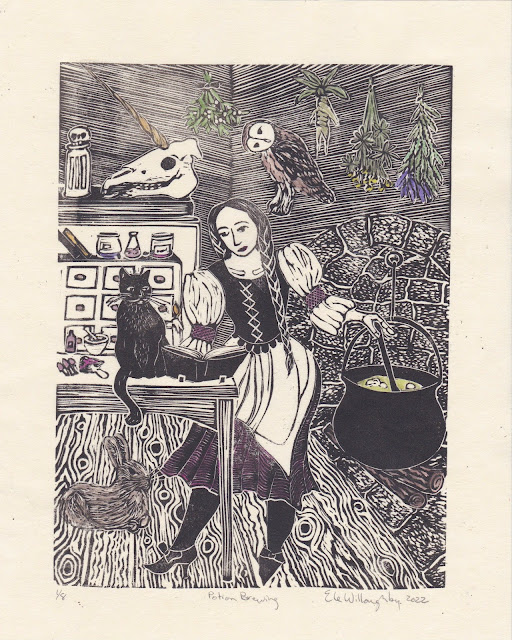
POTION

Potion Brewing linocut by Ele Willoughby
Potion Brewing, linocut on washi 8" x 10" by Ele Willoughby, 2022

For the 
#folktaleweek2022 prompt “potion” I couldn’t find a folktale potion I wanted to illustrate so I imagined a scene with a hedge witch and her familiars as she brews a potion. 

I put some of the research I did to illustrate ‘Death by Shakespeare’ to work. Behind the cat you can spy a Renaissance style medicine cabinet, and the cauldron, jars and bottles are also like some I found of that era. Also the plants and mushrooms used in medicine and poisons or generally seemed to fit the theme and be associated with magic: Amanita, witches cap mushroom, mistletoe, mandrake, vervain, and lady’s mantle. The unicorn skull is for a hint of #magic and the familiars, barn owl, black cat and rabbit all have rich folklore. 

I embellished this print with some hand painted India ink details. 

VICTORY

The Morrigan linocut by Ele Willoughby
The Morrigan, linocut 8" x 10" by Ele Willoughby, 2022


For the final #folktaleweek2022 prompt victory I chose The Morrigan, the tripartite Goddess of Irish mythology. The Morrígan or Mórrígan, also known as Morrígu or as "the three Morrígna" in her form as the three sisters (often Badb, Macha, and Nemain or sometimes Badb, Macha, and Anand). She sometimes appears as an individual, sometimes as three sisters. She was a shape-shifting goddess associated with fate, doom or victory in battle. She incited battle, inspires bravery and can bring victory over the enemies of warriors. She was the wife of The Dagda, the "good god," a father-figure and king, god of agriculture and fertility. She could inspire fear and be a symbol of impending death, often as a crow or raven but she could also be seen as a protector, associated with land, livestock and fertility. She is also the goddess of death and purveyor of prophecy. She sometimes appears in multiple forms within the same story, most commonly a beautiful maiden, a fierce warrior-queen, an old crone or washerwoman washing the blood-stained clothes of the dead, and a raven. The ominous shriek of The Morrigan at battles means she is sometimes associated with banshees.  

It was close to the wire and I finished this print last night, having lost a couple of days I had planned to work with my 8 year old home with a cold. This one might have turned out differently if I had time to linger on decisions but I think it works. There’s something to be said for working intuitively.

It was a challenge to create this week of art but huge thanks to @folktaleweek for organizing this annual event! It’s been a huge treat to see how some many talented artists illustrated these prompts. I loved finding new to me artists and illustrators, checking the hashtag daily, seeing their magical work and learning many myths, legends and folktales. This is a truly international event with posts in my languages and great variety in tales and style of work and I will definitely return to this again next year. If you haven’t already, you should check it out!

Thursday, July 21, 2022

Early Photographic Methods: Anthotypes and Cyanotypes

Anthotype of raspberry leaves made on paper coated with juice from day lily petals
Anthotype of plants made on paper coated with older day lily blooms

Making art using plants lead me to experimenting with anthotypes, an early photographic method of coating paper with juice from photosensitive plants and then exposing them, for hours or even days, to sunlight. I've had varied results. It can be a little unpredictable. Some argue that this medium is always ephemeral, and always subject to fading, but some anthotypes exist which were made a century ago. So if carefully stored or displayed (away from direct sunlight and/or under UV-resistant glass), they can be long-lasting. 


Reading up about the method I learned that it was invented by none other than great mathematician, writer and polymath, Mary Somerville (1780-1872). 
My linocut portrait of Mary Somerville

She wrote about her findings in a letter to Sir John Herschel (nephew of Caroline, also in my women in STEM series). Herschel presented her results to the Royal Society* & did a lot of further research on early photographic methods, so he is often credited with this invention too. 

Sir John Herschel's own accomplishments include the discovery of the cyanotype method to make images first used in 1842, which produces a cyan blue print used today for monochromatic art or blueprints. It is made using a slow-reacting, photographic printing formulation sensitive to a limited near ultraviolet and blue light spectrum, the range 300nm to 400nm known as UVA radiation. Two chemicals are mixed: potassium ferricyanide and ferric ammonium citrate, and coated on a surface.

The first person to publish a book with photographs was botanist and scientific illustrator Anna Atkins. A friend of both William Henry Fox Talbot, who invented the salted paper and calotype processes, and Sir John Herschel, she was well positioned to understand what these methods could mean to scientific illustration, and as such she was acting as a science employing the high tech imaging of her day. When I made her portrait, I carved her as a linocut and then combined that with a blue screen print of fern leaves to mimic the look of the cyanotypes that she used in her books on seaweed and ferns. I have long wanted to make her portrait with actual cyanotypes so, that was my first goal when I started experimenting with making cyanotypes on paper and fabric.

Anna Atkins portrait by Ele Willoughby
Anna Atkins, linocut and cyanotype by Ele Willoughby, 2022

I have also been making a number of cyanotypes of plants and sometimes incorporating my linocut images on acetate. These are mediums which have a lot of potential and I'm experimenting!

Cyanotype of Queen Anne's Lace by Ele Willoughby

Cyanotype with linocuts of moths, flowers, grasses, and narcomedusa by Ele Willoughby

Cyanotype of my Narcomedusa linocut


*On the Action of the Rays of the Spectrum on Vegetable Juices. Extract of a Letter from Mrs. M Somerville to Sir J.F.W. Herschel, Bart., dated Rome, September 20, 1845. Communicated by Sir J. Herschel. Received November 6, -Read November 27, 1845, published in the Philosophical Transactions of the Royal Society of London, 136 (1846), p. 111-120.

Thursday, July 7, 2022

Rusty patched bumblebee, In The Landscape and These Are a Few Of Our Favourite Bees


View through viewing portal into Ele Willoughby's rusty patched bumblebee lambe lambe box

In the Landscape, multimedia by Ele Willoughby and Sarah Peebles, linocut, painting, video projection, branch, wire, DNA bar codes, sound

Top of Ele Willoughby's rusty patched bumblebee lambe lambe box with view through skylight, paper flowers, twig chair, dandelion stem woven table, hand bound tiny book with linocut bee

Shot of Ele Willoughby's rusty patched bumblebee wooden lambe lambe box on legs, short table with other artifacts and bumblebee specimen

Some photos of my pieces in our art show, These are a Few of Our Favourite Bees, with my diorama like lambe lambe theatre box for a rusty patched bumblebee, and rusty patched bumblebee print along with the In the Landscape multimedia collaboration with Sarah Peebles.


Come see the show at the Campbell House Museum until July 16! Hear our artist talks this evening at the Canadian Music Centre, 20 St Joseph St, at 7:30 pm. Or you can watch the webcast here!