Tuesday, February 9, 2010

Registration Owls

horned owl
owl questions
mis-registered owl
owl linocut
registration pupil echo
Owl Query
owl proof

So last night, I had my second class of 'Power Printmaking'. This time it was, well, my specialty, relief printing. So, I wanted, in particular, to do something I was unlikely to do at home. As I suspected, this was easy because the teacher had planned a reduction print, which is something I rarely do. Also, we used stiffer lino than I would choose, oil-based inks (which I avoid, like the plague, though I confess their slower drying time and viscosity are enviable, but like a good scientist I abhor VOCs and prefer the more environmentally-friendly water-based inks), and of course, printed these on a press - actually two. So I got to play with presses. There are a couple of reasons I avoid the reduction print: 1) it's self-destructive (you carve a block, print a colour, irreversibly carve it some more, print a second colour, etc., and may end up with very little lino left) and 2) registration is tricky. Registration is the process of lining up successive printmaking marks so they are properly aligned. There are various tricks one can employ. The best I've seen is the Japanese method of kentos. With these prints, we employed a map (like a jig). The shape of the paper, and of the block was traced unto paper, under plexiglass on the bed of the press. So, in theory if your paper and block were lined up, registration of successive colours would naturally ensue. Of course, that rarely happens, as the photos testify. Though, that can be viewed as part of the beauty. I mean, owls with (accidental) red retinas, have a certain appeal. Even the one f*ck up is interesting. I include also a proof, lacking the yellow flat, because I like it. I should point out: attempting to print a three-colour lino reduction print, even if this small (photos are approximately life-sized on your screen), within 3 hours is dementedly ambitious.

What do you do to keep fit ? RELIEF PRINTING. Seriously. Carving, rushing about, working the presses is hard, physical labour. Soon, my right arm will have a measurably bigger diameter than the left.

Reading is sexy XXXII

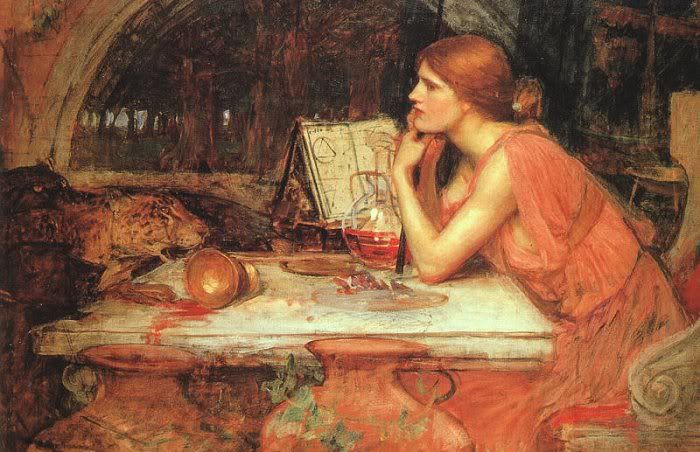
{image: The sorceress (1911) by John William Waterhouse (Rome 1849-London 1917) via Guarda chi legge}
7. Ingenious Pursuits by Lisa Jardine Following reading Jardine's biographies of both Christopher Wren (accidental architect/astronomer/anatomist/mathematician/occasional surgeon/man about town) and Robert Hooke (engineer/architect/microscopist/inventor/surveyor/secretary to the royal society/astronomer/botanist/unfortunate self-medicator and coffee enthusiast) I read her story of the birth of modern science. It is a well written, clear concise and beautifully-illustrated book detailing astronomy, microcopy, anatomy, the early pursuit of clockworks to solve the longitude problem, the collection of exotic specimens and wunderkammer, the birth of the peer-review with an epilogue on the discovery of DNA's double-helix. Disclaimer: Now, if you're like me, you are ill-equipped to read about the earliest discoveries of William Harvey about blood circulation and worse - those who tried to verify his claims through vivisection. I did enjoy learning more about a variety of scientists and enthusiastic supporters. I will also re-iterate my one frustration: scientists sometimes make loosy historians of science, because they can lack context or create hagiographies, conversely, my issue with this fascinating 'anthropology of scientists' created by Jardine is the lack of scientific context. Yes, I am interested in reading about Hooke and Christiaan Huygens battling it out over their respective attempts to claim priority for spring watches, however, insufficient technical detail is provided here to allow the reader to form an informed opinion on the issue! When Hooke claims priority over Newton for the inverse-square law form for the force of gravity, can this be substantiated? Was Oldenburg a spy? She points out that Newton himself erroneously dismissed astronomer-royal Flamsteed's ideas about periodicity in comet orbits by saying they follow straight line at a time that Hooke and Wren were discussing inverse-square laws for gravity, but she does not go that (to a physicist) obvious next step, to discuss who knew what when!

Also, I ♥ Edmond Halley. He should be the next topic of any scientific biography! Without Halley, all these prickly scientists would have not functioned. Not only was he a sea captain/astronomer/geophysicist/adventurer/gentleman and discoverer of the periodicity of his comet. He was the one who managed to pry data away from Flamsteed and the Principia Mathematica away from Newton! Poor man was repaid for many of his efforts on behalf of the Royal Society with 50 copies of Willoughby*'s A History of Fishes.

Also, the minimal sketches of a few interesting female astronomers left me wanting to read more.

8. One Letter Words - a Dictionary by Craig Conley Somehow, I became someone who reads dictionaries. The idea behind this one is intriguing (well, to me at least), and the definitions are illustrated with quotations from literature (some, sadly repeated). As the author points out, most people respond by saying there are only two or three one-letter words (the obvious ones: 'a', 'I' and maybe 'O'). However, if you put a little thought into it, you remember there are a large number of vitamins, musical notes, base pairs in our genetic sequence, personality types, Roman numerals and other things which are labelled with single letters. Then, of course, there are shapes (A-frame, f stop, j stroke, T-shirt, and so forth). Each and every letter can be used to signify a piece of type or a key for that letter. There are also numbers (c is the speed of light, e is the base of natural logorithms, h is Planck's constant, i is the square root of -1, k can be Boltzmann's constant - though sensible people use a subscript 'B'). He also includes commonly used scientific symbols - and here is where he goes wrong! Because the only real justification for such a dictionary could be some sort of completeness -otherwise, why segregate the words based on length? And yet, here, off the top of my head are single letter word definitions he has omitted: a for acceleration, B for magnetic field (and yet he does include H for magnetic field!) or b for bottom quark - formerly known as beauty, C for capacitance or c for charm quark, d for displacement or down quark or D for Deuterium (which is particularly annoying because he repeatedly uses a literary quotation which erroneoulsy calls heavy water H2O2, which is wrong, rather than D2O), E for energy or Young's modulus, f for frequency, g for gluon, h for height, I for the identity matrix (and yet he defines several other matrices!?!), j for i (hahah! it's true though, we often use j to signify the square root of negative one to distinguish it from I for current), k for 1000 (and yet, he has it for 1024 in computer science) particularly for money (he does get the more colloquial G), L for luminosity or angular momemntum, m for meter (how can anyone miss the meter?) or mass, N for Newton, O for Orthonormal group, P for power, q for electric charge or Q for question (!), R for resistance, S for Siemens or s for strange quark, T for Tritium or Tesla or Tertiary (and yet he has K for Cretaceous!) or t for top quark - formerly known as truth, U for internal energy or potential energy or the up quark, v for velocity, W for work, x for Planet X or even The X files (as he certainly includes other proper nouns), y for the Bessel function, Z for the Z vector boson. It should NOT be this easy for me to brainstorm missing items from any "Dictionary". Apart from that, serious complaint** (and the fact that he clear knows no mathematics and thinks that 'e is the base of the natural logarith' and 'e is Euler's constant' are two distinct definitions), I did enjoy reading the book, and recommend it for your washroom.

9. Like I give a frock: Fashion Forecasts and Meaningless Misguidance by Michi Girl (Michi is the pen-name imaginary friend of Chloe Quigley and Daniel Pollock). Illustrated by Kat Macleod. This was a highly enjoyable, beautifully illustrated book, with no more intellectual pretention than Go Fug Yourself, but as wickedly funny. If the lovely layered, collaged, multimedia illustrations weren't reason enough, the questionaire regardining whether it is acceptable to wear fishnets to work, or definitions like "fashion vermin: noun. a once-cute animal that has become far too popular for its own good" ("Oh, deer, there are currently over 1.5 million web pages that feature a reference to a deer brooch"), and the petition to put an end to badly dressed pets make it worth its price.

Next up will be:
10. Beautiful Evidence by Edward Tufte, because some of us are obsessed with text and images as a means of conveying information - we may be scientists but our bookshelves are stuffed with the folios of da Vinci and the complete works of Blake. (See, not only Reynardin finds Type (the bookstore) dangerous.)


{Series so far: books read, more books read, books read, books read continues, more books read, I, II, III, IV, V, VI, VII, VIII, IX, X, XI, XII, XIII, XIV, XV, XVI, XVII, XVIII,XIX, XX, XXI, XXII, XXIII XXIV, XXV, XXVI, XXVII, XXVIII, XXIX, XXX, XXXI}

*To my knowledge, no relation.
** Now before any of you say, "But, you're a scientist!" consider this:
1) most of these definitions I learned in High School
2) tell me honestly that you have not seen a single one of these before? Surely, if nothing else, you've seen the phrase 'Q & A' or 'm' for meter (or metre if you're British).
3) My Dictionary of Physics cost about $10 and is readily available in any University booksore. Likewise, my Dictionary of Earth Science.
4) Last, but not least, consider, wikipedia, where, with 10 minutes effort one could fill in dozens of missing definitions.

Saturday, February 6, 2010

Toronto Etsy Street Team Shop

The Toronto Etsy Street team has opened a team shop, to highlight local talent while raising money for good causes. Team members donate items and proceeds go to charity. Currently we are raising money for Haiti and giving our proceeds to the Red Cross (40%), Médecins Sans Frontière/ Doctors without Borders: (40%) and Global Medic: (20%).
JRT loveSo, Orbit is working to help alleaviate suffering. We want the shop to be able to respond to current events, and the team will give where we feel it can do the most good. Currently, if you would like to buy, for instance Lady Giggleswick Thinks of Love, if you do so through the T.E.S.T. team shop, all of the proceeds will go to these three charities listed above, and the Canadian federal government will match funds to double the support.

Tuesday, February 2, 2010

cloud chamber

Yesterday, I had a screenprinting class at Open Studio. I've done a lot of screenprinting (also known as silk-screening, but these days, the screens needn't be silk) in the past, but always with a paper stencil (or, a fern leaf). I had never previously tried using a photoemulsion. This lets you make a stencil using photo-chemistry - you basically "burn" a photographic image right onto the screen. It can be of basically anything, but I choose something that would be particularly hard to represent with other printmaking techniques (because of the fine lines and the fluffly texture). I call this two-colour screenprint "Cloud Chamber".

cloud chamber


A Wilson cloud chamber is basically a tank of condensed, supercooled water (or alcohol) vapour. It is used to detect high energy particles - ionizing radiation. The radiation, say from cosmic rays, or radioactivity, or particle accelerators and so forth, leave their distinctive trails in the "clouds". Because of conservation laws (conservation of angular momentum, and conservation of charge, in particular) you get these wonderful spiralling trails. If you look carefully, there's a whole lot of symmetries in the image. In fact, if you look really carefully and measure angles, it's possible to get the mass to charge ratio of the particle in question. It's really a magic piece of 20th century science instrumentation.

ionization tracksCloud Chamber detail


The image is made in two parts. First I found a nice photograph of clouds and I manipulated it in Corel Draw. I likewise came prepared with an image of ionization tracks from a cloud chamber found online. I "burned" these onto the photoemulsion-coated screen. First I printed the cloud-image in periwinkle-sky blue on several sheets of paper. We only had three hours, so the idea was to see what could be acheived, more than to produce a multi-coloured precision print. I did manage to also print the ionization tracks in golden-yellow on top of the sky. I was thinking of the sun, the source of most of our cosmic radiation.

My registration reflects the rushed nature of a single three-hour class; it isn't always what was intended, but I thought ahead a planned this image to be flexible. In fact, this is "Cloud Chamber II", with the ionization tracks printed 180 degrees out of phase:

Cloud chamber II


I like that too. :)

Our teacher was Genevieve, whom , I think, knows. There were five in the class and in typical Toronto fashion they were from Toronto (me), Thailand, Trinidad, Pakistan and undisclosed (sounded like Southern Ontario to me). It was a good little group, which is great because we share resources. My partner's English was a bit limited, but she's clearly extremely bright, exudes competence, and is really considerate. We were using the screen as a coordinated team almost without using words, which was pretty impressive to me.

art hoarders

I find it comforting to see others hoard art. This is printmaker Al Stark's hoard. He's got one multimedia and a couple of my prints in that stash - they are a in very good company indeed.

I love seeing where my art ends up.

Follow the link to see some of his beautiful woodblock prints and kites.

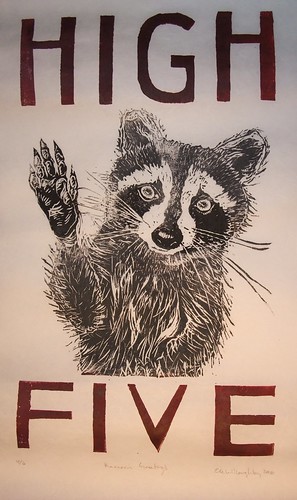
High Five for the Groundhog

raccoon greeting

raccoon at my door A big shout out to the working animals today, even if they saw their shadows, because it must be hard to be a celebrity rodent, awoken once a year for prognostication. Even the raccoons agree.

This is a first edition lino block print on Japanese kozo (mulberry) paper 15" by 8 3/8" (38 cm by 21.3 cm) - one of six. Perhaps you recall my former neighbour? The svelte, young, inexperienced raccoon? (We have some raccoons in this town easily twice his size.)

Some details:

raccoon portrait
raccoon
raccoons on the line