|
| Snowflake Beetles, linocut with chine collé 18 cm x 18 cm, Ele Willoughby 2016 |
This is a whimsical mini lino block print of a couple of Snowflake
Beetles a widely unknown, and quite possibly, completely imaginary
creature. These miniscule insects are camouflaged to match their
environment, the fresh fallen snow. Each of their hexagonal shields (the
elytra) are disguised as snowflakes. Through an extraordinary instance
of biomimicry, each pattern is as unique; it is believed that no two
Snowflake Beetles are the same.*
Both their minute size and their successful
camouflage adaptation have long hid the Snowflake Beetle from discovery.
The Coleopterans include more species than any other order, and the
diversity of beetles is very wide. Yet, the Snowflake Beetle is
exceptional in several ways. At a typical size of 1.5 m (0.06"), they
belong to the Ptiliidae, a highly diverse yet poorly known group of
minute beetles, and are amongst the smallest beetles anywhere in the
world. Like other ptiliids they have feathery wings and are colourless
to white throughout their lifecycle. But unlike any other beetles, they
thrive in high latitudes, high altitudes and polar regions where snow is
abundant. Other arthopods do live in snow, including mites, snow fleas
and some spiders, but insects and beetles in particular were previously
unknown in such cold conditions. It is believed that they make a warm
little burrow or igloo in the snow and farm fungus for food. Like
aquatic beetles, it is believed they hold a pocket of air between their
abdomen and elytra (the snowflake shield) to breathe when "diving" in
snow.
*It should be noted that the adage "no two snowflakes are
alike" is in fact just an adage. It is virtually impossible to prove the
non-existence of any naturally occuring snowflake twins. Simple hollow
collumn snowflakes are quite common and observers do report
(subjectively) identical flakes. Essentially identical snowflakes - even
complex ones with hexagonal plate symmetry and elaborate dendrites -
have been produced in the lab. While photographic evidence of naturally
occurring identical snowflakes may be lacking, it's actually unlikely
that they never occur. So, strictly speaking it is more precise to say
that Snowflake Beetles are as variable in pattern as snowflakes in
nature. Familiar snowflake forms including hexagonal plates, triangular
patterns, 12-point star patterns, sectored plates, radiating dendrites,
simple stars, stellar dendrites and fern-like stellar dendrites have all
been observed on Snowflake Beetle shields. The six-fold symmetry, as in
snowflakes themselves, is generally not perfect... though it may appear
so at a glance.
________________________________________________________________________
An aside:
Okay... the joy of my producing my "quite possibly imaginary"
cryptozoology creature series is in inventing the fictional science and I
would love to produce a book of them where I never explicitly stated
this is SF. The point is to make a sort of scientific pastiche. The
reader isn't literally supposed to be hoodwinked**... but needs to
suspend disbelief to enjoy it. But, allow me to stop being coy and tell
you a bit about the process of creating creatures. Hitting the balance
of 'not quite plausible enough to fool' but 'real enough for us all to
pleasurably pretend it's out there' is harder than I imagined, for an
unexpected reason. Namely, the animal kingdom is a hell of a lot weirder
and more varied than most of us know. For instance, I can safely assume
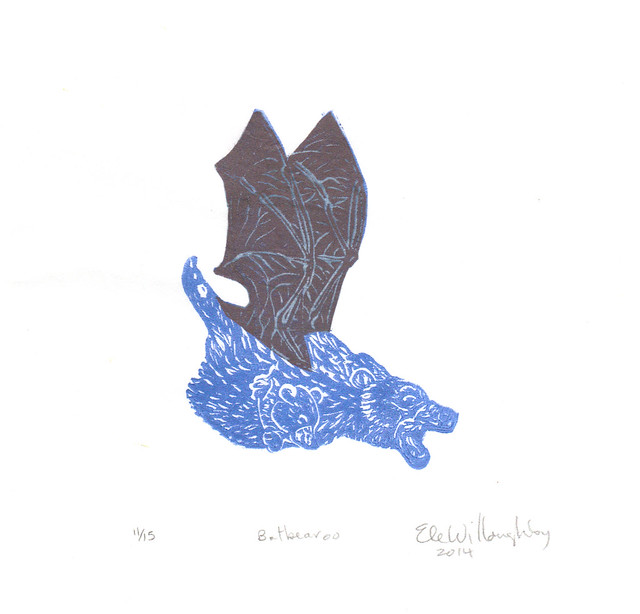
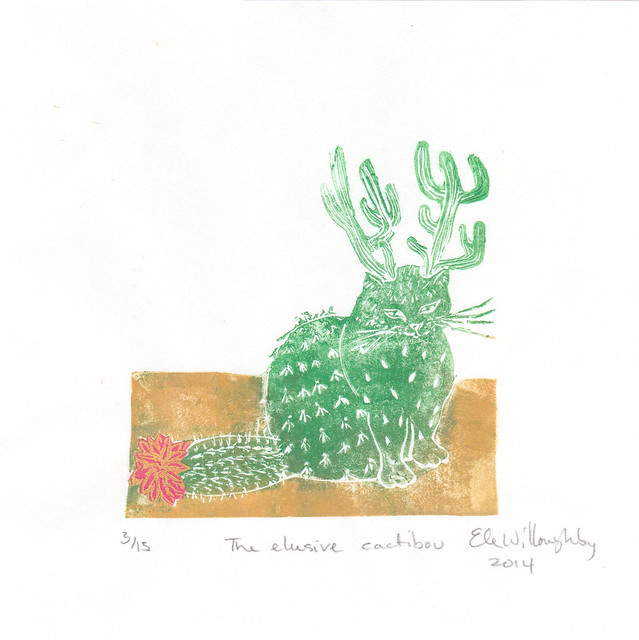
that my far-out hybrids, like the
Cactibou,
Winged Walrus and
Mandriltee,
will be recognized as unreal animals. Though, hybrids are more common
than I realized when I started this project. Merely playing with scale,
habitat and amping up more unusual skills like biomimicry on the other
hand, may not be enough. I think I inadvertently fooled someone with my
Iceberg Squid. Likewise, I imagined the Snowflake Beetle, only to later learn that, of course, there
are arthopods who live in snow...
luckily for me, they happen to have the wrong number of legs to be
insects or beetles in particular. I shouldn't be too surprised. A
recent study which got a lot of press, showed that even our homes are complex biomes filled with
thousands of insects and other arthopods.
They're everywhere! Sometimes, like here, I rely on one peculiar,
someone would say magical, attribute to indicate that the animal in
question is "quite possibly imaginary". In this case, the idea that each
one has its own pattern, as unique as a snowflake, may be the only
thing which is unlikely enough to be untrue. Other "facts" are indeed
true of existing beetles, including the surprising act of fungus farming
or holding air bubbles under their elytra wing covering to breathe if
submerged. The beetle igloo though might also be a tip-off.
**Friends will tell you I'm generally horrified when anyone is hoodwinked by pseudoscience, whatever its intentions.